Blood Bank Serology Market (2026 – 2033)
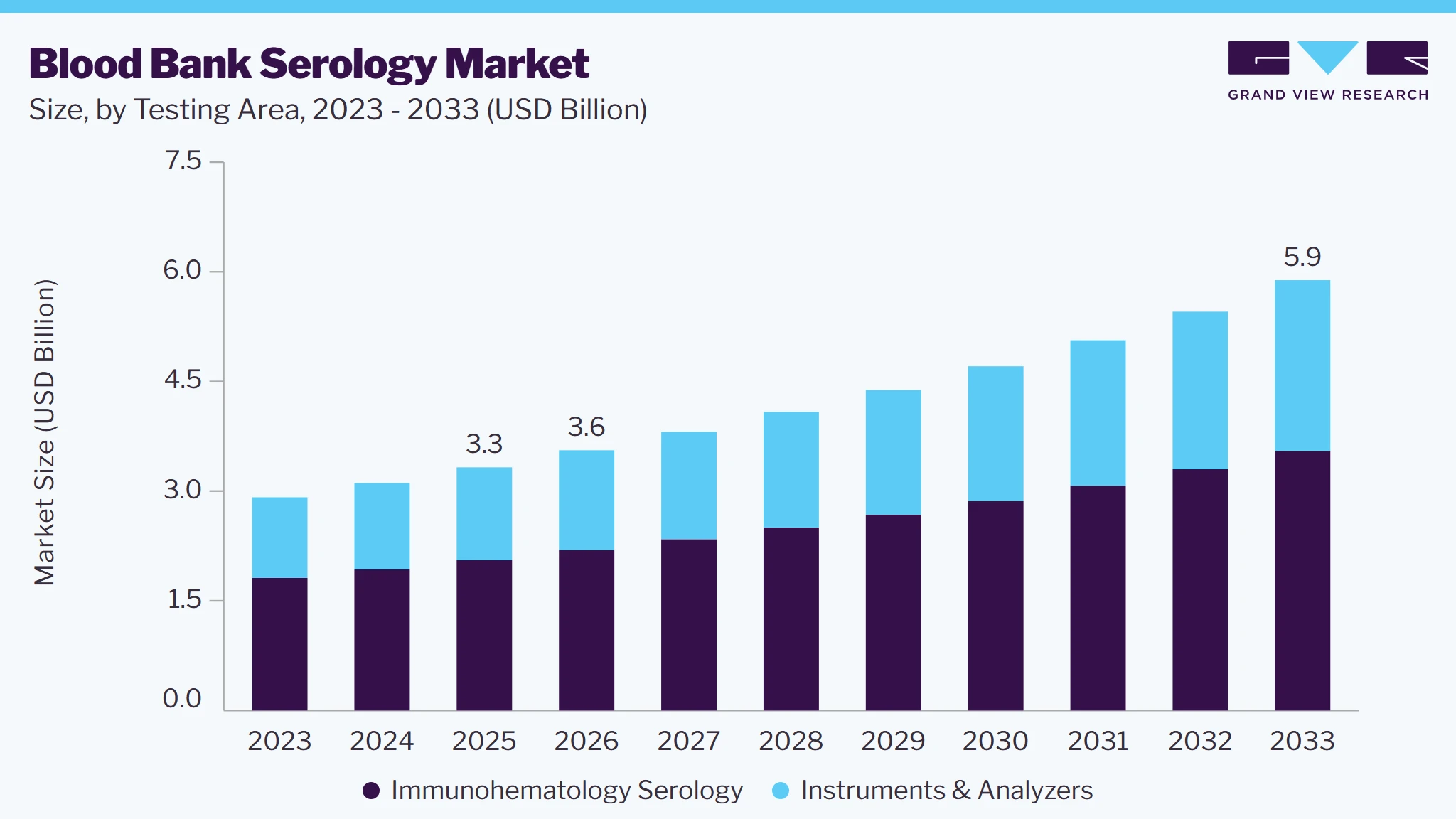
Blood Bank Serology Market Summary
The global blood bank serology market was valued at USD 3.3 billion in 2025 and is projected to grow from USD 3.6 billion in 2026 to USD 5.9 billion by 2033, at a CAGR of 7.5% from 2026 to 2033. North America dominated the market, accounting for a revenue share of 41.3% in 2025. Market growth is primarily driven by mandatory donor screening requirements, the continuing need for blood grouping and compatibility testing, rising transfusion activity, and the adoption of automated serology systems across blood banks, hospitals, transfusion laboratories, and plasma collection facilities.
Key Market Trends & Insights
- By testing area: Immunohematology serology led the market with the largest revenue share of 61.8% in 2025.
- By product: Reagent & consumables led the market with the largest revenue share of 51.0% in 2025.
- By technology: Immunoassay led the market with the largest revenue share of 30.5% in 2025.
- By end use: Hospital-based blood banks & transfusion laboratories led the market with the largest revenue share of 42.5% in 2025.
Regional Highlights
- Largest regional market: North America (41.3% revenue share, 2025)
- Fastest-growing regional market: Asia Pacific (highest CAGR, 2026-2033)
- By country: The U.S. held the largest market share in 2025.
Market Size & Forecast
- Market size in 2025: USD 3.3 Billion
- Estimated market size in 2026: USD 3.6 Billion
- Projected market size by 2033: USD 5.9 Billion
- CAGR (2026-2033): 7.5%
Request a free sample copy or view report summary: https://www.grandviewresearch.com/industry-analysis/blood-bank-serology-market-report/request/rs1
Market Concentration & Characteristics
The blood bank serology market demonstrates a high degree of innovation, driven by advances in immunohematology automation, digital interpretation of results, laboratory connectivity, and integrated testing workflows. Innovation is increasingly focused on reducing manual intervention, standardizing interpretation of reactions, improving traceability, and consolidating multiple immunohematology procedures into automated platforms. Manufacturers are also developing systems that combine scalable throughput with digital imaging, bidirectional laboratory information system connectivity, automated sample and reagent handling, and broader assay menus. For instance, in June 2026, Grifols launched the Evanzys IH automated immunohematology system, expanding its blood typing solutions with a platform designed to automate pretransfusion testing workflows. The system complements the company’s existing DG Gel technology portfolio and reflects continued investment in workflow automation and laboratory efficiency. Increasing integration of automation, digital interpretation, and connectivity is shifting innovation from individual serology reagents toward comprehensive testing ecosystems comprising instruments, consumables, software, and technical services.
Product Insight
The reagent & consumables segment dominated the global blood bank serology market, accounting for the largest revenue share of 51.0% in 2025. Its leading position is supported by the recurring demand for blood grouping antisera, reagent red blood cells, antibody screening and identification panels, gel cards, donor infectious disease assays, calibrators, and quality controls. These products are essential for routine immunohematology testing and transfusion-transmissible infection screening across hospital blood banks, blood centers, and plasma collection facilities. Unlike instruments, reagents and consumables require continuous replenishment, generating consistent revenue streams. Increasing blood donation volumes, stringent transfusion safety requirements, and expanding automated testing workflows further support product utilization. The growing installed base of immunohematology analyzers and donor screening platforms is expected to sustain consumable demand and reinforce the segment’s market dominance.
End Use Insights
The hospital-based blood banks & transfusion laboratories segment accounted for the largest revenue share of 42.5% in 2025. Its leading position is supported by routine requirements for ABO and Rh blood grouping, antibody screening and identification, serologic crossmatching, and direct antiglobulin testing across hospital transfusion services. Increasing numbers of surgical procedures, trauma cases, oncology treatments, and hematological disorders sustain demand for timely compatibility testing and reliable availability of blood components. Hospital laboratories increasingly use automated immunohematology systems, gel cards, reagent red blood cells, and integrated laboratory information systems to improve testing efficiency and traceability of results. Stringent transfusion safety protocols, continuous testing requirements, and recurring reagent consumption further strengthen the segment’s revenue contribution. Continued modernization of hospital blood banks is expected to reinforce its market dominance.
Blood Bank Serology Market Report Scope
|
Report Attribute |
Details |
|
Market size in 2025 |
USD 3.3 billion |
|
Estimated market size in 2026 |
USD 3.6 billion |
|
Projected market size by 2033 |
USD 5.9 billion |
|
Growth rate |
CAGR of 7.5% from 2026 to 2033 |
|
Actual data |
2021-2025 |
|
Forecast period |
2026 – 2033 |
|
Quantitative units |
Revenue in USD million/billion and CAGR from 2026 to 2033 |
|
Report coverage |
Revenue forecast, company ranking, competitive landscape, growth factors, and trends |
|
Segments covered |
Testing Area, product, technology, end use, region |
|
Regional scope |
North America; Europe; Asia Pacific; Latin America; MEA |
|
Country scope |
U.S.; Canada; Mexico; UK; Germany; France; Italy; Spain; Norway; Denmark; Sweden; China; Japan; India; Australia; Thailand; South Korea; Brazil; Argentina; South Africa; Saudi Arabia; UAE; Kuwait |
|
Key companies profiled |
QuidelOrtho Corporation; Immucor, Inc. (Werfen); Grifols, S.A.; Bio-Rad Laboratories, Inc.; Abbott Laboratories; F. Hoffmann-La Roche Ltd.; DiaSorin S.p.A.; DIAGAST; AliveDx Suisse S.A. (ALBA); Fujirebio Holdings, Inc.; Fortress Diagnostics Limited; BAG Diagnostics GmbH; Tulip Diagnostics Private Limited |
|
Customization scope |
Free report customization (equivalent up to 8 analyst working days) with purchase. Addition or alteration to country, regional & segment scope. |
|
Pricing and purchase options |
Avail customized purchase options to meet your exact research needs. Explore purchase options |