Wind Turbine Tower Market growing at a CAGR of 8.1% from 2025 to 2030
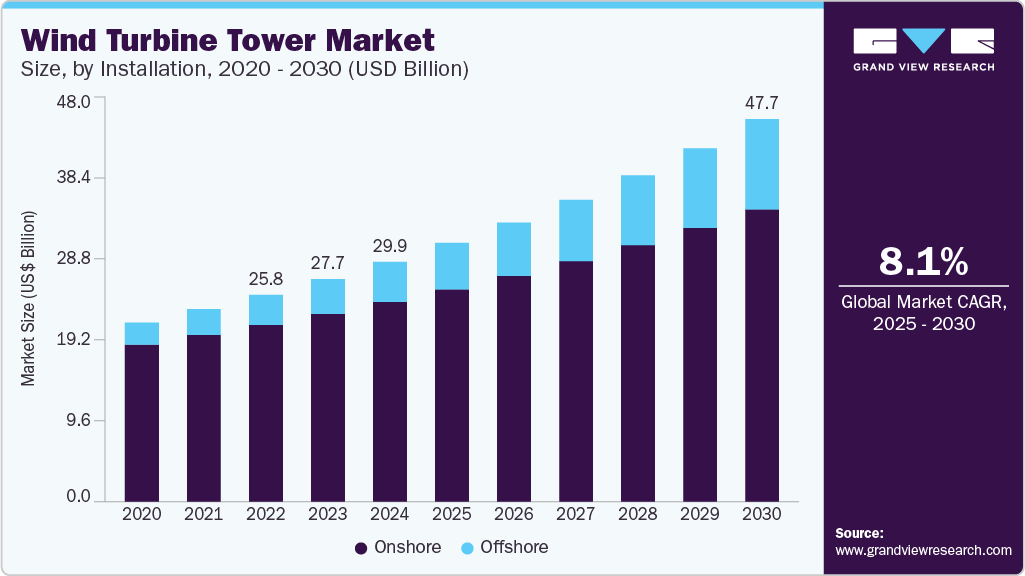
The global wind turbine tower market size was estimated at USD 29.94 billion in 2024 and is projected to reach USD 47.76 billion by 2030, growing at a CAGR of 8.1% from 2025 to 2030. The market is primarily driven by the increasing demand for clean, renewable energy sources as countries worldwide aim to reduce their carbon footprint and combat climate change.
Key Market Trends & Insights
- Asia Pacific dominated the market and accounted for the largest share of over 41.21% in 2024.
- The wind turbine tower market in China dominated the Asia Pacific region in 2024.
- By installation, the onshore installation segment registered the largest share of over 83.32% in 2024.
- Based on the type, the concrete tower segment accounted for the highest share of over 47.0% in 2024.
Market Size & Forecast
- 2024 Market Size: USD 29.94 Billion
- 2030 Projected Market Size: USD 47.76 Billion
- CAGR (2025-2030): 8.1%
- Asia Pacific: Largest market in 2024
Request Free Sample Report: https://www.grandviewresearch.com/industry-analysis/wind-turbine-tower-market-report/request/rs1
Governments are implementing supportive policies, such as tax incentives and renewable energy targets, to encourage the adoption of wind power. For example, the European Union has set a target to derive 32% of its energy from renewable sources by 2030, while China aims to be carbon neutral by 2060, driving significant investments in wind energy infrastructure.
Technological advancements in wind turbine design and manufacturing have also significantly propelled the market. Innovations such as taller towers and larger rotor diameters enhance wind turbines’ efficiency and energy output. Taller towers can access stronger and more consistent wind currents at higher altitudes, which translates to increased energy generation. For example, the latest generation of wind turbines can have towers exceeding 100 meters in height, enabling them to harness more wind power. These advancements not only improve the overall performance of wind turbines but also make wind energy more competitive with traditional energy sources, further driving market growth.
Government policies and incentives are another critical factor driving the global market. Many governments worldwide are implementing supportive policies, including subsidies, tax incentives, and feed-in tariffs, to encourage the adoption of wind energy. The U.S., for instance, offers the Production Tax Credit (PTC) and the Investment Tax Credit (ITC), which have been instrumental in promoting wind power projects. Similarly, China’s government provides substantial subsidies and favorable policies to support the wind energy sector, making it one of the largest markets for wind turbine towers globally. These policy measures create a favorable investment environment, attracting both domestic and international players to the wind energy market.
Moreover, the declining cost of wind energy is a significant factor triggering market growth. Over the past decade, the cost of wind power has decreased considerably due to economies of scale, improved supply chain efficiencies, and technological innovations. This cost reduction makes wind energy an increasingly attractive option for power generation, especially in regions with high wind potential. For example, the Levelized Cost of Energy (LCOE) for wind has reached competitive levels compared to fossil fuels in many markets. This economic viability encourages more investments in wind power projects, driving the demand for wind turbine towers. As these driving factors continue to evolve and strengthen, the global market is poised for sustained growth and development.
Installation Insights
Based on the installation, the market is segmented into offshore and onshore. Onshore installation registered the largest revenue market share of over 83.32% in 2024. These towers are generally easier and less expensive to construct and maintain compared to their offshore counterparts. Onshore installations can range from single turbines to large wind farms, and they are often found in rural or remote locations. The height of onshore towers varies but is usually between 80 to 120 meters tall, allowing the turbines to capture stronger and more consistent winds at higher altitudes.
Offshore wind turbine towers are installed in bodies of water, usually in shallow coastal areas or on continental shelves. These installations can harness stronger and more consistent wind resources compared to onshore sites. Offshore towers are typically taller than onshore ones, often exceeding 100 meters in height, and they require specialized construction and maintenance techniques to withstand marine conditions. While more expensive to install and maintain, offshore wind farms can generate more electricity due to better wind conditions and can be built at larger scales without the land-use constraints faced by onshore installations.
Type Insights
Based on the type, the market is segmented into steel, concrete, and hybrid towers. The concrete tower type accounted for the highest revenue market share of over 47.0% in 2024. Concrete towers are gaining popularity, especially for taller turbines and offshore installations. These towers can be constructed using precast concrete segments or cast-in-place concrete. Concrete towers offer superior stability and can reach heights exceeding 200 meters. They have longer lifespans and require less maintenance compared to steel towers. Concrete towers also have better damping properties, reducing vibrations and potentially extending the life of turbine components. However, they are generally more expensive to produce and transport than steel towers.
Steel towers are the most common type in the wind turbine market due to their cost-effectiveness and ease of manufacturing. They are typically made from cylindrical steel sections that are bolted together on-site. Steel towers offer good strength-to-weight ratios, allowing them to reach heights of up to 160 meters. They are relatively easy to transport and install, making them suitable for a wide range of locations. However, as turbine sizes increase, steel towers face challenges in terms of stability and transportation logistics for taller structures.
Hybrid towers combine the advantages of both steel and concrete designs. Typically, they feature a concrete base section topped with a steel upper section. This design allows for greater heights while maintaining stability and reducing transportation challenges associated with very tall steel towers. Hybrid towers can reach heights of 140-180 meters or more, making them suitable for low-wind areas where taller turbines are needed to capture stronger winds at higher altitudes. While they offer a good balance of benefits, hybrid towers can be more complex to design and construct compared to single-material towers.
Wind Turbine Tower Market Report Scope
|
Report Attribute |
Details |
|
Market size value in 2025 |
USD 32.30 billion |
|
Revenue forecast in 2030 |
USD 47.76 billion |
|
Growth rate |
CAGR of 8.1% from 2025 to 2030 |
|
Actual data |
2018 – 2024 |
|
Forecast period |
2025 – 2030 |
|
Quantitative units |
Revenue in USD million/billion, and CAGR from 2025 to 2030 |
|
Report coverage |
Revenue forecast, competitive landscape, growth factors, and trends |
|
Segments covered |
Installation, type, region |
|
Regional scope |
North America; Europe; Asia Pacific; Central & South America; Middle East & Africa |
|
Country Scope |
U.S.; Canada; Mexico; Germany; UK; France; Italy; Spain; China; India; Japan; South Korea; Australia; Brazil; UAE |
|
Key companies profiled |
Siemens Gamesa Renewable Energy, S.A.U.; Arcosa Wind Towers, Inc.; US Forged Rings Inc.; CS Wind; Marmen; Modvion; CNBM; GRI Renewable Industries; Vestas; Pemamek; PVUNITE Ltd.; SENLISWELD; Rohn Products, LLC; Ventower Industries; Global Energy (Group) Limited |
|
Customization scope |
Free report customization (equivalent up to 8 analyst’s working days) with purchase. Addition or alteration to country, regional & segment scope |
|
Pricing and purchase options |
Avail customized purchase options to meet your exact research needs. Explore purchase options |