Vibration Control System Market growing at a CAGR of 6.4% from 2025 to 2030
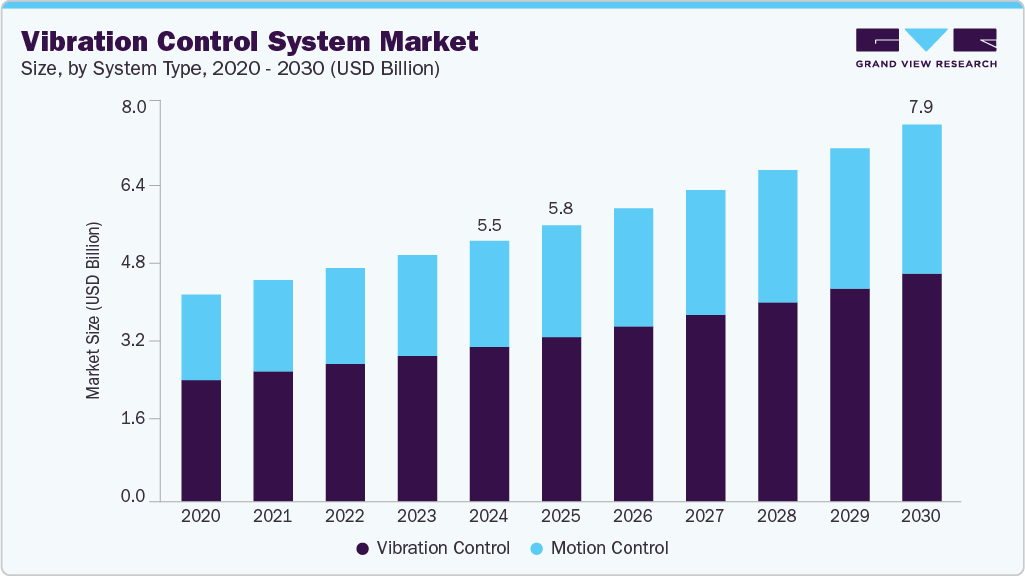
The global vibration control system market size was valued at USD 5,483.6 million in 2024 and is projected to reach USD 7,933.9 million by 2030, growing at a CAGR of 6.4% from 2025 to 2030. The market is experiencing significant growth driven by accelerating demand across multiple high-growth industries such as automotive, aerospace, healthcare, and manufacturing.
Key Market Trends & Insights
- The vibration control system market in Europe accounted for the largest revenue share of 23% in 2024.
- The U.S. vibration control system market dominated the North America market with a share of over 78% in 2024.
- Based on system type, the vibration control segment accounted for the largest revenue share of over 59% in 2024.
- Based on application, the automotive segment is expected to register the highest CAGR of 8.2% in 2024.
Market Size & Forecast
- 2024 Market Size: USD 5,483.6 Million
- 2030 Projected Market Size: USD 7,933.9 Million
- CAGR (2025-2030): 6.4%
- Europe: Largest market in 2024
Request Free Sample Report: https://www.grandviewresearch.com/industry-analysis/vibration-control-systems-market/request/rs1
Increasing industrialization worldwide and stringent government regulations concerning noise, vibration, and harshness (NVH) reduction are major market drivers. These regulations are compelling manufacturers to adopt advanced, efficient vibration control solutions to improve machinery longevity, operational safety, and environmental sustainability.
Additionally, technological advancements significantly support the vibration control system industry growth, with innovations in active vibration control systems integrating smart sensors, IoT, and AI for real-time monitoring and adaptive vibration mitigation. This foster improved performance and predictive maintenance capabilities, particularly in precision-dependent sectors such as semiconductor manufacturing, automotive safety systems, and aerospace. Moreover, the rise of electric vehicles, where quieter engines demand enhanced vibration control, further stimulates adoption and innovation in the vibration control system industry.
Additionally, companies are investing heavily in research and development to innovate advanced active vibration control solutions integrated with smart sensors, IoT, and AI technologies. These initiatives aim to offer real-time monitoring, adaptive control, and predictive maintenance capabilities tailored for high-growth sectors, including automotive, aerospace, and healthcare. Furthermore, these players are expanding their global footprint with focused activities in emerging markets where rapid industrialization and urbanization fuel demand, thereby driving the vibration control system industry growth.
Furthermore, the escalating global production demand for electric vehicle (EV) fleets is transforming the strategic landscape of the vibration control system industry. As governments and automakers worldwide commit to ambitious electrification targets, there is a pronounced surge in EV manufacturing volumes, driven by policies promoting zero-emission transportation and sustainability goals. This rapid expansion necessitates advanced vibration control solutions specifically optimized for EV architectures, which encounter unique vibration and noise challenges due to electric motors, high voltage batteries, and lightweight chassis materials.
Moreover, the growing adoption of wireless communication technology in vibration control systems has become a pivotal driver of market growth, fueled by rapid advancements in sensors and communication technologies. Wireless vibration sensors eliminate the constraints associated with traditional wired systems, offering greater flexibility, lower installation and maintenance costs, and enhanced scalability. Key industry players are leveraging wireless sensor networks utilizing protocols such as BLE and LoRaWAN, to enable real-time remote monitoring of vibration parameters even in challenging or inaccessible environments. These innovations facilitate more comprehensive and frequent data collection that bolsters predictive maintenance and fault detection capabilities.
Vibration Control System Market Report Scope
|
Report Attribute |
Details |
|
Market size value in 2025 |
USD 5,812.1 million |
|
Revenue forecast in 2030 |
USD 7,933.9 million |
|
Growth rate |
CAGR of 6.4% from 2025 to 2030 |
|
Base year of estimation |
2024 |
|
Actual data |
2018 – 2023 |
|
Forecast period |
2025 – 2030 |
|
Quantitative units |
Revenue in USD million/billion and CAGR from 2025 to 2030 |
|
Report coverage |
Revenue forecast, company ranking, competitive landscape, growth factors, and trends |
|
Segments covered |
System Type, application, region |
|
Regional scope |
North America; Europe; Asia Pacific; Latin America; Middle East & Africa |
|
Country scope |
U.S.; Canada; Germany; UK; France; Russia; China; Japan; India; Brazil; Mexico; UAE; Saudi Arabia; South Africa |
|
Key companies profiled |
ContiTech Deutschland GmbH; Resistoflex; HUTCHINSON (CK Hutchison Holdings Ltd); Fabreeka (Stabilus); ELESA S.p.A.; Sentek Dynamics Inc.; VICODA GmbH.; Isolation Technology Inc.; Trelleborg AB; Kinetics Noise Control, Inc. |
|
Customization scope |
Free report customization (equivalent up to 8 analysts working days) with purchase. Addition or alteration to country, regional & segment scope. |