Vacuum Cleaner Market growing at a CAGR of 10.1% from 2025 to 2033
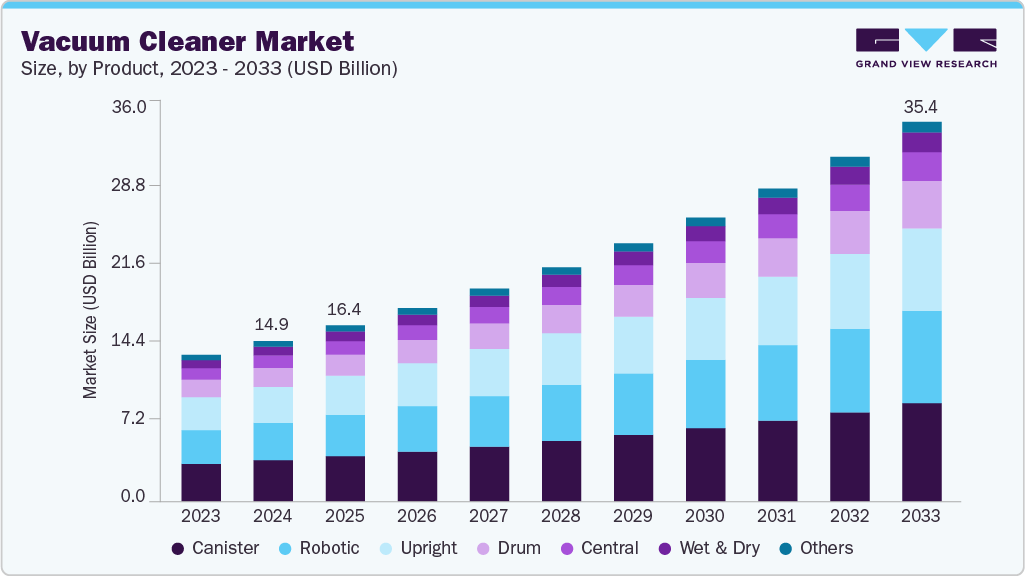
The global vacuum cleaner market size was valued at USD 14.93 billion in 2024 and is expected to reach USD 35.37 billion by 2033, growing at a CAGR of 10.1% from 2025 to 2033. The factors, including changing lifestyles, high disposable incomes, and a growing working population, have driven market growth. In addition, increased awareness about the benefits of maintaining cleanliness in residential and commercial places has contributed to the market’s growth.
Key Market Trends & Insights
- North America held the largest share of the vacuum cleaner market in 2024, accounting for 27.8%.
- The Asia Pacific vacuum cleaner market is experiencing significant growth, with a projected CAGR of 12.2% from 2025 to 2033.
- By product, the canister market held the largest share of 25.6% in 2024.
- The robotic vacuum cleaner segment is experiencing significant growth, with a projected CAGR of 12.0% from 2025 to 2033.
- By application, the residential segment held the largest share of 47.0% in 2024.
Market Size & Forecast
- 2024 Market Size: USD 14.93 Billion
- 2033 Projected Market Size: USD 35.37 Billion
- CAGR (2025-2033): 10.1%
- North America: Largest market in 2024
- Asia Pacific: Fastest growing market
Request Free Sample Report: https://www.grandviewresearch.com/industry-analysis/vacuum-cleaner-market/request/rs1
The industry is expected to benefit from several trends and drivers, including changing lifestyles, high disposable incomes, a growing working population, increased awareness of hygiene and cleanliness, and shifting consumer preferences toward online shopping. Additionally, the increasing incidences of allergy and asthma caused due to the dust and dirt in residential settings, coupled with the need to keep homes disease-free, is expected to drive the demand for residential vacuum cleaners. Furthermore, the rising availability of advanced products, which can capture the tiniest of impurities efficiently, is projected to drive market growth in the upcoming years.
In the past few years, robotic vacuum cleaners have seen rapid growth in demand due to their cleaning ability with less or no human intervention. Such vacuum cleaners are equipped with advanced sensors and offer functionalities, including multi-surface cleaning with powerful suction, remote-controlled cleaning, long battery life, and auto-recharging. For instance, in September 2021, iRobot Corp., a consumer robots company, launched the Roomba j7+ robot vacuum to provide its customers with more control and new features powered by iRobot Genius 3.0 Home Intelligence.
Modern vacuum cleaners use high-efficiency particulate air filtration technology that helps in removing airborne particles from an indoor space. These filters can capture smaller particulates that might otherwise not be trapped by the vacuum bags. Such vacuum cleaners are being preferred by allergy sufferers and end users seeking cleaner air.
Product Insights
The canister segment accounted for the largest share of 25.6% of the total revenue in 2024. The canister vacuum cleaners are efficient than upright vacuum cleaners and offer better flow-rate and suction. Also, these machines are able to easily vacuum dust from areas such as stairs, underneath furniture, and hard-to-reach corners. Such features are responsible for the growth of this segment. Furthermore, the development of canister vacuum cleaners equipped with a HEPA filter, which has a significantly lower risk of causing pulmonary side effects such as allergies and asthma, is expected to work in favor of the segment’s future growth prospects.
The robotic segment is projected to grow at a CAGR of 12.0% from 2025 to 2033. Growth of the robotic vacuum cleaner segment is driven by the major benefit of these products to provide an end user with significant time and energy savings. In addition, the increasing urbanization and purchasing power of consumers are contributing to the demand for robotic vacuum cleaners. In addition, the automatic charging, smart home trend, and voice-activated commands powered by digital voice assistants such as Amazon Alexa and Google Assistant are attracting residential clients and end-us
|
Report Attribute |
Details |
|
Market value size in 2025 |
USD 16.38 billion |
|
Revenue Forecast in 2033 |
USD 35.37 billion |
|
Growth rate (revenue) |
CAGR of 10.1% from 2025 to 2033 |
|
Actuals |
2021 – 2024 |
|
Forecast period |
2025 – 2033 |
|
Quantitative units |
Revenue in USD million/billion, and CAGR from 2025 to 2033 |
|
Report coverage |
Revenue forecast, company ranking, competitive landscape, growth factors, and trends |
|
Segments covered |
Product, distribution channel, application, region |
|
Regional scope |
North America, Europe, Asia-Pacific, Latin America, Middle East & Africa |
|
Country scope |
U.S.; Canada; UK; Germany; France; Italy; Spain; China; India; Japan; Australia; Brazil; South Africa |
|
Key companies profiled |
Alfred Karcher SE & Co. KG; BISSELL; CRAFTSMAN; DEWALT; Dreame International (Hongkong) Limited; Dyson; Ecovacs; Emerson Electric Co.; Haier Group; iRobot Corporation; Neato Robotics, Inc. Nilfisk Group; Panasonic Corporation; Samsung Electronics Co., Ltd.; Snow Joe LLC |
|
Customization scope |
Free report customization (equivalent up to 8 analysts’ working days) with purchase. Addition or alteration to country, regional & segment scope. |
|
Pricing and purchase options |
Avail customized purchase options to meet your exact research needs. Explore purchase options |
ers.