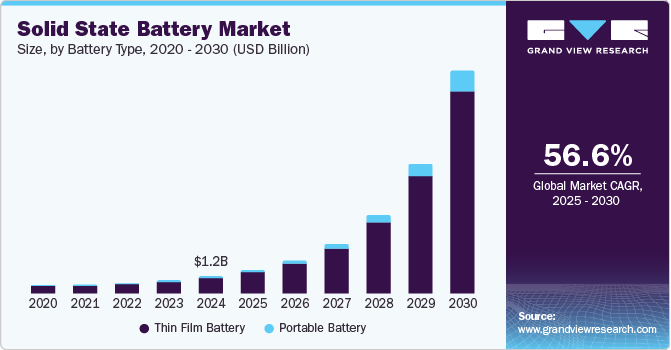
Solid State Battery Market growing at a CAGR of 31.8% from 2026 to 2033
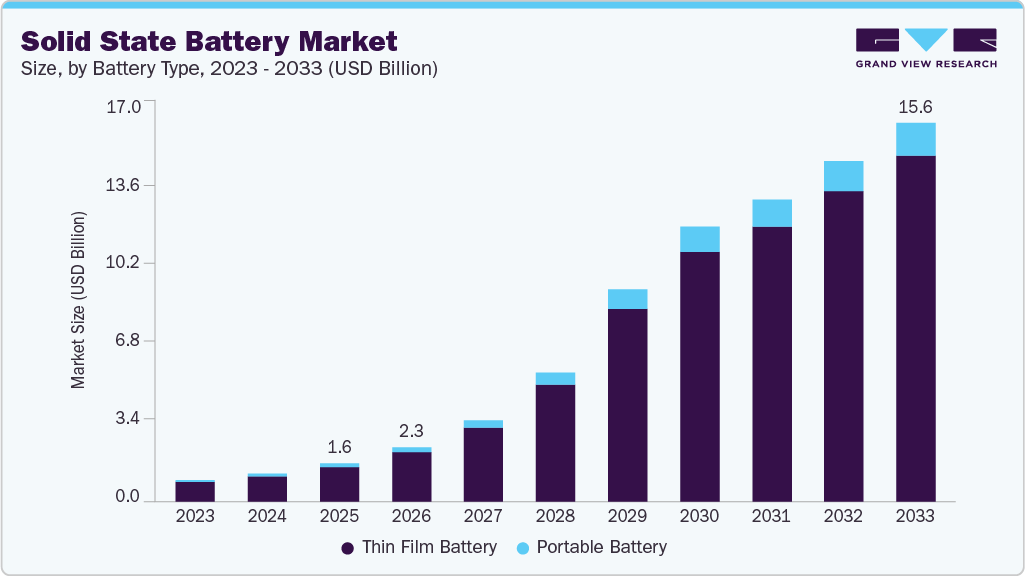
The global solid state battery market size was estimated at USD 1.60 billion in 2025 and is projected to reach USD 15.65 billion by 2033, growing at a CAGR of 31.8% from 2026 to 2033. The market is expected to witness steady growth over the next several years due to the increasing integration of renewable energy systems, rising demand for high-efficiency power architectures, and the shift toward decentralized and digitalized power distribution.
Key Market Trends & Insights
- The Asia Pacific solid state battery market held the largest share of over 54.0% of the global market in 2025.
- The solid state battery market in the U.S. is expected to grow significantly over the forecast period.
- By battery type, thin film batteries held the largest market share of over 89.0% in 2025.
- Based on the application, the consumer & portable electronics segment held the largest market share in 2025.
- Based on the capacity, the 20mAh-500mAh segment held the largest market share in 2025.
Market Size & Forecast
- 2025 Market Size: USD 1.60 Billion
- 2033 Projected Market Size: USD 15.65 Billion
- CAGR (2026-2033): 31.8%
- Asia Pacific: Largest market in 2025
- North America: Fastest-growing market
Request Free Sample Report: https://www.grandviewresearch.com/industry-analysis/solid-state-battery-market/request/rs1
Deployment is being accelerated by the growing penetration of consumer & portable electronics, EV charging infrastructure, and industrial automation systems, along with advancements in power electronics, solid-state circuit breakers, and DC-optimized grid components.
Sustainability is emerging as a key catalyst for the growth of next-generation energy storage globally, with governments and corporations prioritizing decarbonization, achieving net-zero targets, and implementing large-scale renewable energy deployment. Regions such as North America, Europe, and the Asia Pacific are integrating advanced storage systems to stabilize solar and wind output, improve grid resilience, and reduce reliance on fossil fuels. Advanced battery solutions are emerging as attractive long-term options due to enhanced safety, recyclability potential, and extended operational lifespan, which help lower lifecycle emissions and electronic waste. The global transition toward circular energy planning, including policies that support low-carbon industries, electric mobility, and sustainable smart-city infrastructures, positions next-generation battery technologies as the backbone for environmentally responsible power storage worldwide.
Technology adoption is advancing rapidly through strategic collaborations between energy infrastructure providers, automotive OEMs, and battery innovators. Breakthrough formats such as solid-state polymer batteries, solid-state lithium metal batteries, and thin-film solid-state batteries are gaining traction due to their compact design, improved safety, and higher energy performance compared to conventional lithium-ion chemistries. Global industrial stakeholders are evaluating modular storage units and micro-battery systems for applications in electric vehicles, aerospace, defense electronics, consumer electronics, and industrial automation. Early-stage manufacturing pilot lines, testbeds, and R&D centers are helping companies build supply chain readiness and workforce capabilities, laying the foundation for large-scale commercialization over the next decade.
Drivers, Opportunities & Restraints
The global market is primarily driven by the increasing demand for high-density, safe, and long-life energy storage across electric mobility, consumer electronics, and renewable integration projects. Advanced formats, including solid-state car batteries, solid-state polymer batteries, and thin-film batteries, are receiving attention for their superior energy density, longer cycle life, and enhanced thermal stability compared to conventional lithium-ion solutions. Notable developments in 2025 include the successful validation of next-generation solid-electrolyte materials by multiple battery developers, which has strengthened confidence in scaling these technologies for commercial applications worldwide.
Substantial growth opportunities exist as regions pursue technology localization, the adoption of large-scale renewable energy, and smart infrastructure programs. Smaller, high-performance formats, such as solid-state micro batteries and solid-state chip batteries, are ideal for aerospace, defense, sensors, IoT devices, and wearable electronics. Larger-capacity cells based on solid-state lithium metal batteries are being explored for grid stabilization, renewable energy integration, and electric transportation systems. In 2025, several global collaborations and feasibility studies between battery developers and energy corporations signalled strong potential for manufacturing partnerships, supply chain development, and localized production expansion.
Despite strong growth potential, global adoption faces hurdles due to high production costs, technical complexity, and limited large-scale manufacturing infrastructure. Challenges include ensuring stable electrode-electrolyte interfaces, preventing dendrite formation, achieving high production yields, and sourcing high-purity materials. The absence of fully matured supply chains in some regions increases reliance on imports and slows deployment. Even with technological breakthroughs in 2025, demonstrating improved electrolyte stability and scalable cell designs, affordability and large-volume availability remain primary constraints delaying widespread adoption.
Battery Type Insights
The thin film battery segment holds the dominant share within the battery type segmentation, driven by its compact design, lightweight structure, and ability to deliver stable power in ultra-miniaturized electronics. Its suitability for smart cards, RFID tags, medical patches, IoT sensors, and compact consumer devices has positioned it as the preferred choice for next-generation microelectronics. Demand continues to rise as industries move toward smaller, safer, and long-life power sources that can be integrated into flexible and ultra-thin form factors. Increasing investment in medical wearables, wireless monitoring systems, and skin-adhesive diagnostics has played a crucial role in strengthening the market position of thin-film chemistries, further supported by advancements in solid electrolyte interfaces and higher energy-density deposition techniques.
The portable battery segment has contributed noticeable revenue, but it trails behind thin-film systems due to its more conventional size and use cases. Portable cells remain relevant in mid-power applications, such as smart consumer electronics, industrial handheld devices, and emerging mobility solutions, where higher capacity is required compared to ultra-thin batteries. However, adoption is more gradual, influenced by higher manufacturing costs and the need to refine electrolyte integration for reliable scalability. Despite this, ongoing improvements in energy density, safety, and charging efficiency are expected to help the portable category expand over the next decade – particularly as consumer electronics and wearables continue to evolve toward enhanced performance and all-day operation.
Application Insights
The consumer & portable electronics segment represents the largest application area for the market, driven by the global proliferation of smartphones, tablets, laptops, gaming consoles, smart home devices, and handheld gadgets. Demand for compact, high-performance energy storage solutions has surged as OEMs increasingly prioritize longer runtimes, fast-charging capability, and safety across consumer electronics. Miniaturization trends and the transition toward sleeker, lightweight form factors are further accelerating adoption in this category, with manufacturers integrating next-generation battery technologies to elevate device efficiency and overall user experience. The segment continues to benefit from rising digitalization, expanding consumer purchasing power, and rapid product innovation cycles from electronics brands.
Beyond consumer applications, batteries are gaining traction in electric vehicles, energy harvesting, wearable devices, medical devices, and other industrial and commercial uses. The electric vehicle category is witnessing steady momentum due to OEM electrification roadmaps and global sustainability commitments, while energy-harvesting systems are emerging as an attractive space for powering low-maintenance IoT sensors and industrial automation devices. Wearable and medical electronics, including smartwatches, fitness trackers, hearing aids, and portable medical tools, are also developing into high-growth pockets as the focus on remote health monitoring increases worldwide. Although these segments currently trail consumer electronics in market share, technology upgrades, cost reductions, and ecosystem expansion are expected to broaden their contribution over the forecast period.
Solid State Battery Market Report Scope
|
Report Attribute |
Details |
|
Market Definition |
The solid-state battery market size represents the total annual revenue generated from the production, sale, and commercialization of solid-state batteries and related technologies across automotive, consumer electronics, aerospace, and energy storage applications. |
|
Market size value in 2026 |
USD 2.26 billion |
|
Revenue forecast in 2033 |
USD 15.65 billion |
|
Growth rate |
CAGR of 31.8% from 2026 to 2033 |
|
Base year for estimation |
2025 |
|
Historical data |
2021 – 2024 |
|
Forecast period |
2026 – 2033 |
|
Quantitative Units |
Revenue in USD million/billion and CAGR from 2026 to 2033 |
|
Report coverage |
Revenue forecast, competitive landscape, growth factors, and trends |
|
Segments covered |
Battery type, capacity, application, region |
|
Regional scope |
North America; Europe; Asia Pacific; Latin America; Middle East & Africa |
|
Country scope |
U.S.; Canada; Mexico; UK; Germany; Spain; France; Italy; Russia; China; India; Japan; South Korea; Australia; Brazil; Colombia; Paraguay; Saudi Arabia; UAE; South Africa; Egypt |
|
Key companies profiled |
BrightVolt Solid-State Batteries; Hitachi Zosen Corporation; Ilika Ltd.; Ion Storage Systems; Panasonic Energy Co., Ltd.; QuantumScape Corporation; Samsung SDI Co., Ltd.; Solid Power; STMicroelectronics; Toyota Motor Corporation |
|
Customization scope |
Free report customization (equivalent up to 8 analysts working days) with purchase. Addition or alteration to country, regional & segment scope. |
|
Pricing and purchase options |
Avail customized purchase options to meet your exact research needs. Explore purchase options |