Robotic Lawn Mowers Market growing at a CAGR of 11.4% from 2026 to 2033
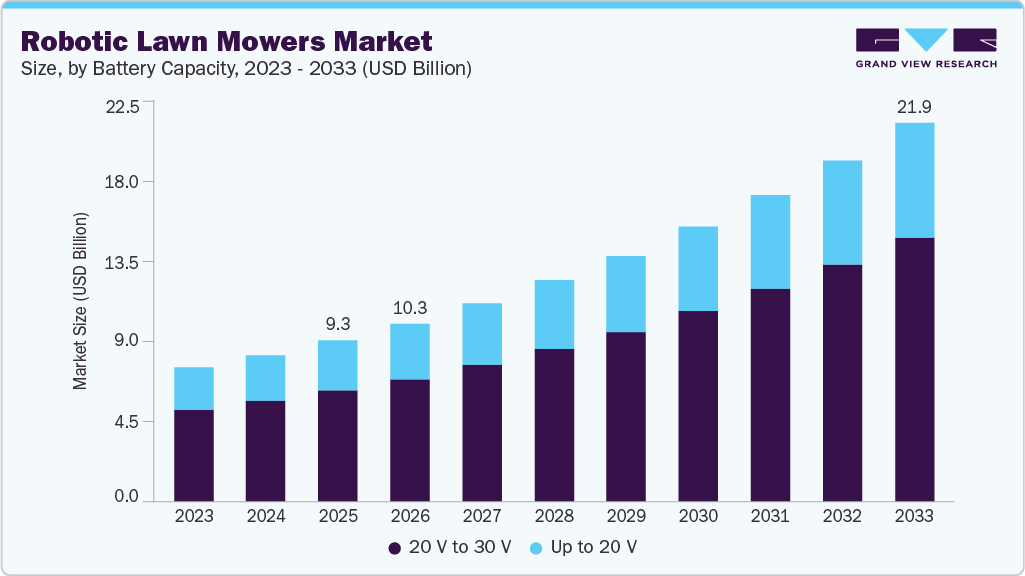
The global robotic lawn mowers market size was estimated at USD 9.33 billion in 2025, and is projected to reach USD 21.97 billion by 2033, growing at a CAGR of 11.4% from 2026 to 2033. The emergence of remote-controlled, GPS-equipped autonomous lawn mowers has made gardening easier by enabling these products to be tracked, monitored, and operated remotely.
Key Market Trends & Insights
- The North America robotic lawn mowers market accounted for a global revenue share of 38.2% in 2025.
- The robotic lawn mower industry in the U.S. held a dominant position in 2025.
- By battery capacity, the 20V to 30V segment accounted for the largest share of 68.8% in 2025.
- By sales channel, the retail stores/offline segment held the largest market share in 2025.
- By end use, the residential segment dominated the market in 2025.
Market Size & Forecast
- 2025 Market Size: USD 9.33 Billion
- 2033 Projected Market Size: USD 21.97 Billion
- CAGR (2026-2033): 11.4%
- North America: Largest market in 2025
- Asia Pacific: Fastest growing market
Request Free Sample Report: https://www.grandviewresearch.com/industry-analysis/robotic-lawn-mowers-market/request/rs1
Also, there has been a notable rise in consumer interest in gardening activities across the globe, creating an increased need for gardening tools such as robotic lawn mowers. Growing expenditure on activities such as backyard beautification, landscaping, garden parties, and backyard cookouts, among others, along with the need to save time spent on lawn maintenance activities, are expected to drive the demand for gardening tools. The market growth is also driven by factors such as the growing construction and tourism industries, coupled with the increasing disposable income of individuals across the globe. Moreover, growing consumer preference toward energy-efficient products and the growing popularity of autonomous products are also anticipated to positively impact the global demand for robotic lawn mowers.
Consumers in countries such as the U.S., Germany, and the UK are significantly investing time and money in improving their gardens, yards, and lawns. This consumer approach is apparently increasing demand for smart lawn care products that save time, money, and energy. Thus, high consumer spending on landscaping activities is anticipated to drive the growth of the robotic lawn mowers industry.
Robotic mowers are programmed to follow efficient and precise cutting patterns. Unlike traditional mowers, which tend to leave uneven patches, the consistent cutting patterns of robotic mowers promote healthier grass growth. This improved lawn health reduces the need for excessive chemical inputs such as fertilizers and pesticides, contributing to a more environmentally friendly lawn care approach.
The market faces a significant challenge due to the high initial cost of these machines. Robotic lawn mowers’ advanced features and capabilities include remote control via smartphone apps, automatic scheduling, and integration with smart home ecosystems. These features enhance user convenience but require additional components and engineering effort, thereby increasing product costs. However, this elevated cost can deter potential consumers, particularly those prioritizing budget considerations. Price-sensitive consumers may opt for more affordable traditional mowers. As a result, such factors challenge the growth of the market.
Battery Capacity Insights
The 20V to 30V segment led the robotic lawn mowers market, accounting for the largest share of 68.8% in 2025. Batteries in the 20V to 30V range are predominantly used in commercial robotic lawn mowers. These relatively costlier products are often used for mowing lawns of 1.0 to 2.5 acres, which are often found in commercial areas such as sports/golf fields or the hospitality sector. The segment provides ample power to navigate various terrains, handle taller grass, and operate for extended periods between charges. Moreover, battery innovations have led to faster charging times and longer overall lifespans, addressing downtime and maintenance cost concerns. With app-based controls, GPS mapping, and automated scheduling, users can effortlessly manage their lawn maintenance remotely.
The Up to 20V segment is anticipated to grow at a considerable CAGR over the forecast period. This is attributed to the rising usage of automated lawn mowers in residential applications. Up to 20V robotic lawn mowers are expected to become increasingly popular due to their eco-friendly and efficient operation. Up to 20V robotic lawn mowers offer extended operation times, covering larger areas on a single charge.
Sales Channel Insights
The retail stores/offline segment held the largest share of the robotic lawn mowers industry in 2025. The increasing demand for time-saving and convenient solutions has pushed traditional retail stores to embrace robotic lawn mowers. These devices cater to homeowners seeking effortless lawn maintenance and appeal to a wide demographic, ranging from busy professionals to elderly individuals who may find traditional mowing physically challenging. The sector’s success is intrinsically tied to consumers’ demands for convenience, variety, and value.
The online segment is expected to register the fastest CAGR during the forecast period. The growing trend of convenience-seeking consumers has propelled the demand for online shopping. With a few clicks, the customers can compare a wide range of robotic lawn mower models, features, and prices from their homes. One of the primary drivers is the widespread adoption of digital technologies and the increasing accessibility of the internet, which has connected billions of people worldwide. This connectivity has enabled consumers to shop conveniently from the comfort of their homes or mobile devices, thereby fueling the demand for online shopping platforms.
End Use Insights
The residential segment dominated the robotic lawn mowers market in 2025. The increasing demand for convenience and time-saving solutions has led homeowners to seek automated alternatives for lawn maintenance. Robotic lawn mowers offer the advantage of hands-free operation, allowing homeowners to delegate the time-consuming task of mowing to a machine while they focus on other activities.
The commercial sector is expected to register considerable growth over the forecast period. Rising government investment in improving existing infrastructure, parks, and lawns near historic monuments is anticipated to drive the demand for robotic lawn mowers in the commercial sector. Also, the segment is expected to witness significant growth over the forecast period owing to the steady growth of the hospitality and tourism industries.
Robotic Lawn Mowers Market Report Scope
|
Report Attribute |
Details |
|
Market size value in 2026 |
USD 10.30 billion |
|
Revenue forecast in 2033 |
USD 21.97 billion |
|
Growth rate |
CAGR of 11.4% from 2026 to 2033 |
|
Base year for estimation |
2025 |
|
Historical data |
2021 – 2024 |
|
Forecast period |
2026 – 2033 |
|
Quantitative units |
Revenue in USD million/billion and CAGR from 2026 to 2033 |
|
Report coverage |
Revenue forecast, company ranking, competitive landscape, growth factors, and trends |
|
Segments covered |
Battery capacity, sales channel, end use, region |
|
Regional scope |
North America; Europe; Asia Pacific; Latin America; MEA |
|
Country scope |
U.S.; Canada; Mexico; Germany; UK; France; Italy; Spain; China; Japan; India; South Korea; Australia; Brazil; Argentina; KSA; UAE; South Africa |
|
Key companies profiled |
AL-KO; Belrobotics; Deere & Company; HONDA MOTOR CO., LTD.; Husqvarna Group; Robert Bosch GmbH; STIGA S.p.A.; WIPER S.R.L.; Worx; Segway Navimow |
|
Customization scope |
Free report customization (equivalent up to 8 analysts working days) with purchase. Addition or alteration to country, regional & segment scope. |
|
Pricing and purchase options |
Avail customized purchase options to meet your exact research needs. Explore purchase options |