Respiratory Health Supplements Market growing at a CAGR of 7.7% from 2025 to 2033
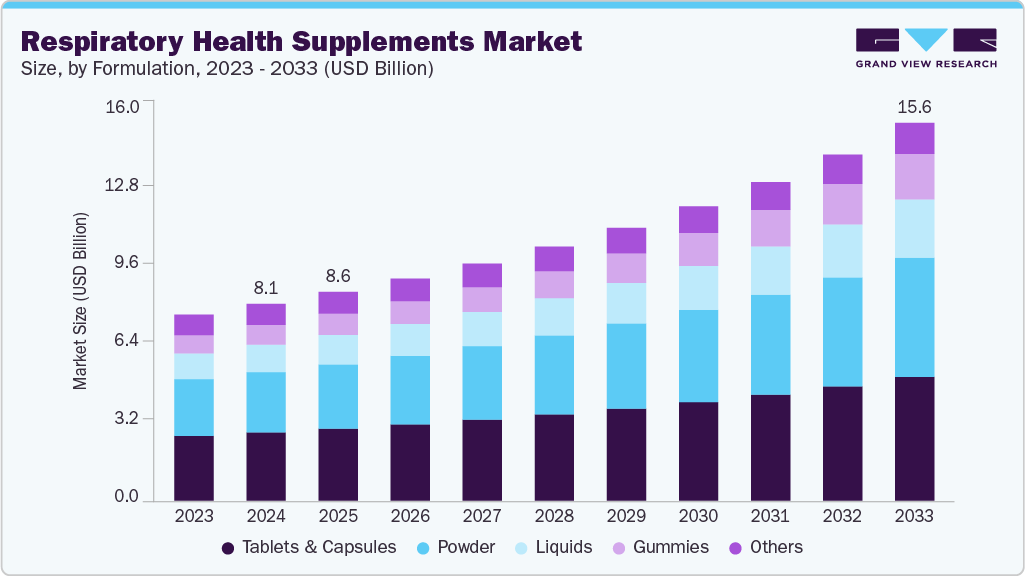
The global respiratory health supplements market size was estimated at USD 8.11 billion in 2024 and is projected to reach USD 15.57 billion by 2033, expanding at a CAGR of 7.7% from 2025 to 2033. The market expansion is driven by rising consumer awareness of preventive healthcare, increasing prevalence of respiratory disorders, growing demand for immunity-boosting and natural supplements, and the availability of convenient formats through diverse distribution channels worldwide.
Key Market Trends & Insights
- Asia Pacific respiratory health supplements market held the largest share of 35.16% of the global market in 2024.
- The respiratory health supplements industry in the China is expected to grow significantly over the forecast period.
- By product type, the vitamins & minerals segment held the largest market share in 2024.
- By formulation, the tablets & capsules segment dominated with the market share of 34.69% in 2024.
- By consumer group, the adults segment held the largest market share of 45.21% in 2024.
- By distribution channel, the brick and mortar segment dominated with the market share in 2024.
Market Size & Forecast
- 2024 Market Size: USD 8.11 Billion
- 2033 Projected Market Size: USD 15.57 Billion
- CAGR (2025-2033): 7.7%
- Asia Pacific: Largest market in 2024
Request Free Sample Report: https://www.grandviewresearch.com/industry-analysis/respiratory-health-supplements-market-report/request/rs1
Growing Shift Toward Herbal & Natural Formulations
The growing shift toward herbal and natural supplements has become a defining trend in the global respiratory health supplements market. Consumers are increasingly seeking plant-based formulations that offer preventive and therapeutic benefits without the adverse effects often associated with synthetic ingredients. This shift is largely driven by rising awareness of holistic wellness and growing acceptance of traditional medicine systems such as Ayurveda, Traditional Chinese Medicine (TCM), and herbal therapeutics in Western markets. The post-pandemic emphasis on immunity and lung health has further accelerated the use of natural ingredients such as turmeric, licorice root, elderberry, eucalyptus, quercetin, and ginger-known for their anti-inflammatory, antimicrobial, and antioxidant properties that support respiratory function.
The surge in demand for herbal and natural ingredients is also closely linked to the clean-label movement, where consumers prioritize transparency, sustainability, and purity in product sourcing and formulation. Companies are responding by highlighting organic certification, botanical authenticity, and non-GMO standards to cater to increasingly health-conscious buyers. Moreover, growing scientific research and clinical validation of herbal compounds are enhancing credibility and consumer trust in these formulations. Leading manufacturers are investing in R&D to create standardized, evidence-based herbal blends that meet international quality benchmarks. This trend is particularly strong in Asia Pacific, a region with deep-rooted herbal traditions and expanding nutraceutical manufacturing capacities, making it a global hub for natural supplement production.
Additionally, the integration of herbal ingredients with modern delivery formats such as gummies, effervescent powders, and flavored liquids has increased consumer appeal and convenience across various age groups. These innovations are helping brands differentiate themselves in a competitive marketplace while improving adherence among adults, children, and the elderly. Regulatory bodies in several regions are also increasingly supportive of botanical formulations, recognizing their safety and preventive health potential. Furthermore, as consumers become more environmentally conscious, demand for sustainably sourced and eco-friendly supplements continues to rise. Overall, this transition toward herbal and natural formulations represents a structural transformation in the respiratory health supplements market, positioning plant-based products as a key driver of long-term global growth.
Respiratory Health Supplements Market Report Scope
|
Report Attribute |
Details |
|
Market size value in 2025 |
USD 8.60 billion |
|
Revenue forecast in 2033 |
USD 15.57 billion |
|
Growth rate |
CAGR of 7.7% from 2025 to 2033 |
|
Base year for estimation |
2024 |
|
Historical data |
2021 – 2023 |
|
Forecast period |
2025 – 2033 |
|
Quantitative units |
Revenue in USD million/billion, and CAGR from 2025 to 2033 |
|
Report coverage |
Revenue forecast, company ranking, competitive landscape, growth factors, and trends |
|
Segments covered |
Product type, formulation, consumer group, distribution channel, region |
|
Regional scope |
North America; Europe; Asia Pacific; Latin America; MEA |
|
Country scope |
U.S.; Canada; Mexico; UK; Germany; France; Italy; Spain; Denmark; Sweden; Norway; India; China; Japan; Australia; South Korea; Thailand; Brazil; Argentina; Saudi Arabia; UAE; South Africa; Kuwait |
|
Key companies profiled |
Amway Corporation; Herbalife Nutrition Ltd.; Glanbia PLC; Haleon plc; Nu Skin Enterprises, Inc.; Nature’s Sunshine Products, Inc.; The Bountiful Company; Vitabiotics Ltd.; NOW Foods; Nature’s Bounty |
|
Customization scope |
Free report customization (equivalent up to 8 analyst’s working days) with purchase. Addition or alteration to country, regional & segment scope. |
|
Pricing and purchase options |
Avail customized purchase options to meet your exact research needs. Explore purchase options |