Quantum Dot Solar Cells Market grow at a CAGR of 16.6% from 2025 to 2030
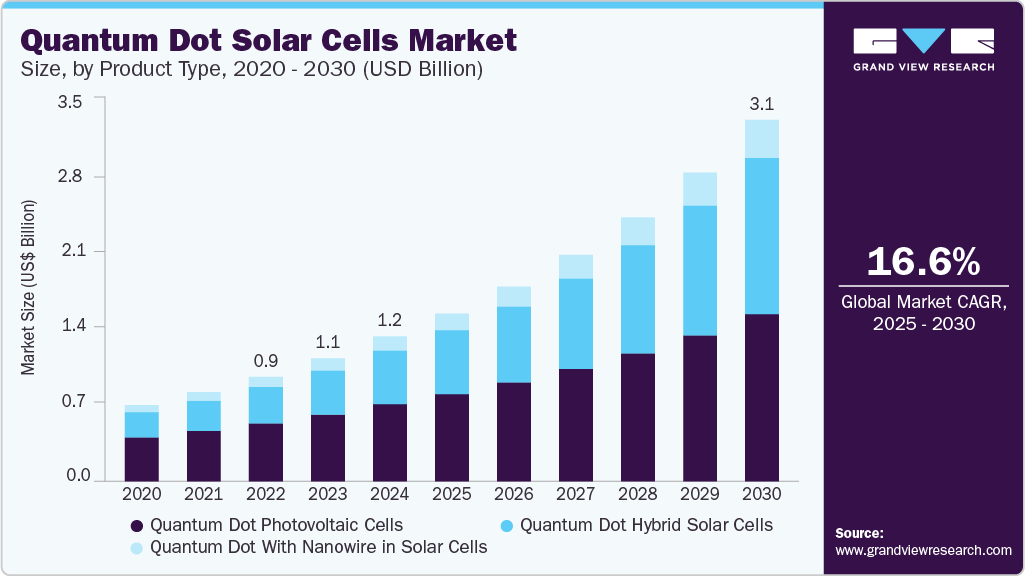
The global quantum dot solar cells market size was estimated at USD 1.24 billion in 2024 and is expected to grow at a CAGR of 16.6% from 2025 to 2030. Advancements in material stability and efficiency are improving the commercial viability of quantum dot solar cells.
Key Highlights:
- North America leads the global market, and accounting for a largest share of 36.8% in 2024.
- The U.S. is at the forefront of adopting quantum dot solar technology, with growing awareness of sustainability among consumers and businesses.
- The quantum dot photovoltaic cells segment dominated the market with a revenue share of 53.2% in 2024.
- By material, the cadmium-based segment has accounted for the highest revenue in 2024.
- By application, the BIPV segment dominated with the largest revenue share in 2024.
Request Free Sample Report: https://www.grandviewresearch.com/industry-analysis/quantum-dot-solar-cells-market-report/request/rs1
As these cells become more efficient, their production costs are expected to decrease, making them more accessible for various applications. This progress will likely spur more partnerships and collaborations between industry leaders, pushing the technology into broader markets.
The increased interest in quantum dot solar cells will likely lead to their adoption in both residential and industrial sectors. As the technology scales, it could transform the solar energy landscape by offering cost-effective and high-performance alternatives to traditional solar cells. This progress is highlighted by recent achievements, such as the record-breaking efficiency demonstrated by researchers at Ulsan National Institute of Science & Technology.
For instance, in January 2024, researchers at Ulsan National Institute of Science & Technology (UNIST) in South Korea achieved a record efficiency of 18.1% for quantum dot solar cells, a significant improvement from 16.6% in 2020. The new solar cells, made with organic perovskite quantum dots, also demonstrated improved stability, maintaining efficiency for 1,200 hours under normal conditions and 300 hours at 80°C.
Quantum dot technology allows for precise tuning of the bandgap, which enhances its ability to absorb light. This adjustment improves the material’s efficiency in converting sunlight into electricity. By manipulating the size and composition of quantum dots, researchers can optimize their response to specific light wavelengths. This capability leads to better energy conversion, making quantum dot solar cells more effective than traditional solar technologies. As a result, quantum dots are increasingly seen as a key component for next-generation solar cells. The potential to increase overall solar panel efficiency is a major factor in their growing popularity. This advancement is driving significant investment in research and development in the solar energy field. The trend is expected to push solar technologies toward higher performance and greater sustainability in the near future.
Integrating quantum dot technology with IoT solutions in solar cells enables smart energy systems that optimize power generation. Sensors embedded in quantum dot solar panels monitor energy output in real time. Data collected from these panels allows for adjusting energy distribution based on demand and environmental factors. This combination improves energy management, enhancing efficiency and reducing waste. Quantum dot solar cells can contribute to more intelligent and responsive energy grids. Companies are actively pursuing advancements in this area. For instance, in February 2025, UbiQD, a nanotechnology company in Mexico, acquired BlueDot Photonics to expand its quantum dot technology applications in energy and agriculture. This acquisition enhances UbiQD’s capabilities in developing advanced quantum dot materials for various industries.
Product Types Insights
The quantum dot photovoltaic cells segment dominated the market with a revenue share of 53.2% in 2024. Its dominance stems from superior light absorption capabilities, tunable bandgaps, and compatibility with flexible substrates. These attributes make the technology suitable for a range of applications, including portable power systems, building-integrated photovoltaics, and wearable electronics. Continuous improvements in synthesis methods and stability are further enhancing its viability. As the demand for lightweight and efficient solar solutions grows, this segment is projected to maintain its leading position in the market.
Quantum dot hybrid solar cells are experiencing notable growth in the quantum dot solar cell market. This growth is driven by their ability to combine quantum dots with other materials, such as perovskites or organic compounds, to enhance overall efficiency. These hybrid systems leverage the strengths of multiple technologies, resulting in improved light harvesting and charge separation. Their adaptability to flexible and lightweight substrates supports a wide range of applications, from consumer electronics to building-integrated photovoltaics. Ongoing research efforts are focused on improving stability and large-scale manufacturing potential. As performance metrics improve, the hybrid category is becoming a key area of innovation and investment.
Material Insights
The cadmium-based quantum dots segment has accounted for the highest revenue in the quantum dot solar cells market. Cadmium-based quantum dots dominate the quantum dot solar cell market due to their superior optical and electronic properties. They offer high efficiency in converting sunlight to electricity, making them suitable for high-performance solar applications. These quantum dots are relatively mature in terms of synthesis and integration into devices. However, their use is increasingly limited by environmental and health concerns related to cadmium toxicity. Despite regulatory challenges, their performance continues to sustain a strong market presence in specific applications.
Cadmium-free quantum dots are emerging as a growing alternative in the solar cell industry. They address environmental and health concerns associated with heavy metals, supporting safer and more sustainable solar technologies. Materials such as indium phosphide and carbon-based quantum dots are under active development in this category. While they currently lag in efficiency compared to cadmium-based variants, advancements in material science are narrowing the gap. Growing regulatory pressure and green energy initiatives are accelerating their adoption across global markets. Their potential for large-scale deployment is increasing as manufacturers prioritize eco-friendly solutions.
Quantum Dot Solar Cells Market Report Scope
|
Report Attribute |
Details |
|
Market size value in 2025 |
USD 1.44 billion |
|
Revenue forecast in 2030 |
USD 3.10 billion |
|
Growth rate |
CAGR of 16.6% from 2025 to 2030 |
|
Base year for estimation |
2024 |
|
Historical data |
2018 – 2023 |
|
Forecast period |
2025 – 2030 |
|
Quantitative units |
Revenue in USD million/billion, and CAGR from 2025 to 2030 |
|
Report coverage |
Revenue forecast, company ranking, competitive landscape, growth factors, and trends |
|
Segment scope |
Product type, material, application, end-use, region |
|
Region scope |
North America; Europe; Asia Pacific; Latin America; Middle East & Africa |
|
Country scope |
U.S.; Canada; Mexico; Germany; UK; France; China; Japan; India; Australia; South Korea; Brazil; KSA; UAE; South Africa |
|
Key companies profiled |
Hanwha Group; HELIENE Inc.; Nanoco Group plc; NNCrystal US Corporation; Oxford Photovoltaics Ltd.; QDsolar; Quantum Material Corporation; QUANTUM SOLUTIONS; TFQD; UbiQD |
|
Customization scope |
Free report customization (equivalent up to 8 analysts’ working days) with purchase. Addition or alteration to country, regional & segment scope |
|
Pricing and purchase options |
Avail customized purchase options to meet your exact research needs. Explore purchase options |