Propylene Glycol Market growing at a CAGR of 6.3% from 2025 to 2030
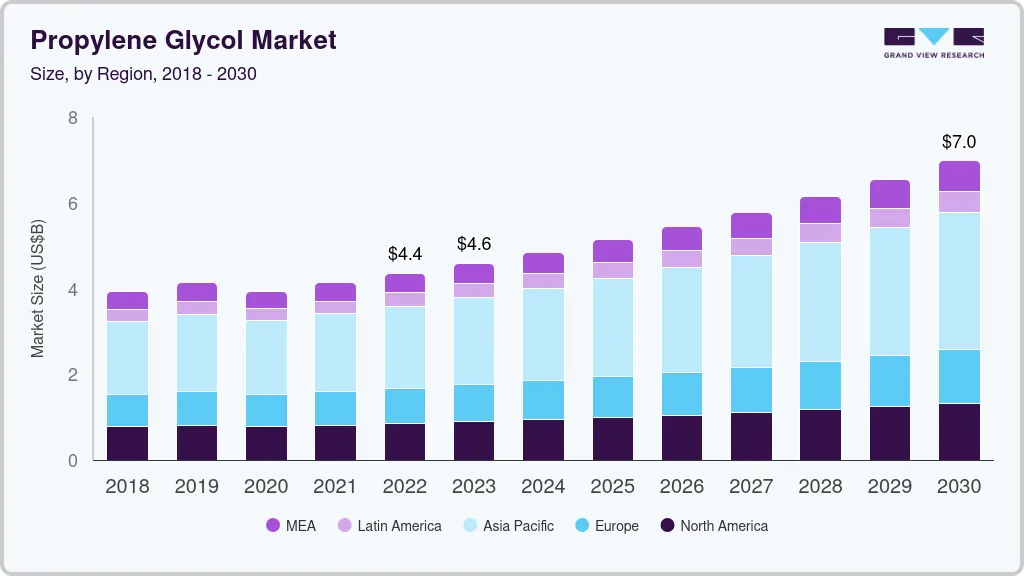
The global propylene glycol market size was estimated at USD 4,850.4 million in 2024 and is projected to reach USD 6,975.8 million by 2030, growing at a CAGR of 6.3% from 2025 to 2030. This is attributable to the growing utilization of propylene glycol in the construction industry and other applications such as engine coolant and as a raw material for de-icing planes in the transportation industry.
Key Market Trends & Insights
- Asia Pacific emerged as a dominating market, accounting for a revenue share of over 45% in 2024.
- China held over 41% revenue share of the overall Asia Pacific Propylene Glycol market.
- In terms of source, the petroleum-based segment dominated the market with a revenue share of over 71.2% in 2024.
- In terms of grade, the industrial grade segment dominated the market with a revenue share of over 63.3% in 2024.
- In terms of end-use, the construction segment dominated the market with a revenue share of over 38.6% in 2024.
Market Size & Forecast
- 2024 Market Size: USD 4,850.4 Million
- 2030 Projected Market Size: USD 6,975.8 Million
- CAGR (2025-2030): 6.3%
- Asia Pacific: Largest market in 2024
Request Free Sample Report: https://www.grandviewresearch.com/industry-analysis/propylene-glycol-market-report/request/rs1
The product is widely used as a chemical intermediate, heat transfer medium, and as a solvent in numerous industries. The product is typically produced in two grades that are industrial or technical grade and USP/EP grade. Industrial grade propylene glycol is used for manufacturing non-ionic detergents used in sugar refining, papermaking, and petroleum industries. It is also used as an additive in latex paints and coatings to improve freeze-thaw capability. USP/EP grade is commonly used as an excipient in several drugs, cosmetics, and food products.
Propylene glycol is very low-toxic and does not cause any health issues. However, some people are allergic to propylene glycol, which can lead to dermatitis, skin reactions, and skin rashes. Also, when the product is injected in higher amounts, it can cause rapid heart rate and heart rhythm problems, thereby leading to an increased risk of heart attack. This is likely to act as a restraining factor for market growth.
Propylene glycol is manufactured from propylene oxide. The most commonly used process is the non-catalytic hydrolysis of propylene oxide in a higher temperature and higher pressure environment. The catalytic method is the one that proceeds at 150°C in the presence of ion exchange resin or a small amount of alkali or sulphuric acid. It can also be produced from glycerol, a biodiesel by-product. The Food and Drug Administration considers the product safe for indirect and direct addition to food. The European Union has also listed the ingredient as safe for cosmetic use.
Drivers, Opportunities & Restraints
The market is witnessing steady growth, primarily driven by its wide-ranging applications across food & beverage, pharmaceuticals, personal care, and industrial manufacturing sectors. Propylene glycol is valued for its hygroscopic properties, low toxicity, and chemical stability, making it a preferred solvent, humectant, and carrier fluid in cosmetics, food additives, and drug formulations. In the industrial domain, it plays a critical role in antifreeze formulations, de-icing solutions, and as a base fluid in heat transfer applications. The rising demand for sustainable and low-VOC ingredients in consumer goods and the push toward safer alternatives to ethylene glycol in automotive and HVAC systems further propel market growth.
The market is expanding with the growing adoption of bio-based propylene glycol derived from renewable feedstocks such as glycerin and corn starch. These green alternatives are gaining traction as industries shift toward circular economy models and environmentally compliant supply chains. In addition, the increasing demand for propylene glycol in emerging economies, driven by rapid urbanization, expanding pharmaceutical manufacturing, and growth in packaged food production, presents lucrative avenues for manufacturers. Innovation in downstream applications, particularly personal care and specialty chemicals, is also expected to drive market diversification and premiumization.
The market faces notable restraints. Volatility in crude oil prices and supply chain disruptions impact the cost and availability of petroleum-derived propylene glycol, which still accounts for a significant share of global production. Environmental regulations regarding VOC content and occupational exposure limits are tightening, particularly in North America and Europe, requiring reformulation efforts and higher compliance costs. Furthermore, competition from ethylene glycol and other multifunctional solvents and margin pressures due to commoditization in bulk applications challenge profitability. Key players are investing in process optimization, regional capacity expansion, and strategic sourcing of bio-based feedstocks to remain competitive.
Propylene Glycol Market Report Scope
|
Report Attribute |
Details |
|
Market size value in 2025 |
USD 5,132.1 million |
|
Revenue forecast in 2030 |
USD 6,975.8 million |
|
Growth rate |
CAGR of 6.3% from 2025 to 2030 |
|
Base year for estimation |
2024 |
|
Historical data |
2018 – 2023 |
|
Forecast period |
2025 – 2030 |
|
Quantitative Units |
Volume in kilotons, revenue in USD million,/billion, and CAGR from 2025 to 2030 |
|
Report coverage |
Volume & revenue forecast, competitive landscape, growth factors, and trends |
|
Segments covered |
Source, grade, end use, region |
|
Regional scope |
North America; Europe; Asia Pacific; Latin America; Middle East & Africa |
|
Country scope |
U.S.; Canada; Mexico; Germany; UK; France; Italy; Spain; China; India; Japan; South Korea; Brazil; Argentina; Saudi Arabia; South Africa |
|
Key companies profiled |
Dow; BASF SE; ADM; INEOS; Shell Plc; Adeka Corporation; Huntsman International LLC.; LyondellBasell Industries Holdings B.V. |
|
Customization scope |
Free report customization (equivalent to 8 analysts working days) with purchase. Addition or alteration to country, regional & segment scope. |
|
Pricing and purchase options |
Avail customized purchase options to meet your exact research needs. Explore purchase options |