Post-harvest Treatment Market growing at a CAGR of 10.1% from 2025 to 2033
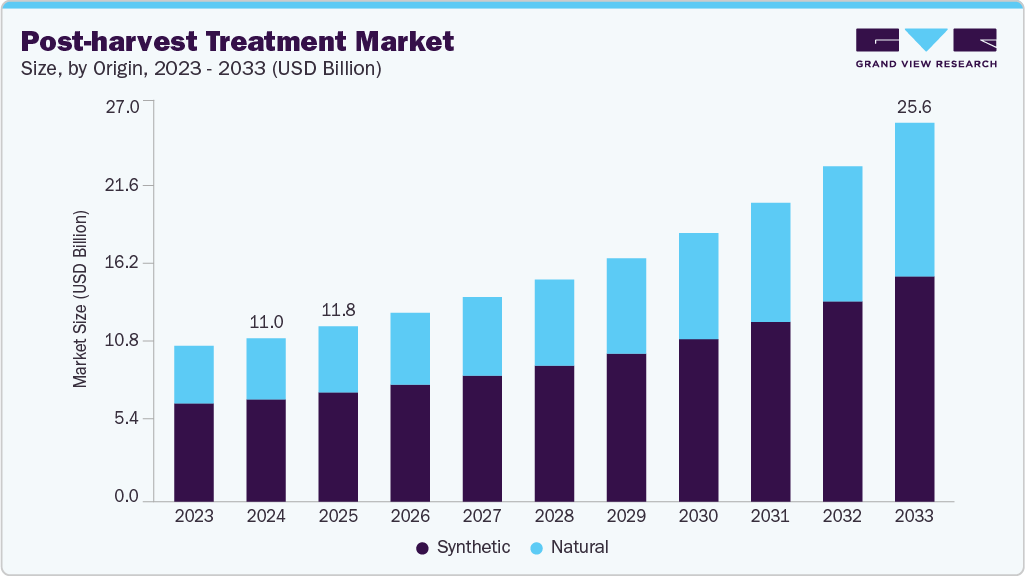
The global post-harvest treatment market size was estimated at USD 11,025.5 million in 2024 and is projected to reach USD 25,606.7 million by 2033, growing at a CAGR of 10.1% from 2025 to 2033. The market is primarily driven by the increasing demand for fresh and high-quality produce, rising concerns over food loss and waste, and the expansion of global trade in perishable agricultural commodities.
Key Market Trends & Insights
- Asia Pacific dominated the post-harvest treatment market with the largest revenue share of 37.1% in 2024.
- The market in China is expected to grow at a significant CAGR of 9.4% from 2025 to 2033.
- By origin, the synthetic post-harvest treatments accounted for the largest revenue share of 62.7% in 2024.
- By product, the ethylene blockers segment held the largest revenue share of 31.3% in 2024 in terms of value.
- By application, the fruits & vegetables segment held the largest revenue share of 46.7% in 2024 in terms of value.
Market Size & Forecast
- 2024 Market Size: USD 11,025.5 Million
- 2033 Projected Market Size: USD 25,606.7 Million
- CAGR (2025-2033): 10.1%
- Asia Pacific: Largest market in 2024
Request Free Sample Report: https://www.grandviewresearch.com/industry-analysis/post-harvest-treatment-market-report/request/rs1
In addition, growing consumer preference for residue-free and organic fruits and vegetables, coupled with stringent food safety regulations, is accelerating the adoption of both natural and synthetic post-harvest solutions. Advancements in post-harvest technologies and cold chain infrastructure are further supporting market growth across developed and emerging economies.
The market presents significant growth opportunities driven by increasing global demand for fresh produce, expanding international trade of perishables, and heightened focus on reducing food loss across the value chain. Emerging markets in Asia Pacific, Latin America, and Africa offer strong potential due to the modernization of agricultural practices, rising investments in cold chain infrastructure, and favorable government initiatives to minimize post-harvest wastage. The growing shift toward sustainable agriculture and organic produce is creating demand for bio-based and residue-free treatment solutions, opening doors for innovation and product differentiation.
Despite its growth potential, the market faces several challenges, including stringent regulatory frameworks surrounding the use of chemical-based treatments and growing scrutiny over pesticide residues and food safety. High dependency on synthetic products in cost-sensitive markets poses a barrier to the adoption of natural alternatives, which are often more expensive. The lack of awareness and inadequate infrastructure in developing regions limit the implementation of effective post-harvest solutions. The variability in climatic and logistical conditions complicates uniform application across diverse geographies and crop types.
Market Concentration & Characteristics
The market is moderately fragmented, with a few global players, such as JBT, Syngenta Crop Protection, and Nufarm, dominating the competitive landscape. These companies benefit from their scale of operations, competitive pricing, and diversified product offerings. They are actively investing in research and development, expanding production capacities, and focusing on sustainable practices to strengthen their positions in the competitive market.
Leading players in the industry are actively pursuing a combination of strategies to strengthen their market position, including product innovation, strategic acquisitions, and geographic expansion. Companies are increasingly investing in the development of sustainable and bio-based treatment solutions to meet evolving regulatory standards and consumer demand for residue-free produce. Strategic partnerships with growers, exporters, and cold chain logistics providers are also being leveraged to enhance value delivery and end-to-end service offerings. These players are expanding their footprint in emerging markets through localized production facilities and tailored product portfolios to capture untapped growth potential and build long-term customer loyalty.
Post-harvest Treatment Market Report Scope
|
Report Attribute |
Details |
|
Market size value in 2025 |
USD 11,837.4 million |
|
Revenue forecast in 2033 |
USD 25,606.7 million |
|
Growth rate |
CAGR of 10.1% from 2025 to 2033 |
|
Base year for estimation |
2024 |
|
Historical data |
2021 – 2023 |
|
Forecast period |
2025 – 2033 |
|
Quantitative units |
Revenue in USD million/billion, volume in kilotons and CAGR from 2025 to 2033 |
|
Report coverage |
Revenue forecast, company ranking, competitive landscape, growth factors, and trends |
|
Segments covered |
Origin, product, application, region |
|
Regional scope |
North America; Europe; Asia Pacific; Middle East & Africa; Latin America |
|
Country scope |
U.S.; Canada; Mexico; Germany; UK; France; Italy; Spain; China; India; Japan; South Korea; Saudi Arabia; South Africa; Brazil; Argentina |
|
Key companies profiled |
JBT; Syngenta Crop Protection; Nufarm; Bayer AG; BASF SE; Citrosol; Hazel Technologies Inc.; Lytone Enterprise Inc.; Janssen PNP; Futureco Chemicals Inc. |
|
Customization scope |
Free report customization (equivalent up to 8 analysts’ working days) with purchase. Addition or alteration to country, regional & segment scope. |
|
Pricing and purchase options |
Avail customized purchase options to meet your exact research needs. Explore purchase options |