Pipeline Monitoring System Market growing at a CAGR of 10.3% from 2025 to 2033
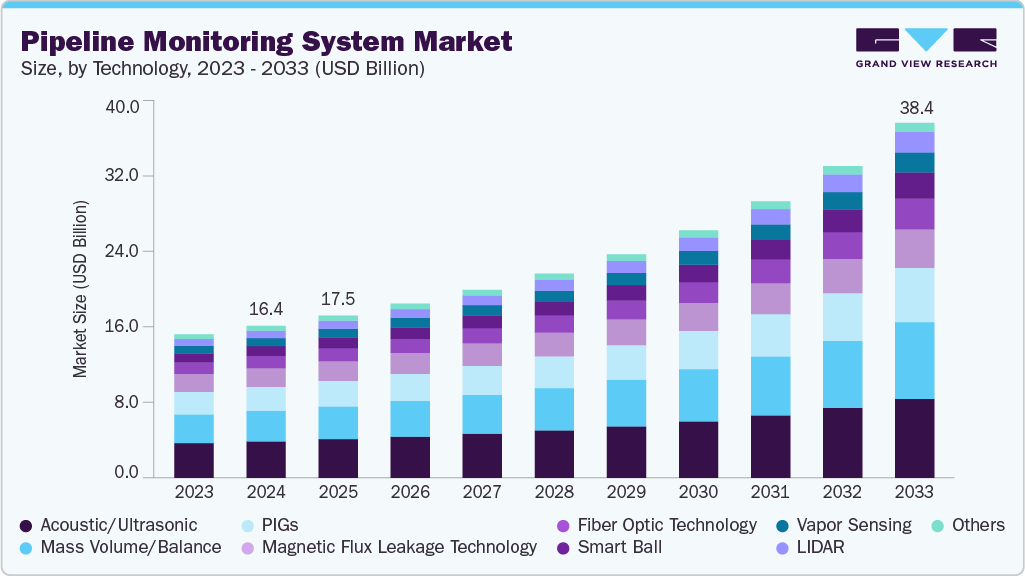
The global pipeline monitoring system market size was estimated at USD 16.43 billion in 2024, and is projected to reach USD 38.36 billion by 2033, growing at a CAGR of 10.3% from 2025 to 2033. The growth is attributed to the increasing pipeline installations utilized for the transportation and distribution of oil and gas supplies globally.
Key Market Trends & Insights
- The North America pipeline monitoring system market accounted for a 27.6% revenue share in 2024.
- The pipeline monitoring system industry in the U.S. held a dominant position in 2024.
- By technology, the acoustic/ultrasonic segment accounted for the largest revenue share of 24.0% in 2024.
- By pipe type, the metallic segment held the largest market share in 2024.
- By application, the leak detection segment dominated the market in 2024.
Market Size & Forecast
- 2024 Market Size: USD 16.43 Billion
- 2033 Projected Market Size: USD 38.36 Billion
- CAGR (2025-2033): 10.3%
- North America: Largest Market in 2024
- Asia Pacific: Fastest-Growing Market in 2024
Request Free Sample Report: https://www.grandviewresearch.com/industry-analysis/pipeline-monitoring-system-market-report/request/rs1
Moreover, the growing number of cases of leakage due to pipeline corrosion propels the demand for pipeline monitoring systems. Oil and gas manufacturers are rapidly adopting monitoring systems to reduce wastage, minimize environmental footprint, and ensure safety.
The adoption of leak detection systems has ensured safety, feasibility, real-time analysis, and improved performance owing to the improved pipeline infrastructure. Additionally, the installation of pipeline monitoring/detection systems has reduced geo-hazards, thefts, internal leakage, and ruptures. Furthermore, the advent of pigging technology within existing and new pipelines is positively influencing the growth of the market. The pigging technology performs operations such as maintenance, clearing, inspection, clearing, dimensioning, and pipeline testing.
The pipeline monitoring systems are utilized to locate corrosion, flow constrictions, and liquid accumulations, and collect samples by evaluating risk and bacteriological control programs. The pipeline monitoring systems are generally employed within the following applications: plants & refineries, refined products, wet gas & crude pipelines, water & wastewater, offshore platforms, and pipeline terminals. The monitoring/detection systems provide accurate real-time monitoring of internal corrosion, gases, fluids, and oil contamination.
Advancing technological aspects within pipeline infrastructure, such as Human Machine Interface (HMI), Distributed Vibration Sensing (DVS)/Distributed Acoustic Sensing (DAS), Distributed Temperature Sensing (DTS), and Programmable Logic Controller (PLC), have strengthened the downstream process monitoring capabilities, intuitive interface software, and detection algorithms. The improved technological solutions integrated within monitoring systems have significantly propelled the growth of the market.
Manufacturers employ hardware- and software-based methods, classifying leakage detection systems into three primary groups: internal, external, and non-technical methods. The detection/monitoring methods comprise ground penetration radar, pressure point analysis, fiber optic sensor, negative pressure wave, acoustic emission, and dynamic modeling.
The pipeline monitoring system industry has undergone a remarkable evolution across North America and the Asia Pacific, driven by the increased accessibility of improved pipeline infrastructure, technological breakthroughs, and growing demand for oil & gas substances. The Pipeline Monitoring System market is fragmented, with a few players dominating and capturing a significant share of the overall market. These companies have invested an enormous sum of the amount in research and development activities, as the industry is anticipated to grow exponentially in the near future.
Pipeline Monitoring System Market Report Scope
|
Report Attribute |
Details |
|
Market size value in 2025 |
USD 17.53 billion |
|
Revenue forecast in 2033 |
USD 38.36 billion |
|
Growth rate |
CAGR of 10.3% from 2025 to 2033 |
|
Base year for estimation |
2024 |
|
Historical data |
2021 – 2023 |
|
Forecast period |
2025 – 2033 |
|
Quantitative units |
Revenue in USD million/billion and CAGR from 2025 to 2033 |
|
Report coverage |
Revenue forecast, company ranking, competitive landscape, growth factors, and trends |
|
Segments covered |
Technology, pipe type, application, industry vertical, region |
|
Regional scope |
North America; Europe; Asia Pacific; Latin America; MEA |
|
Country scope |
U.S.; Canada; Mexico; Germany; UK; France; China; Japan; India; South Korea; Australia; Brazil; KSA; UAE; South Africa |
|
Key companies profiled |
ABB Ltd.; Emerson Electric Co.; Generic Electric Co.; Honeywell International Inc.; Huawei Investment and Holding Co. Ltd.; ORBCOMM Inc.; QinetiQ Group Plc; Rockwell Automation Inc.; Schneider Electric SE; Siemens AG |
|
Customization scope |
Free report customization (equivalent up to 8 analysts working days) with purchase. Addition or alteration to country, regional & segment scope. |
|
Pricing and purchase options |
Avail customized purchase options to meet your exact research needs. Explore purchase options |