Moringa Ingredients Market growing at CAGR of 11.2% from 2026 to 2033
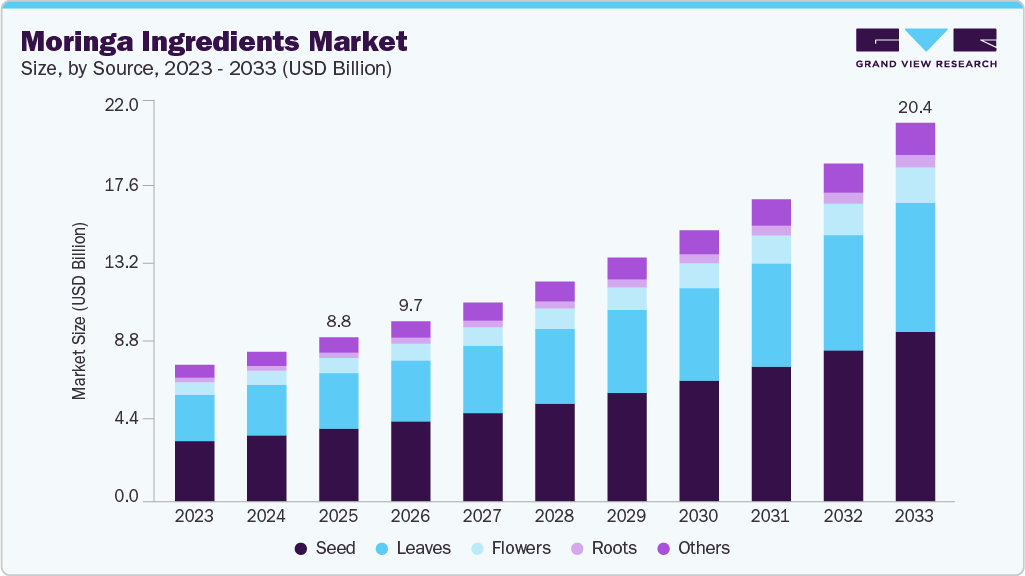
The global moringa ingredients market size was valued at USD 8.83 billion in 2025 and is expected to reach USD 20.40 billion by 2033, witnessing a CAGR of 11.2% from 2026 to 2033. The industry for moringa ingredients is rising due to increasing consumer prioritization of preventive nutrition and natural, multifunctional ingredients.
Key Market Trends & Insights
- By region, Asia Pacific dominated the moringa ingredients market with a share of 47.2% in 2025.
- The U.S. market dominated the North America with a revenue share of 63.2% in 2025.
- By source, seeds led the market and accounted for a share of 44.3% in 2025.
- By application, food & beverages led the market and accounted for a share of 53.7% in 2025.
- By origin, the conventional segment led the market and accounted for a share of 51.8% in 2025.
Market Size & Forecast
- 2025 Market Size: USD 8.83 Billion
- 2033 Projected Market Size: USD 20.40 Billion
- CAGR (2026-2033): 11.2%
- Asia Pacific : Largest market in 2025
Request Free Sample Report: https://www.grandviewresearch.com/industry-analysis/moringa-ingredients-market/request/rs1
Health-conscious buyers are shifting toward plant-based bioactives that offer antioxidant, anti-inflammatory, and metabolic benefits, all of which are well-documented for moringa. Key demand drivers include rising lifestyle-linked conditions such as diabetes, obesity, gut imbalance, and micronutrient deficiencies, which push consumers toward nutrient-dense natural ingredients.
The clean-label movement favors minimally processed botanicals for food, beverage, cosmetic, and wellness products, giving moringa an advantage due to its high Vitamin A, C, calcium, iron, protein, and polyphenol density. The growth of plant-based diets has expanded use cases beyond supplements into snacking, vegan baking oils and fats, emulsifiers for beverages, natural cosmetic oils, and protein isolates from seed cake.
Geographically, moringa benefits from being a pan-tropical crop with a strong production base in the Global South. The tree is native to the sub-Himalayan belt of India and is now widely cultivated across South and Southeast Asia, Africa, and Latin America; India is the largest producer and a key exporter of moringa powder, with growing volumes also coming from countries such as Nigeria, Senegal, Thailand, and Indonesia. Export data show India shipping moringa powder to high-value markets such as the U.S., Germany, UAE, Japan, and France, underlining strong demand from North America, Europe, and the Gulf for processed moringa ingredients. Because moringa thrives in semi-arid, low-input conditions and can be rainfed, it is increasingly positioned as a sustainable, climate-resilient cash crop for smallholders in India and Africa, supporting development programs and ensuring a scalable raw-material base for ingredient suppliers.
Consumer Insights
Consumers are increasingly adopting moringa due to a shift toward natural functional nutrition that delivers multiple health benefits in a single ingredient. A key trend is the preference for botanicals that combine immunity, gut support, and metabolic wellness, rather than isolated vitamins, which aligns with moringa’s appeal. Modern buyers favor seed-derived formats such as cold-pressed oil because they integrate easily into daily cooking routines, beauty applications, and protein blends and signal minimal processing to clean-beauty and clean-food audiences. There is growing interest in plant-based diets and lactose/sugar reduction, which is expanding moringa use in dairy-alternative drinks, vegan baked foods, and protein fortification.
Geographically, moringa consumption reflects the broader regional nutrition priorities and food-culture integration routes. In North America, the rise of metabolic and immunity-oriented diets has increased the appeal of moringa seed oil for heart-healthy and anti-inflammatory cooking routines, while moringa powders are frequently incorporated into smoothies and green-protein blends. Rural and midwestern states also show adoption driven through hospital-initiated chronic-care nutrition plans and specialist-adjacent carts that include plant antioxidants, providing directional justification for high awareness and usage among chronic respiratory and cardio-metabolic households.
Source Insights
The moringa ingredients by seeds accounted for the largest market share of 44.3% in 2025. Moringa seeds hold concentrated bioactive compounds including healthy lipids, plant proteins, and natural antioxidants such as quercetin and chlorogenic acid making them attractive for immunity, anti-inflammatory, and functional food formulations. Unlike leaves, seeds are increasingly favored for cold-pressed moringa oil, clean-label protein isolates, and powdered premix blends used in fortified snacks, vegan bakery fats, and beverage emulsifiers. Seed cultivation also supports higher industrial scale, longer shelf stability, and by-product valorization (seed cake for proteins/animal feed, and seed husk for fiber), improving commercial viability.
The moringa ingredients from leaves are expected to grow at a CAGR of 11.3% from 2026 to 2033. Leaves deliver a richer profile of micronutrients, polyphenols, and bioactive plant proteins than seeds or bark, enabling broader formulation use in dietary supplements, functional teas, and green blends. Iowa and other U.S. consumers increasingly prefer leaf-led powders and infusions as they are perceived as less industrial, more versatile, and easier to integrate into “daily health rituals” such as immunity drinks and hair/skin nutraceutical blends.
Moringa Ingredients Market Report Scope
|
Report Attribute |
Details |
|
Market size value in 2026 |
USD 9.70 billion |
|
Revenue forecast in 2033 |
USD 20.40 billion |
|
Growth rate |
CAGR of 11.2% from 2026 to 2033 |
|
Base year for estimation |
2025 |
|
Historical data |
2021 – 2025 |
|
Forecast period |
2026 – 2033 |
|
Quantitative units |
Revenue in USD million/billion and CAGR from 2026 to 2033 |
|
Report coverage |
Revenue forecast, company ranking, competitive landscape, growth factors, and trends |
|
Segments covered |
Source, application, origin, region |
|
Regional scope |
North America; Europe; Asia Pacific; Central & South America; Middle East & Africa |
|
Country scope |
U.S.; Canada; Mexico; UK; Germany; France; Italy; Spain; China; India; Japan; South Korea; Australia; Brazil; South Africa |
|
Key companies profiled |
Organic India Pvt. Ltd.; Earth Expo Company; KuliKuli, Inc.; Ancient Greenfields Pvt. Ltd; Grenera Nutrients Pvt.; Botanica Natural Products; Aayuritz Phytonutrients Pvt. Ltd.; Herbs & Crops Overseas; Moringa Initiative Ltd.; Green Virgin Products LLC; Dominate Industries (India) |
|
Customization scope |
Free report customization (equivalent up to 8 analysts working days) with purchase. Addition or alteration to country, regional & segment scope. |
|
Pricing and purchase options |
Avail customized purchase options to meet your exact research needs. Explore purchase options |