Modular Construction Market growing at a CAGR of 8.2% from 2026 to 2033
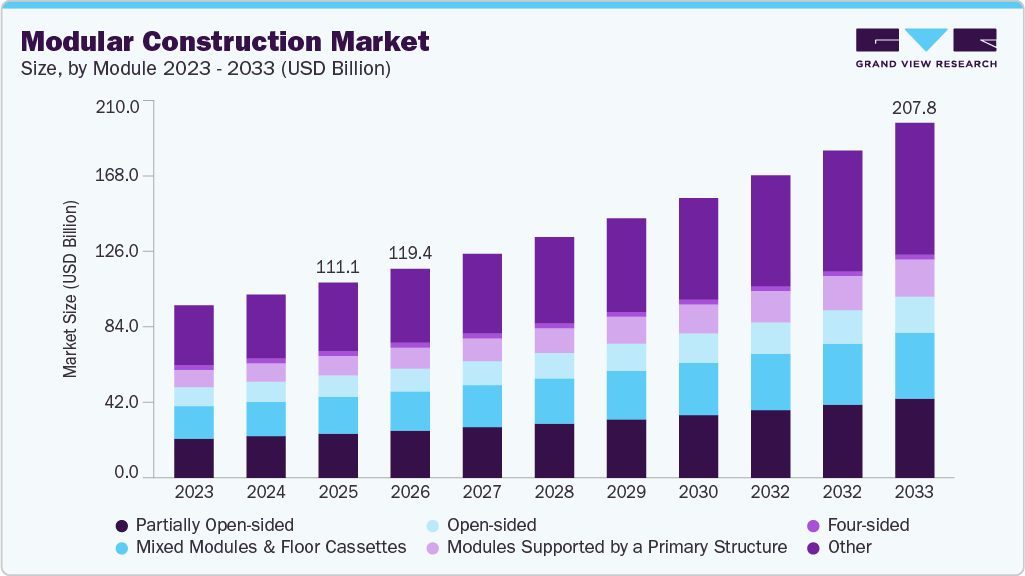
The global modular construction market size was valued at USD 111.07 billion in 2025 and is projected to reach USD 207.82 billion by 2033, growing at a CAGR of 8.2% from 2026 to 2033. This growth is attributed to growing demand for affordable housing, coupled with increasing investment in the development of healthcare and commercial infrastructure around the globe.
Key Market Trends & Insights
- Europe dominated the modular construction market with the largest revenue share of 45.0% in 2025.
- By type, the permanent segment is expected to grow at the fastest CAGR of 8.5% over the forecast period.
- By application, the residential segment is expected to grow at the fastest CAGR of 8.9% over the forecast period.
- By material, the concrete segment is expected to grow at the fastest CAGR of 8.4% over the forecast period.
- By modules, the open-sided segment is expected to grow at the fastest CAGR of 9.3% over the forecast period.
Market Size & Forecast
- 2025 Market Size: USD 111.07 Billion
- 2033 Projected Market Size: USD 207.82 Billion
- CAGR (2026-2033): 8.2%
- Europe: Largest market in 2025
- Asia Pacific: Fastest market in 2025
Request Free Sample Report: https://www.grandviewresearch.com/industry-analysis/modular-construction-market/request/rs1
Off-site building activities in urban regions are also growing, which is further driving the growth of the modular building market. Off-site building is not affected by weather conditions, as it is manufactured within closed factories using advanced machinery, thereby optimizing construction time and providing high-quality Types. The benefits of off-site building make modular building cost-effective and contribute to less site-generated waste. The steady rise in urbanization and industrial expansion is anticipated to spur a greater number of upcoming commercial and industrial projects, thereby supporting global construction sector growth. Ongoing technological progress in the building industry, along with the benefits offered by modular methods such as faster project delivery, cost efficiency, improved adaptability, reusability, and lower material wastage, continues to strengthen overall demand. These strengths are becoming increasingly relevant in the modular construction for high rise buildings market, where rapid and efficient construction solutions are essential.
Modular building enables industries to customize designs and leverage the latest innovations in style and functionality. Before the development of the modular prefabricated construction market, industries were compelled to spend countless man-hours on planning and designing, while actual construction took months or even years to complete. The evolution of modular methods takes the guesswork out of the planning stage and simplifies construction to a large extent, reducing the time from conception to completion by months or more.
Market Concentration & Characteristics
The market growth stage is high, and the pace of this industry’s growth is accelerating. Modular construction industry is characterized by a high degree of innovation owing to rapid technological advancements. This industry is characterized by technological advancements that enable the production of advanced products for various applications. Advancements in extended 3D analysis of building systems (ETABS) and revit software/3D max have resulted in development of increased penetration of modular building in different applications. Extended 3D Analysis of Building Systems (ETABS) is an engineering software that carries out the design and structural analysis of buildings. It offers 3D object modeling and visualizing tools. This software also offers insightful reports, graphic displays, and schematic drawings to enable users to decipher design results and understand the building structure analysis easily. ETABS has sophisticated and comprehensive design capabilities for a broad range of materials and possesses fast linear and nonlinear analytical power.
Modular construction industry is also characterized by a high level of merger and acquisition (M&A) activity by leading players. This is due to several factors, including shifting focus towards expansion of production capabilities and strengthening their position in this industry.
Various associations and regulatory bodies across the globe have set regulations with regard to the designing, manufacturing, transportation, and erection of pre-engineered and modular buildings. ASTM standards define various parameters such as dimensions and tolerance level of components used in pre-engineered buildings. Manufacturing companies have to adhere to the standards set by various associations such as MBMA, AISC, AISI, and AWS for modular construction structures during their entire manufacturing process.
End-user concentration is a significant factor in this industry as there are a number of end-user industries that are driving demand for modular construction. The demand for modular building is growing among the end-user industries on account of growing awareness regarding benefits of offsite construction. The manufacturers of modular construction offer final Types to end users in the residential, industrial, commercial, educational, and healthcare sectors. The demand for modular construction is rising from end users as it helps reduce the building time, cost, and material waste generated. As modular construction building units are manufactured at the worksites and simply assembled & installed by the end-users at the project site, this further helps to speed up the building process, there preference among the end-users is largely increasing.
Type Insights
The permanent segment led the modular construction market and accounted for a revenue share of 64.6% in 2025. Permanent modular construction offers enhanced design flexibility and customization, enabling the creation of visually appealing and architecturally diverse buildings. Its robust quality control ensures consistent safety, durability, and high standards, making it a preferred option for developers, architects, and clients seeking reliable, long-lasting solutions. These advantages position permanent modular construction as a leader in the modular construction market, catering to permanent and relocatable building needs with a growing demand for efficiency and resilience.
The relocatable modular construction segment is expected to grow significantly at a CAGR of 7.7% over the forecast period. Temporary housing for emergency and relief efforts has become increasingly popular. These structures are designed to be easily relocated and adapted to different sites. During the urgent need for housing for disadvantaged communities, relocatable construction models offer an ideal solution, helping to address both time and budget limitations efficiently. The demand for temporary office spaces, storage, and housing in large construction projects has driven their increased need. These structures offer a practical and flexible solution to meet the short-term needs of such projects.
Material Insights
The steel segment dominated the market, accounting for a revenue share of 41.2% in 2025. The material comes in various forms, including H-type beams, columns, angles, I-beams, and T-shapes. It boasts remarkable mechanical and chemical properties such as high strength, durability, ductility, ease of fabrication, resistance to seismic forces, and rapid assembly. It is commonly used as a reinforcing agent in concrete to offset its lower tensile strength. Pre-engineered steel structures are frequently employed in large, open spaces, particularly for commercial and industrial applications. Steel frames are lighter than many other wall materials, making it easier to crane and transport building components efficiently, which minimizes disruption to the surrounding area and helps lower costs.
The concrete segment in the modular construction market is estimated to grow at the fastest CAGR of 8.4% over the forecast period. Concrete’s durability and strength make it ideal for modular buildings, ensuring long-term structural integrity and resistance to weather conditions. Its natural fire resistance enhances safety, benefiting both residential and commercial projects. Concrete also improves energy efficiency by providing better insulation and lowering heating and cooling costs. Minimal maintenance requirements further reduce long-term expenses. With its wide availability and cost-effectiveness, concrete is preferred in modular construction, enabling faster, more affordable project completions while meeting the growing demand for sustainable building solutions.
Modular Construction Market Report Scope
|
Report Attribute |
Details |
|
Market size value in 2026 |
USD 119.41 billion |
|
Revenue forecast in 2033 |
USD 207.82 billion |
|
Growth rate |
CAGR of 8.2% from 2026 to 2033 |
|
Base year for estimation |
2025 |
|
Historical data |
2021 – 2024 |
|
Forecast period |
2026 – 2033 |
|
Quantitative units |
Revenue in USD million/billion and CAGR from 2026 to 2033 |
|
Report coverage |
Revenue forecast, company ranking, competitive landscape, growth factors, and trends |
|
Segments covered |
Type, material, application, module, region |
|
Regional scope |
North America; Europe; Asia Pacific; Middle East & Africa; Central & South America |
|
Country scope |
U.S.; Canada; Mexico; Germany; UK; Sweden; China; India; Japan; Singapore; Australia; Brazil; Saudi Arabia; UAE |
|
Key companies profiled |
Sekisui House Ltd.; LAING O’ROURKE; Red Sea International; Skanska; Bouygues Construction; Premier Modular Limited; LEUSBERG GmbH & Co KG; DuBox; Wernick Group; CIMC Modular Building Systems Holdings Co., Ltd. (CIMC-MBS); Riko Hiše d.o.o; Lendlease Corporation; Modulaire Group; Guerdon, LLC; Hickory Group |
|
Customization scope |
Free report customization (equivalent up to 8 analysts working days) with purchase. Addition or alteration to country, regional & segment scope. |
|
Pricing and purchase options |
Avail customized purchase options to meet your exact research needs. Explore purchase options |