Lab Automation Market growing at a CAGR of 9.3% from 2025 to 2033
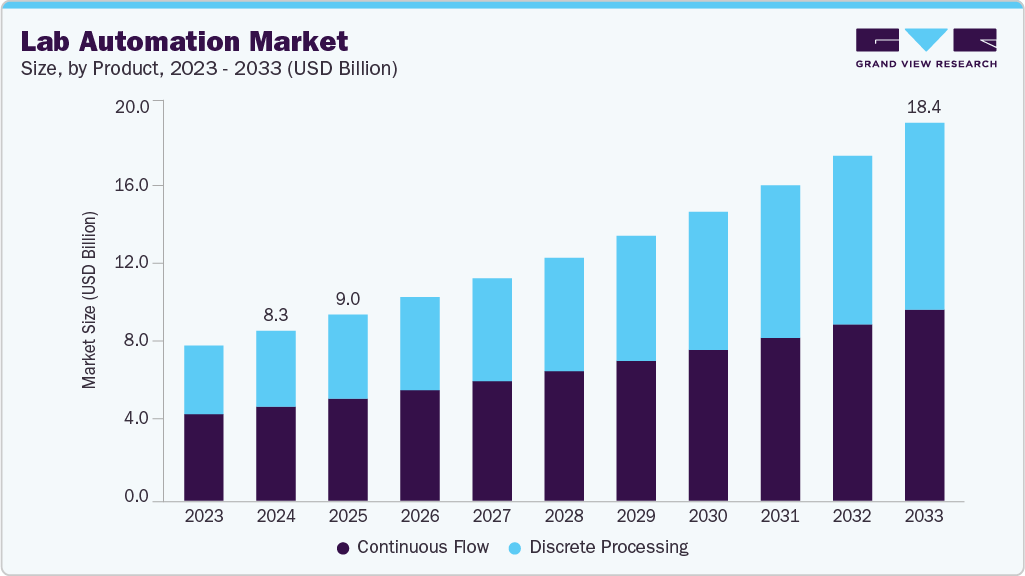
The global lab automation market size was estimated at USD 8.27 billion in 2024 and is projected to reach USD 18.39 billion by 2033, growing at a CAGR of 9.3% from 2025 to 2033. The market growth is driven by rising demand for advanced screening, laboratory efficiency, and the adoption of advanced automated solutions globally.
Key Market Trends & Insights
- The North America lab automation market held the largest share of 36.54% of the global market in 2024.
- The lab automation industry in the U.S. is expected to grow significantly over the forecast period.
- By process, the continuous flows segment held the largest market share of 55.35% in 2024.
- By automation type, the total automation segment held the largest market share in 2024.
- By end-use, the clinical chemistry analysis segment captured the largest market share of 27.72% in 2024.
Market Size & Forecast
- 2024 Market Size: USD 8.27 Billion
- 2033 Projected Market Size: USD 18.39 Billion
- CAGR (2025-2033): 9.3%
- North America: Largest market in 2024
- Asia Pacific: Fastest growing market
Request Free Sample Report: https://www.grandviewresearch.com/industry-analysis/lab-automation-market/request/rs1
Cost & Time Efficiency
Cost and time efficiency are major factors influencing the global lab automation market. Automation technologies are increasingly being used by laboratories in the biotechnology, pharmaceutical, and clinical sectors to improve productivity, reduce manual intervention, and streamline processes. Automated instruments can more accurately and quickly complete repetitive and time-consuming tasks such as pipetting, sample preparation, and data analysis than manual methods. This helps to enhance the workflow effectiveness and scientific output by freeing researchers to concentrate on higher-value tasks such as experimental design and data interpretation.
Moreover, automation dramatically lowers labor costs by reducing reliance on trained technicians for routine tasks. It also reduces mistakes that result in expensive rework or experimental delays. Lab throughput is improved by processing large numbers of samples in shorter amounts of time, which is especially important in high-demand fields such as drug discovery, genomics, and diagnostics. Cost and time efficiency continue to drive the global adoption of automated laboratory systems as labs face increasing pressure to produce accurate results more quickly while effectively managing budgets.
Market Concentration & Characteristics
The degree of innovation in the global lab automation industry is high, driven by continuous advancements in robotics, artificial intelligence (AI), and data analytics. Accuracy and efficiency are greatly increased by the increasing integration of smart automation technologies in modern laboratory systems that can perform predictive maintenance, adaptive learning, and real-time monitoring. These innovations highlight the market’s strong potential for innovation by lowering operational costs and human intervention while speeding up research and discovery procedures in biotechnology, clinical diagnostics, and pharmaceutical industries.
The global lab automation industry has seen a high volume of M&A activity, which indicates the industry’s strategic significance and expansion prospects. Businesses are pursuing mergers, acquisitions, and strategic alliances more frequently to broaden their product offerings, penetrate new markets, and improve their technological prowess. For instance, in December 2023, in the United States, Hudson Robotics and Art Robbins Instruments acquired Tomtec Inc., expanding liquid-handling capabilities and entering the bioanalytical sample-preparation segment for life sciences R&D.
Lab Automation Market Report Scope
|
Report Attribute |
Details |
|
Market size value in 2025 |
USD 9.05 billion |
|
Revenue forecast in 2033 |
USD 18.39 billion |
|
Growth rate |
CAGR of 9.3% from 2025 to 2033 |
|
Base year for estimation |
2024 |
|
Historical data |
2021 – 2023 |
|
Forecast period |
2025 – 2033 |
|
Quantitative units |
Revenue in USD million/billion and CAGR from 2025 to 2033 |
|
Report coverage |
Revenue forecast, company ranking, competitive landscape, growth factors, and trends |
|
Segments covered |
Process, automation type, end-use, region |
|
Regional scope |
North America; Europe; Asia Pacific; Latin America; MEA |
|
Country scope |
U.S.; Canada; Mexico; UK; Germany; France; Italy; Spain; Denmark; Sweden; Norway; India; China; Japan; Australia; South Korea; Thailand; Brazil; Argentina; Saudi Arabia; UAE; South Africa; Kuwait |
|
Key companies profiled |
F. Hoffmann-La Roche Ltd; QIAGEN; PerkinElmer Inc.; Thermo Fisher Scientific, Inc.; Siemens Healthcare GmbH; Danaher; Agilent Technologies, Inc.; Eppendorf SE; Hudson Robotics; Aurora Biomed Inc.; BMG LABTECH GmbH; Tecan Trading AG.; Hamilton Company |
|
Customization scope |
Free report customization (equivalent up to 8 analyst’s working days) with purchase. Addition or alteration to country, regional & segment scope. |