Green Cement Market growing at a CAGR of 6.1% from 2025 to 2030
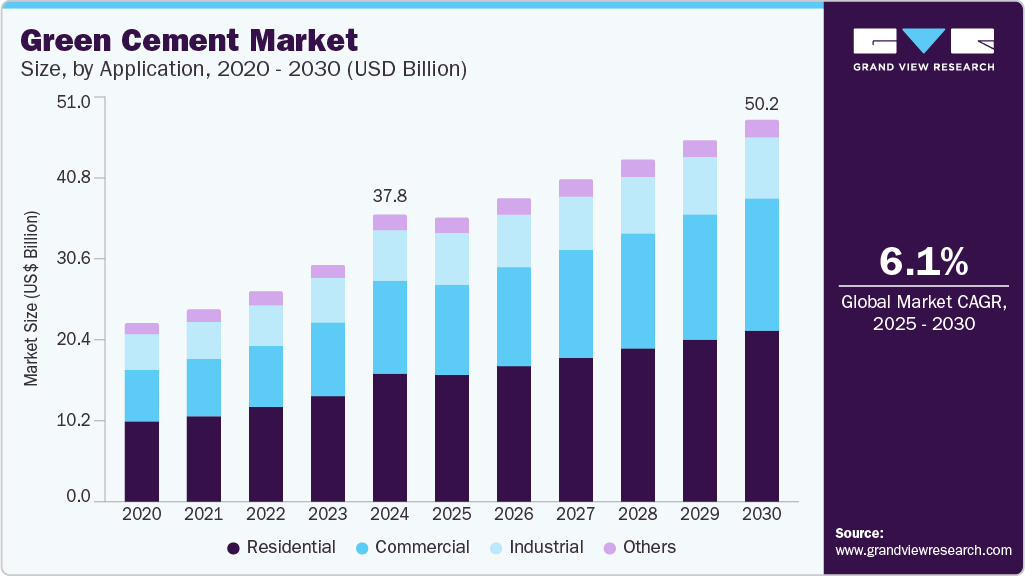
The global green cement market size was valued at USD 37.76 billion in 2024 and is expected to reach USD 50.24 billion by 2030, growing at a CAGR of 6.1% from 2025 to 2030. The construction industry is gradually embracing eco-friendly practices, with a growing focus on utilizing green cement to minimize carbon emissions in building and construction projects.
Key Market Trends & Insights
- North American green cement dominated the global market with the largest revenue share of 36.9% in 2024.
- The U.S. led the North American market with a significant revenue share in 2024.
- By application, the residential segment dominated the market and accounted for the largest revenue share of 44.6% in 2024.
Market Size & Forecast
- 2024 Market Size: USD 37.76 Billion
- 2030 Projected Market Size: USD 50.24 Billion
- CAGR (2025-2030): 6.1%
- North America: Largest market in 2024
Request Free Sample Report: https://www.grandviewresearch.com/industry-analysis/green-cement-market/request/rs1
This trend has intensified competition in the market, leading to significant investments in research and development. Green cement, an eco-friendly alternative to conventional cement that incorporates recycled materials and reduces carbon emissions during production, is witnessing growing demand due to multiple influential factors. The global residential sector’s rapid growth, driven by increasing population, urbanization, and higher disposable incomes, significantly encourages using green cement in construction. This momentum is further strengthened by enforcing strict building codes and energy-efficiency regulations, promoting sustainable building practices.
The other forces driving the market are the advantages that result from the use of green cement. Green cement is produced from industrial waste products such as fly ash and slag, solving the problem of disposing of industrial waste and instead using it. Thus, it was a better option to utilize it. Further, IT contributes more to reducing the use of fossil fuels than normal cement manufacturing.
Moreover, rising government initiatives to reduce carbon emissions while setting standards, providing incentives, and enforcing regulations to promote green buildings increase product demand. The benefits of using green cement in buildings, such as increased mechanical strength, tensile strength, durability, crack resistance, and others, have made it a better and more sustainable choice than traditional buildings. Stringent environmental regulations in regions like North America, particularly those imposed by the Environmental Protection Agency to curb greenhouse gas emissions, push consumers and builders toward cleaner, sustainable materials.
Application Insights
Residential applications dominated the market and accounted for the largest revenue share of 44.6% in 2024, driven by the advantages of green cement over traditional cement. Green cement offers superior acid and thermal resistance, making it a preferable option for construction in extreme conditions. Cost effectiveness, enhanced durability, superior finished products, and low lifetime maintenance costs for buildings have also contributed to the increasing demand for the product and to expanding the market.
Commercial applications are expected to grow at the fastest CAGR of 7.8% over the forecast period. This growth is attributed to ensuring longevity, protecting building structures from corrosion, and providing higher strength and resistance to harsh weather. In addition, commercial buildings benefit from energy efficiency, improved indoor air quality, and higher market value, making green cement an attractive option for environmentally conscious investors.
Regional Insights
North American green cement dominated the global market with the largest revenue share of 36.9% in 2024. The region’s government bodies have been strict with carbon emissions and environmental rules and regulations, which have led to increasing demand for the product. Moreover, the shift toward circular economy practices and increased demand for eco-friendly alternatives support ongoing expansion across both residential and commercial sectors.
Green Cement Market Report Scope
|
Report Attribute |
Details |
|
Market size value in 2025 |
USD 37.31 billion |
|
Revenue forecast in 2030 |
USD 50.24 billion |
|
Growth Rate |
CAGR of 6.1% from 2025 to 2030 |
|
Base year for estimation |
2024 |
|
Historical data |
2018 – 2023 |
|
Forecast period |
2025 – 2030 |
|
Quantitative units |
Revenue in USD million/billion, and CAGR from 2025 to 2030 |
|
Report coverage |
Revenue forecast, company ranking, competitive landscape, growth factors, and trends |
|
Segments covered |
Application, region. |
|
Regional scope |
North America; Asia Pacific; Europe; Latin America; Middle East and Africa. |
|
Country scope |
U.S.; Canada; Mexico; Germany; UK; France; Russia; Turkey; China; India; Japan; Indonesia; South Korea; Brazil; Argentina; Saudi Arabia. |
|
Key companies profiled |
Anhui Conch Cement Company; CEMEX; CNBM; Italcementi; LafargeHolcim; CeraTech; Calera Corporation; Heidelberg Cement AG; Navrattan Blue Crete Industries Pvt., Ltd.; Siam Cement Public Company (SCG). |
|
Customization scope |
Free report customization (equivalent to 8 analyst working days) with purchase. Addition or alteration to country, regional & segment scope. |
|
Pricing and purchase options |
Avail customized purchase options to meet your exact research needs. Explore purchase options |