Commercial Food Dehydrators Market growing at a CAGR of 5.5% from 2025 to 2030
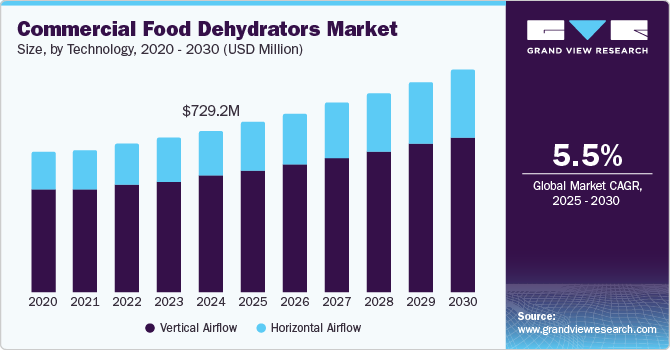
The global commercial food dehydrators market size was estimated at USD 729.2 million in 2024 and is anticipated to reach USD 1.00 billion by 2030, growing at a CAGR of 5.5% from 2025 to 2030. This growth is attributed to the increasing demand for foods with extended shelf lives is driving market expansion as consumers seek convenient options that reduce food waste.
Key Market Trends & Insights
- The commercial food dehydrators market in North America dominated the global market and accounted for the largest revenue share of 38.0% in 2024.
- The U.S. commercial food dehydrators dominated the North American market and accounted for the largest revenue share in 2024.
- By technology, vertical airflow segment dominated the market and accounted for the largest revenue share of 71.6% in 2024.
Market Size & Forecast
- 2024 Market Size: USD 729.2 Million
- 2030 Projected Market Size: USD 1.00 Billion
- CAGR (2025-2030): 5.5%
- North America: Largest market in 2024
Request Free Sample Report: https://www.grandviewresearch.com/industry-analysis/commercial-food-dehydrators-market/request/rs1
In addition, rising disposable incomes enable more consumers to invest in dehydrated technology. Furthermore, awareness of food wastage is also a significant factor, prompting organizations to utilize dehydrators to preserve surplus food for distribution. Moreover, the popularity of processed foods and dehydration technology advancements further bolster market growth.
The commercial food dehydrator market is experiencing significant growth, driven by various factors. One primary catalyst is the rising demand for convenience foods, as consumers increasingly prefer quick and easy meal options. Dehydrated foods offer a practical solution, requiring only rehydration to create complete meals or snacks, thus enhancing their appeal. Furthermore, health consciousness is another major influence, with many opting for dehydrated options that are low in calories and fats while retaining essential nutrients. This shift towards healthier eating habits is expected to sustain the demand for commercial food dehydrators in the coming years.
In addition to these trends, the expanding e-commerce market contributes to the demand for commercial food dehydrators. As more consumers turn to online shopping for food technology, the accessibility of dehydrated foods is increasing, creating new opportunities for suppliers. The convenience of purchasing these items online aligns with the growing preference for ready-to-eat options, further fueling market growth.
Moreover, global food waste awareness has prompted governmental and non-governmental organizations to utilize food dehydrators to preserve surplus food. This initiative addresses hunger in affected areas and promotes sustainability by reducing waste. As a result, the market for commercial food dehydrators is projected to continue expanding, supported by technological advancements and a growing emphasis on food preservation methods.
Technology Insights
Vertical airflow technology dominated the market and accounted for the largest revenue share of 71.6% in 2024. This growth is attributed to its efficient and uniform drying capabilities. This technology ensures that heat is evenly distributed throughout the dehydrator, providing consistent dehydration across multiple layers of stacked trays. Furthermore, the vertical design optimizes space usage, allowing businesses to maximize their product capacity while maintaining high-quality output, thus appealing to health-conscious consumers and food processors alike.
Horizontal airflow technology is expected to grow at a CAGR of 6.6% from 2025 to 2030, owing to its versatility and ease of use. This system allows for effective air circulation across the entire dehydrator, ensuring that all food items receive adequate airflow for optimal drying. In addition, these airflow units are particularly favored for their ability to accommodate larger volumes of food, making them suitable for various commercial settings. Furthermore, advancements in this technology have led to improved energy efficiency and reduced operational costs, making horizontal airflow dehydrators an attractive option for businesses looking to enhance their product while adhering to sustainability practices.
Commercial Food Dehydrators Market Report Scope
|
Report Attribute |
Details |
|
Market size value in 2025 |
USD 766.4 million |
|
Revenue forecast in 2030 |
USD 1.00 billion |
|
Growth Rate |
CAGR of 5.5% from 2025 to 2030 |
|
Base year for estimation |
2024 |
|
Historical data |
2018 – 2023 |
|
Forecast period |
2025 – 2030 |
|
Quantitative units |
Revenue in USD Million and CAGR from 2025 to 2030 |
|
Report coverage |
Revenue forecast, company ranking, competitive landscape, growth factors, and trends |
|
Segments covered |
Technology, region |
|
Regional scope |
North America, Europe, Asia Pacific, Latin America, Middle East & Africa |
|
Country scope |
U.S., Canada, Mexico, UK, Germany, France, Italy, Spain, China, Japan, India, Australia, South Korea, Brazil, Argentina, South Africa, UAE |
|
Key companies profiled |
Tribest Corporation; Koolatron Corporation; Excalibur Dehydrator; National Presto Industries, Inc.; Lem Products Holding LLC; Hamilton Beach Brands, Inc.; COSORI; Aroma Housewares; Presto; Magic Mill; Harvest Right; Magic Chef |
|
Customization scope |
Free report customization (equivalent to 8 analyst working days) with purchase. Addition or alteration to country, regional & segment scope. |
|
Pricing and purchase options |
Avail customized purchase options to meet your exact research needs. Explore purchase options |