Bio-succinic Acid Market growing at a CAGR of 12.1% from 2024 to 2030
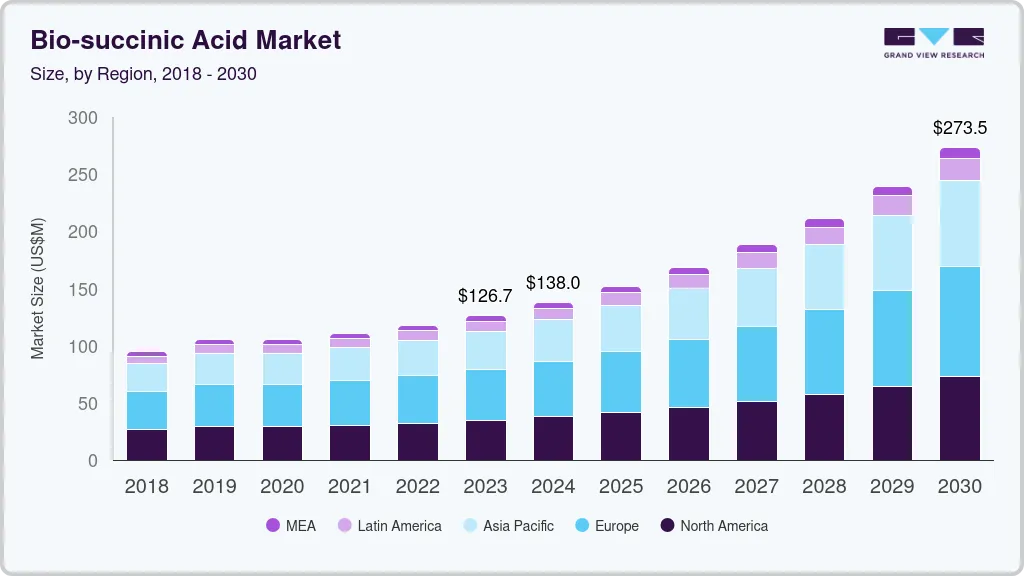
The global bio-succinic acid market size was estimated at USD 126.04 million in 2023 and is projected to reach USD 272.36 million by 2030, growing at a CAGR of 12.1% from 2024 to 2030. The anticipated surge in demand for the product is expected to stem from the escalating interest in natural products, given their non-toxic nature to both humans and the environment.
Key Market Trends & Insights
- Europe dominated the market with a revenue share of 35.51% in 2023.
- The Germany bio-succinic acid market has a strong emphasis on sustainability and reducing carbon emissions.
- By application, the 1,4-butanediol (BDO) application segment dominated the market with a revenue share of 34.50% in 2023.
- By end use, the industrial end-use segment dominated the market with a revenue share of more than 41.68% in 2023.
Market Size & Forecast
- 2023 Market Size: USD 126.04 Million
- 2030 Projected Market Size: USD 273.6 Million
- CAGR (2024-2030): 12.1%
- Europe: Largest market in 2023
Request Free Sample Report: https://www.grandviewresearch.com/industry-analysis/bio-succinic-acid-market/request/rs1
The market is characterized by intense competition, largely owing to the involvement of numerous multinational corporations actively engaged in diverse production, research, and development endeavors. With a diverse array of products experiencing high demand, the market is poised for exponential growth. It is anticipated that various competitive strategies will further intensify the rivalry in the market in the foreseeable future.
Succinic acid finds applications in a variety of industries including food, skincare, and pharmaceuticals. Its utility extends beyond product formulations, as it plays a role in various chemical processes within the human body. When applied topically, the product can alleviate joint pain and arthritis discomfort. Additionally, it is known to mitigate signs of aging and aid in scar reduction on the skin.
Growing apprehensions regarding the use of chemicals detrimental to human health and the environment across various industries have prompted the exploration of substitutes. The production process of succinic acid entails the application of several such chemicals, resulting in adverse effects on the surrounding environment. Consequently, there has been an increase in demand for alternatives to the product, with bio-succinic acid emerging as a prominent substitute.
The production of natural succinic acid contributes to mitigating climate change. By replacing petrochemicals, this product promotes a cleaner environment through the utilization of waste streams. It is regarded as an ideal substitute for various chemicals that pose environmental risks, thus supporting efforts towards environmental sustainability.
Market Concentration & Characteristics
The global bio-succinic acid market exhibits traits reminiscent of a consolidated landscape, featuring several key players including BASF SE, DSM, Roquette Freres, BioAmber, Myriant Corporation, and Kawasaki Kasei Chemicals, alongside smaller and medium-sized market participants such as GC Innovation America, among others.
The market is currently experiencing high growth at an accelerating pace. Notably, the product market is marked by a high level of innovation. Ongoing research and development efforts, particularly in the realm of succinic acid extraction from natural sources, fuel advancements in both production techniques and application methodologies.
The manufacturing and utilization of bio-succinic acid are governed by a complex array of regulations and standards intended to ensure the safety and quality of these products. These regulations are formulated to protect both human health and environmental well-being. While the precise regulatory requirements may vary depending on the country or region, there are overarching frameworks that govern the industry as a whole. Key regulatory bodies and organizations overseeing the market include the Code of Federal Regulations in the United States, the Department of Energy, the U.S. Environmental Protection Agency (EPA), among others.
Bio-succinic Acid Market Report Scope
|
Report Attribute |
Details |
|
Market size value in 2024 |
USD 137.27 million |
|
Revenue forecast in 2030 |
USD 272.36 million |
|
Growth rate |
CAGR of 12.1% from 2024 to 2030 |
|
Historical data |
2018 – 2023 |
|
Forecast period |
2024 – 2030 |
|
Quantitative units |
Volume in kilotons, revenue in USD million, and CAGR from 2024 to 2030 |
|
Report coverage |
Volume & revenue forecast, company ranking, competitive landscape, growth factors, and trends |
|
Segments covered |
Application, end-use, region |
|
Regional scope |
North America; Europe; Asia Pacific; Central & South America; MEA |
|
Country scope |
U.S.; Canada; Mexico; Germany; UK; France; Italy; Spain; China; India; Japan; South Korea; Thailand; Brazil; Argentina; Saudi Arabia; South Africa |
|
Key companies profiled |
BASF SE; DSM; Roquette Freres; BioAmber; Myriant Corporation; Kawasaki Kasei Chemicals; Mitsui & Co., Ltd; Mitsubishi Chemical Corporation |
|
Customization scope |
Free report customization (equivalent up to 8 analysts working days) with purchase. Addition or alteration to country, regional & segment scope. |
|
Pricing and purchase options |
Avail customized purchase options to meet your exact research needs. Explore purchase options |