
Bio-Based Polymers Market is forecasted to hit USD 63.7 billion by 2034, growing at a strong CAGR of 14.30%.
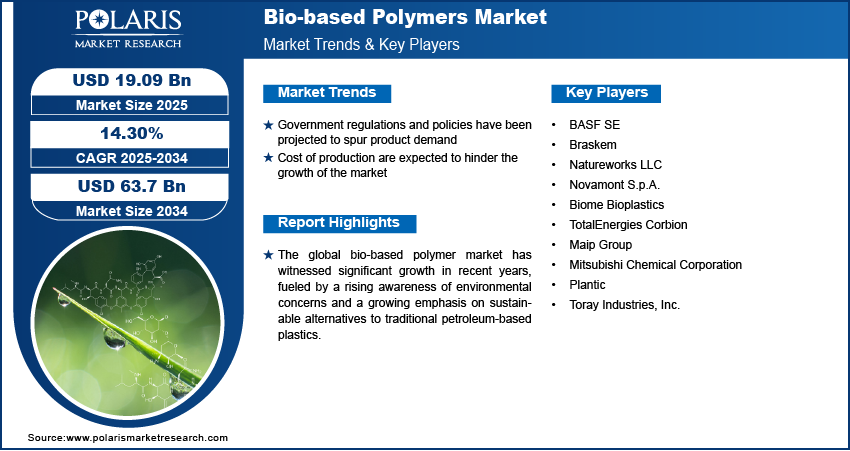
The global bio-based polymers market was valued at USD 16.7 billion in 2024 and is expected to grow at a CAGR of 14.30% from 2025 to 2034.
Market Trends & Insights:
- Surging Demand for Sustainable Packaging:
Packaging, especially food and beverage applications, is the largest consumer of bio-based polymers due to rising demand for compostable and recyclable alternatives. - Advances in Biopolymer Technologies:
Innovations in material engineering are improving the mechanical properties, heat resistance, and shelf-life of bio-based polymers, making them more competitive with conventional plastics. - Shift Toward Circular Economy Models:
The transition from linear to circular production and consumption is prompting industries to adopt renewable materials like bio-based polymers. - Integration with Additive Manufacturing:
The use of bio-based materials in 3D printing is gaining momentum due to their reduced environmental impact and adaptability in prototyping and end-use applications. - Policy Support and Green Labeling:
Government mandates banning or taxing fossil-fuel-based plastics and promoting green labeling are accelerating market acceptance of bio-based alternatives.
Market Size & Forecast
Market size value in 2025 USD – 19.09 billion
Revenue forecast in 2034 USD – 63.7 billion
CAGR – 14.30% from 2025 – 2034
Request for Free Sample:
https://www.polarismarketresearch.com/industry-analysis/bio-based-polymers-market/request-for-sample
Market Overview:
The Bio-Based Polymers Market is rapidly expanding as global industries seek sustainable and environmentally friendly alternatives to traditional petroleum-based plastics. Bio-based polymers, derived from renewable biomass sources such as corn, sugarcane, cellulose, and vegetable oils, are increasingly used in packaging, automotive, textiles, agriculture, and consumer goods.
Market Growth Drivers:
- Environmental Regulations and Plastic Bans:
Stringent global policies restricting single-use plastics are pushing industries to explore bio-based alternatives. - Consumer Preference for Eco-Friendly Products:
Growing consumer awareness and preference for biodegradable and compostable materials are fueling demand in packaging and personal care. - Corporate Sustainability Goals:
Businesses across sectors are aligning with ESG goals and incorporating bio-based materials into their supply chains and product offerings. - Availability of Renewable Feedstocks:
The abundance of raw materials like starch, cellulose, and vegetable oils makes large-scale production of bio-based polymers increasingly viable. - Technological Advancements in Processing:
Improved manufacturing techniques, including enzymatic and microbial processes, are enhancing yield and quality, reducing production costs.
Market Challenges:
- Higher Production Costs:
Bio-Based Polymers are often more expensive to produce than their petroleum-based counterparts, affecting competitiveness in price-sensitive markets. - Limited Industrial Composting Infrastructure:
In many regions, lack of proper composting and recycling systems hampers the full environmental benefits of bio-based polymers. - Performance Limitations in Specific Applications:
Some bio-based polymers may not match the durability, flexibility, or heat resistance of traditional plastics, restricting their use in high-performance applications. - Feedstock Supply Volatility:
Agricultural variability, land use issues, and competition with food production can affect the stable supply of biomass feedstock. - Lack of Consumer Awareness:
Misunderstanding about the difference between “bio-based” and “biodegradable” may lead to confusion, improper disposal, and reduced impact.