Amusement Machine Market (2026 – 2033)
Amusement Machine Market Summary
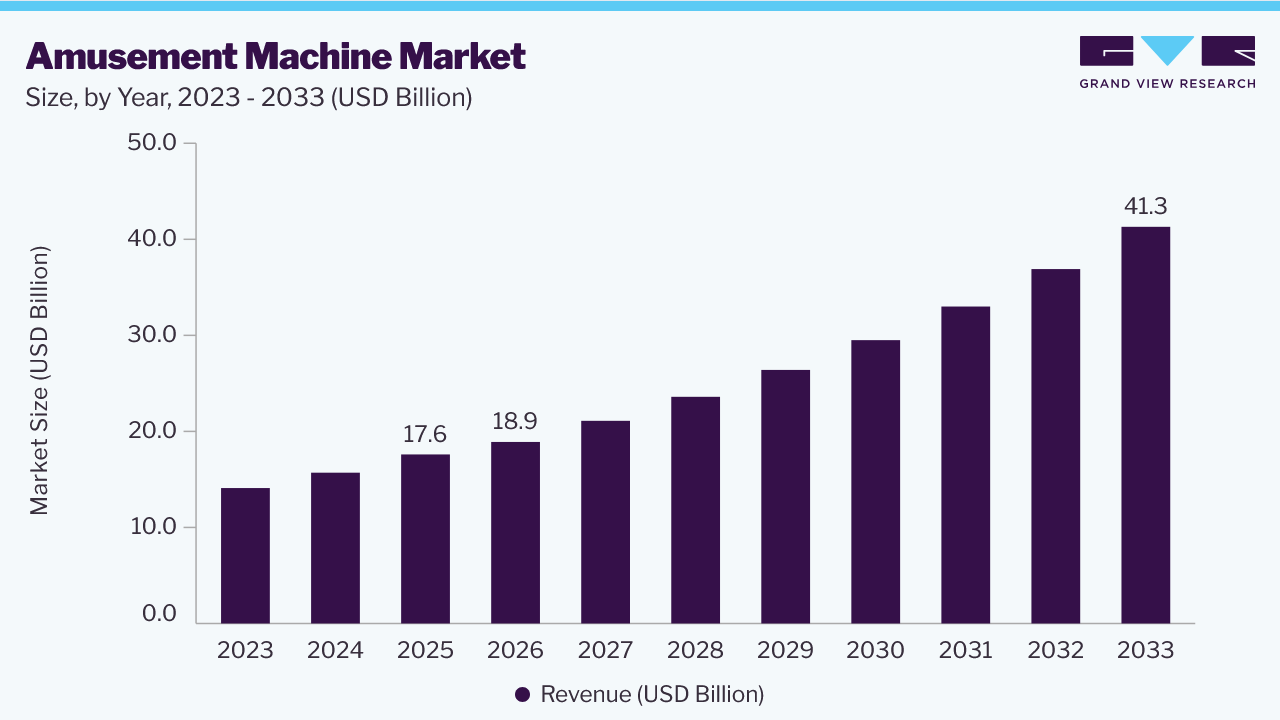
The global amusement machine market size was valued at USD 17.6 billion in 2025 and is projected to grow from USD 18.9 billion in 2026 to USD 41.3 billion by 2033, at a CAGR of 11.8% from 2026 to 2033. North America dominated the market, accounting for a revenue share of 41.0% in 2025. The market growth can be attributed to technological innovation and the increasing demand for immersive entertainment experiences.
Key Market Trends & Insights
- By game type: The video games segment accounted for the largest revenue share, at around 24.1%, in 2025.
- By application: Indoor specialty centers segment held the largest market share of around 31.0% in 2025
Regional Highlights
- Largest regional market: North America (41.0% revenue share, 2025)
- Fastest-growing regional market: Asia Pacific (highest CAGR, 2026-2033)
Market Size & Forecast
- Market size in 2025: USD 17.6 Billion
- Estimated market size in 2026: USD 18.9 Billion
- Projected market size by 2033: USD 41.3 Billion
- CAGR (2026-2033): 11.8%
Three ways to get this report
Buy it, customize it, or ask a question.
Ask an Analyst
Analyst response in 1 business day
- AccessReport author, directly
- Reply timeWithin 1 working day
- No sales callDirect answer only
- FormatEmail reply
- CostFree, no cost
Get the Full Report
What the study covers
- FormatsPDF · Excel · Dashboard
- Timeline2026–2033 annual, 2025 base
- Coverage20+ countries, 5 regions
- Companies10+ key players profiled
Customize the Report
20% free customization
- IncludeCountries, segments, points
- TailorTo your product definition
- ExtendDeeper competitor detail
- OrA fully bespoke study
- Turnaround5–10 working days
Advances in technology, such as virtual reality (VR), augmented reality (AR), and collaborative features, have transformed amusement machines, making them more engaging and appealing to tech-savvy consumers. Moreover, the growing desire for social and immersive entertainment experiences has fueled demand for arcade-style gaming, particularly in malls, family entertainment centers, and venues.
One of the most prominent trends is the integration of Virtual Reality (VR) and Augmented Reality (AR), which are enhancing gameplay by offering immersive, interactive environments that go beyond traditional gaming experiences. These technologies allow players to engage in highly dynamic and realistic virtual worlds, attracting a new generation of tech-savvy consumers. In addition, Artificial Intelligence (AI) is being leveraged to create adaptive gameplay, where machines can learn user behavior, personalize experiences, and improve game interactions in real time.
The integration of gamification into nontraditional spaces, such as restaurants, hotels, and shopping centers, where amusement machines enhance social interaction and customer engagement, merges entertainment with daily activities. Mobile payment systems are becoming more prevalent, streamlining transactions and offering greater convenience to users. For instance, in March 2024, TouchTunes announced the launch of FunWallet, a cashless mobile payment platform for the amusement industry.
The platform simplifies transactions for in venue entertainment, offering seamless payment via the TouchTunes app. FunWallet supports both connected and non-connected machines, aiming to modernize payment systems and enhance user experiences in entertainment venues. FunWallet is available at no cost for any Internet-connected machine or payment device, with a low-cost retrofit kit for non-connected machines. The platform aims to enhance the in venue entertainment experience by facilitating seamless digital transactions. The customization of machines, with unique themes or experiences tailored to specific demographics, is driving demand for bespoke solutions.
Analyst Perspective
The amusement machine market is poised for steady growth, driven by the increasing adoption of immersive technologies such as AR/VR and AI, as well as cashless payment systems that enhance user engagement and operational efficiency. The increasing investment in FECs, indoor specialty centers, and theme parks is driving demand for technologically enhanced arcade machines and interactive games. Growth in location-based entertainment, popularity of electric go-karts, and simulation games, is creating additional revenue streams. The ongoing introduction of new amusement machines, along with geographic expansion through product launches and strategic partnerships, is expected to support steady market growth during the forecast period.
Game Type Insights
The video games segment accounted for the largest revenue share, at around 24.1%, in 2025. The segment continues to benefit from rising demand for immersive and interactive entertainment experiences, supported by advancements in high-definition displays, motion-sensing technologies, virtual reality (VR), augmented reality (AR), and connected gaming systems. Modern video game amusement machines increasingly offer multiplayer capabilities, interactive gameplay, and enhanced visual and audio effects, helping improve player engagement and encourage repeat visits. Manufacturers are also incorporating AI-enabled personalization, adaptive gameplay, and real-time performance analytics to create more responsive and engaging experiences. These developments reflect the industry’s broader shift toward technology-driven entertainment, with arcade operators increasingly adopting immersive and connected gaming solutions to enhance customer engagement and differentiate their offerings.
The simulation/AR/VR games segment is projected to witness the fastest CAGR during the forecast period. Continued investments by gaming and technology companies in VR cloud gaming, AI-generated content, and metaverse-based experiences are accelerating innovation across this category. Meanwhile, the expansion of 5G connectivity and edge computing is enabling real-time multiplayer AR/VR experiences with reduced latency and improved responsiveness. Partnerships among VR hardware manufacturers, game developers, and location-based entertainment operators are further strengthening the adoption of advanced simulation gaming systems.