AI Assistant Software Market To Reach US$ 27.5 billion by 2031
The AI Assistant Software Market is undergoing rapid transformation as organizations and consumers increasingly adopt artificial intelligence to automate tasks, improve productivity, enhance customer experiences, and support decision-making.
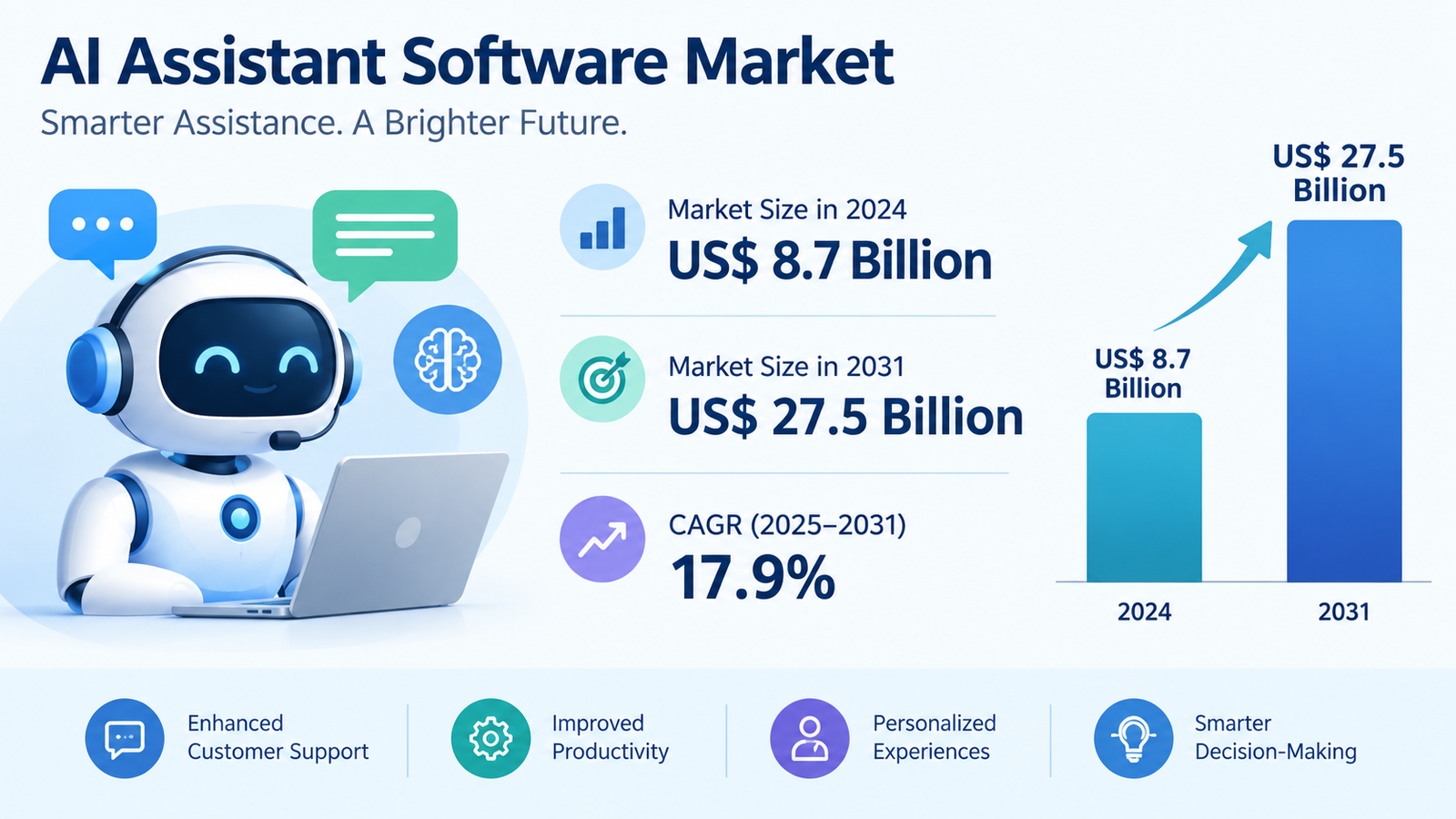
According to The Insight Partners, The AI assistant software market size is expected to reach US$ 27.5 billion by 2031 from US$ 8.7 billion in 2024. The market is anticipated to register a CAGR of 17.9% during 2025–2031.
AI Assistant Software Market Trends
One of the most significant trends shaping the AI Assistant Software Market is the movement toward multifunctional and unified AI assistants. Rather than requiring users to switch between different software applications, next-generation assistants are increasingly designed to combine natural language interaction, reasoning, planning, and task execution within a single platform. This approach can help organizations simplify workflows and improve operational efficiency.
Generative AI is another important trend. Modern AI assistants can draft emails, summarize documents, generate content, answer questions, assist with research, and support complex business interactions. Enterprises are increasingly embedding generative AI capabilities into existing applications to automate repetitive activities and improve employee productivity.
The expansion of multimodal capabilities is also creating new opportunities. AI assistants can increasingly work with text, voice, images, documents, and other forms of information. This supports more natural interactions and enables organizations to develop assistants capable of handling broader business processes.
Personalization is another growing focus. AI assistants are being designed to understand user preferences, organizational context, and previous interactions. As memory and contextual capabilities improve, assistants can provide more relevant responses and recommendations while reducing repetitive user instructions.
Get Sample PDF @ https://www.theinsightpartners.com/sample/TIPRE00042031
Key Drivers of the AI Assistant Software Market
Advances in Artificial Intelligence Technologies:-Rapid developments in NLP, machine learning, generative AI, and LLMs are significantly improving AI assistant capabilities. Better contextual understanding, multilingual functionality, response accuracy, and conversational performance are making AI assistants more useful across both enterprise and consumer environments. Hybrid cloud and edge deployments can further improve responsiveness, reliability, and scalability.
Enterprise Digital Transformation:-Organizations are increasingly integrating AI assistants with enterprise applications such as customer relationship management (CRM), enterprise resource planning (ERP), and IT service management (ITSM). These integrations enable businesses to automate workflows, reduce manual activities, improve employee support, and accelerate access to information.
Growing Adoption of Connected Devices:-The growing use of smartphones, smart speakers, connected devices, and IoT ecosystems is expanding the role of AI assistants. Consumers use assistants for voice search, scheduling, shopping, home automation, and information retrieval. As connected ecosystems become more sophisticated, AI assistants can serve as a central interface between users and multiple digital services.
Opportunities in the AI Assistant Software Market
Enterprise Integration and Automation:-Enterprise integration represents a major opportunity for AI assistant providers. Businesses can integrate assistants into CRM, ERP, ITSM, customer support, and employee-facing systems. Such integration can automate workflows while providing employees with immediate access to organizational information.
Industry-Specific AI Assistants:-Domain-specific AI assistants offer significant growth potential. Healthcare, financial services, manufacturing, and other regulated industries require solutions that understand specialized terminology, workflows, regulations, and privacy requirements.
Responsible and Ethical AI:-Responsible AI development is becoming increasingly important as businesses deploy AI assistants for sensitive tasks. Organizations need greater transparency, data protection, risk management, and reliability.
Segmentation Analysis
The AI Assistant Software Market is segmented by product type, deployment mode, end user, and industry.
By product type, the AI Assistant Software Market includes virtual assistants, chatbots, voice assistants, and conversational AI platforms. Virtual assistants and chatbots support customer and employee interactions, while voice assistants enable hands-free engagement. Conversational AI platforms provide broader capabilities for building and deploying intelligent interactions.
By deployment mode, the AI Assistant Software Market is divided into cloud-based and on-premises solutions. Cloud-based deployment offers scalability and accessibility, while on-premises solutions can provide organizations with greater control over data, infrastructure, and security.
By end user, the AI Assistant Software Market includes SMEs and large enterprises. Large enterprises have substantial demand because of their complex workflows and large employee and customer bases. SMEs are also adopting AI assistants as cloud-based solutions make advanced AI capabilities more accessible.
By industry, the AI Assistant Software Market covers healthcare, finance, retail, education, telecommunications, manufacturing, and others. Customer service, IT support, productivity, document search, scheduling, meeting transcription, and content generation represent important application areas.
Regional Outlook
North America held the largest share of the AI Assistant Software Market in 2024. The region benefits from strong technology infrastructure, significant AI investment, advanced enterprise adoption, and the presence of major technology companies. Demand is particularly strong for enterprise automation, generative AI assistants, and AI-enabled applications across healthcare, finance, and retail.
Europe is experiencing steady adoption across public and private organizations. Data privacy requirements, responsible AI initiatives, digital transformation programs, and demand for multilingual AI solutions are important factors influencing regional development.
Asia Pacific is emerging as a fast-growing region. Increasing mobile penetration, digital transformation, AI infrastructure investment, and government initiatives in countries such as China, India, and South Korea are supporting adoption. Regional customization and multilingual AI capabilities are also creating opportunities.
South and Central America represents an emerging opportunity as internet penetration, digital technology adoption, and demand for localized AI solutions increase.
The Middle East and Africa market is also expanding as governments invest in digital infrastructure, smart-city initiatives, and technology modernization. However, infrastructure availability, regulatory considerations, and digital literacy remain important factors influencing adoption.
Key Players
The competitive landscape includes major technology companies and specialized providers developing AI assistant platforms and related capabilities. Key companies identified by The Insight Partners include:
- Google LLC
- Amazon Web Services (AWS)
- Microsoft
- Apple Inc.
- IBM Corporation
- Salesforce, Inc.
- Oracle Corporation
- SAP SE
- Meta Platforms, Inc.
- Aspire.io
Companies are differentiating themselves through advanced conversational capabilities, generative AI, enterprise integration, multilingual functionality, personalization, and industry-specific solutions. Deep integration with CRM and ERP platforms is also becoming an important competitive factor.
Get the Premium Research Report @ https://www.theinsightpartners.com/buy/TIPRE00042031
Recent Developments
Recent developments demonstrate the increasing focus on agentic and personalized AI assistants. Amazon has introduced agentic AI capabilities across the seller experience to help sellers manage business activities. Microsoft has announced AI innovations designed to support healthcare workflows and improve patient and provider experiences.
Apple has introduced Apple Intelligence, integrating generative AI and personal context into its device ecosystem across iPhone, iPad, and Mac. IBM has also introduced new capabilities focused on helping enterprises move beyond AI experimentation and improve productivity across development, operations, and business workflows.
These developments indicate a broader transition from basic conversational interfaces toward AI systems that can understand context, assist with decisions, and perform increasingly complex tasks.
Future Outlook
The AI Assistant Software Market is expected to maintain strong growth as organizations seek greater automation, improved employee productivity, and enhanced customer engagement. The transition toward generative and agentic AI is likely to broaden the role of assistants from information retrieval tools into platforms capable of planning and executing workflows.
Related Report
3d parts catalogs software market
app monetization software market
About The Insight Partners
The Insight Partners delivers market intelligence and consulting services to help clients make informed decisions. The firm covers industries such as Aerospace and Defense, Automotive and Transportation, Semiconductor and Electronics, Biotechnology, Healthcare IT, Manufacturing, Medical Devices, Technology, Media, and Chemicals and Materials.
Contact Us:
If you have any queries about this report or if you would like further information, please contact us:
Contact Person: Ankit Mathur
E-mail: sales@theinsightpartners.com
Phone: +1-646-491-9876
Also Available in :