Assisted Living Facility Market to Reach US$103.21 Billion by 2034 as Aging Population Drives Demand for Senior Care Services
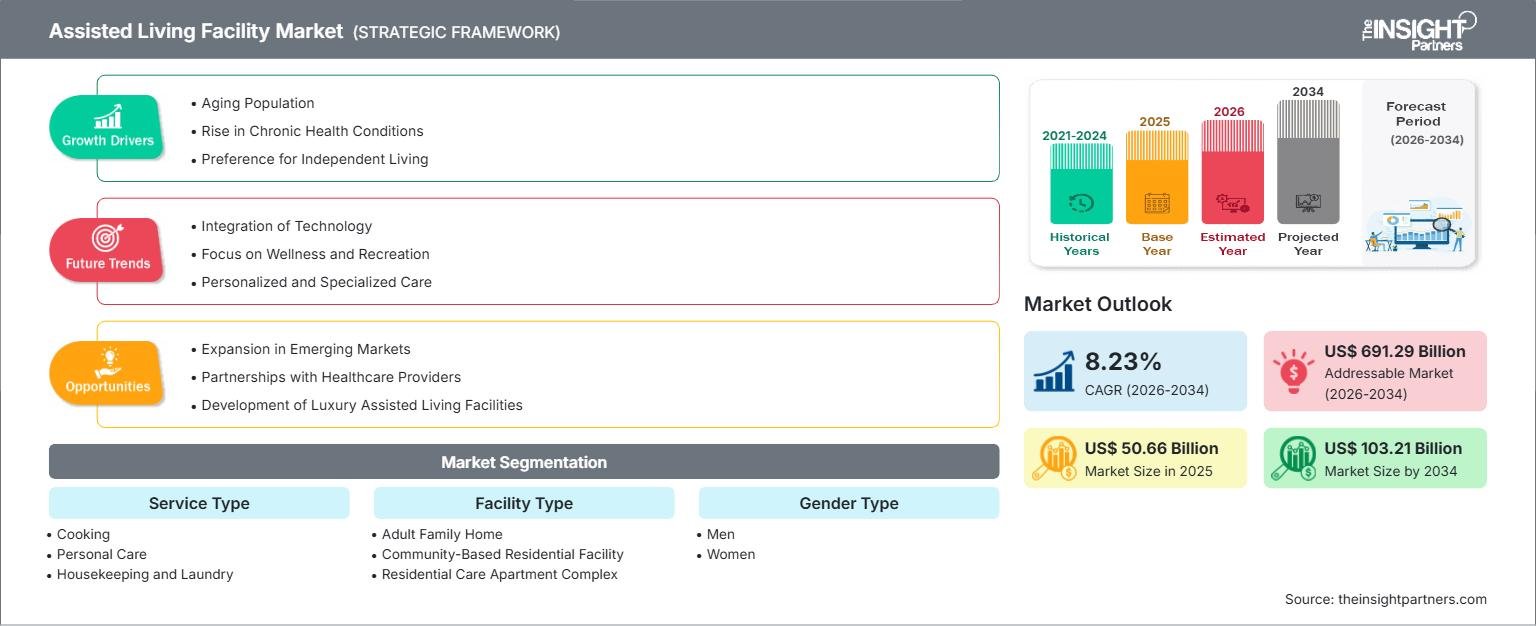
The global Assisted Living Facility Market is undergoing significant expansion as demographic shifts, rising chronic health conditions, and changing preferences among older adults reshape the senior care landscape. According to the latest market analysis, the global assisted living facility market was valued at US$50.66 billion in 2025 and is projected to reach US$103.21 billion by 2034, registering a CAGR of 8.23% from 2026 to 2034.
Assisted living facilities provide residential environments where older adults can maintain a degree of independence while receiving assistance with daily activities and access to care services. The evolving needs of an aging population are encouraging providers to expand service offerings, integrate technology, and develop more personalized living and care models.
Download Sample PDF @ https://www.theinsightpartners.com/sample/TIPRE00039983
Aging Population Creates Sustained Demand for Assisted Living Services
The growth of the elderly population represents one of the key factors supporting the expansion of the Assisted Living Facility Market. As the number of older adults requiring assistance with everyday activities increases, demand for residential environments that combine accommodation, personal support, and healthcare access is also increasing.
Assisted living facilities can provide support with activities such as personal care, medication monitoring, housekeeping, and other daily requirements. This makes these facilities an important option for individuals who require assistance but may not require the level of intensive care associated with some institutional healthcare settings.
The demographic transition is also encouraging healthcare and senior living providers to reconsider how care is delivered. Providers are increasingly focusing on environments that combine safety and support with independence, social interaction, and lifestyle services.
Rise in Chronic Health Conditions Strengthens Market Demand
The increasing prevalence of chronic health conditions among older adults is another important factor influencing the Assisted Living Facility Market. Conditions such as dementia, arthritis, and cardiovascular diseases can increase the need for ongoing assistance, monitoring, and specialized care.
Assisted living providers are responding by expanding services designed around residents’ individual needs. Medication monitoring, personal care, wellness programs, and specialized services can help residents manage daily requirements while remaining within a residential community.
The growing need for specialized support is also creating opportunities for facilities to develop dedicated care programs. Memory care and other personalized services are becoming increasingly important as providers seek to accommodate residents with different levels of care requirements.
Preference for Independent Living Influences Assisted Living Adoption
Changing preferences among older adults are also contributing to market development. Many seniors increasingly seek living arrangements that allow them to retain personal autonomy while having access to assistance when required.
Assisted living facilities can provide a middle ground between complete independent living and more intensive residential care. Residents may receive support with everyday activities while continuing to participate in social, recreational, and wellness programs.
This shift in preferences is encouraging providers to focus not only on healthcare and personal assistance but also on lifestyle experiences. Facilities are increasingly incorporating community activities, wellness services, recreational programs, and amenities designed to support residents’ broader quality of life.
Technology Integration Transforms Assisted Living Facilities
Technology is emerging as an important component of modern assisted living environments. Providers are incorporating smart home devices, health monitoring technologies, and telemedicine capabilities to support residents and improve operational efficiency.
Smart technologies can help facilities monitor residents, support communication, and improve safety. Health monitoring systems can provide caregivers with additional information about residents’ health conditions, while telemedicine can facilitate access to healthcare professionals without requiring residents to travel for every consultation.
The continued adoption of technology is expected to influence Assisted Living Facility Market trends as providers seek solutions that combine resident safety, care coordination, communication, and convenience.
Wellness and Recreation Become Important Service Components
The assisted living model is increasingly extending beyond basic residential and care services. Wellness and recreation programs are becoming important components of facility offerings, reflecting the broader focus on holistic senior care.
Fitness classes, social events, recreational activities, and wellness therapies can help residents maintain active lifestyles and participate in community life. These offerings also enable facilities to differentiate their services as competition increases across the senior living sector.
The emphasis on wellness is expected to remain an important development as assisted living providers seek to create environments that address residents’ physical, social, and lifestyle requirements alongside their care needs.
Personalized and Specialized Care Creates New Opportunities
Personalized care represents another major area of development within the Assisted Living Facility Market. Residents have varying healthcare requirements, levels of independence, and lifestyle preferences, creating demand for services that can be adapted to individual needs.
Specialized care programs, including dementia and memory care, can provide tailored support for residents with specific conditions. The ability to provide customized services can also influence families’ decisions when evaluating assisted living options.
Providers are therefore exploring ways to combine residential services with personalized care plans, healthcare partnerships, technology-enabled monitoring, and lifestyle programs. These developments are contributing to the evolution of assisted living facilities from traditional residential settings toward more integrated senior care environments.
Emerging Markets Present Expansion Opportunities
Expansion into emerging markets represents an important opportunity for assisted living providers. The Insight Partners identifies Asia Pacific and Latin America as regions where demographic changes and increasing demand for senior care can create additional market opportunities.
As healthcare infrastructure develops and awareness of organized senior care services increases, providers may find opportunities to establish new facilities and develop partnerships with healthcare organizations. India, China, Japan, Australia, Brazil, and Argentina are among the countries covered in the market analysis.
The development of senior care infrastructure in emerging economies may also encourage new business models adapted to local demographics, healthcare systems, cultural preferences, and household structures.
Partnerships With Healthcare Providers Strengthen Integrated Care
Collaboration between assisted living facilities and healthcare providers is another area creating opportunities in the market. Partnerships with hospitals, outpatient clinics, and other healthcare organizations can help facilities provide more integrated services to residents.
Such collaborations can support access to medical services, improve coordination between caregivers and healthcare professionals, and help residents receive appropriate care without unnecessary disruption to their daily routines.
As the senior population becomes increasingly complex in terms of healthcare needs, integrated care models may become an increasingly important element of assisted living service development.
Luxury Assisted Living Facilities Open Premium Market Opportunities
The development of luxury assisted living facilities represents another emerging opportunity. Premium facilities can combine assisted living services with high-end amenities, personalized care, and resort-style environments.
This model targets residents seeking a higher level of accommodation and lifestyle services while continuing to receive necessary assistance. The development of premium facilities may create additional market segments for providers capable of combining hospitality, healthcare, wellness, and residential services.
The trend also demonstrates how the assisted living sector is expanding beyond a single standardized model toward facilities designed around different resident preferences and economic segments.
Service Type and Facility Structure Shape Market Development
The Assisted Living Facility Market is segmented by service type, facility type, gender type, and age group. Service types covered in the market analysis include cooking, personal care, housekeeping and laundry, monitoring medication, and others.
By facility type, the market includes adult family homes, community-based residential facilities, and residential care apartment complexes. The gender segmentation covers men and women, while the age group segmentation includes less than 65 years, 65–74 years, 75–84 years, and more than 85 years.
These segments reflect the diversity of assisted living demand and allow stakeholders to evaluate market opportunities according to resident demographics, service requirements, and facility models.
North America and Asia Pacific Remain Important Regional Markets
The market analysis covers North America, Europe, Asia Pacific, South and Central America, and the Middle East and Africa. Countries analyzed include the US, Canada, Mexico, UK, Germany, France, Russia, Italy, China, India, Japan, Australia, Brazil, Argentina, South Africa, Saudi Arabia, and the UAE.
North America represents an important market due to its established senior care infrastructure and demand for assisted living services. Meanwhile, Asia Pacific presents opportunities associated with demographic changes, healthcare infrastructure development, and increasing demand for organized senior care.
The regional landscape provides opportunities for existing operators as well as new entrants seeking to develop assisted living facilities and related services.
Get Full Copy @ https://www.theinsightpartners.com/buy/TIPRE00039983
Competitive Landscape
The competitive landscape includes established senior living and healthcare service providers. Companies profiled in the market analysis include Brookdale Senior Living, Amedisys, LCS, Holiday Retirement, Five Star Senior Living, Sunrise Senior Living, Enlivant, Capital Senior Living, and Benchmark Senior Living.
Companies operating in the sector are increasingly focused on expanding service portfolios, developing specialized care offerings, incorporating technology, and responding to changing expectations among residents and their families.
The competitive environment is expected to continue evolving as providers explore new facility formats, integrated healthcare partnerships, premium services, and technology-enabled care models.
Future Outlook
The global Assisted Living Facility Market is projected to grow from US$50.66 billion in 2025 to US$103.21 billion by 2034, representing a CAGR of 8.23% between 2026 and 2034. The market’s development will be influenced by demographic aging, increasing chronic health conditions, demand for independent living, technology integration, personalized care, wellness services, and expansion into emerging markets.
As senior care requirements continue to evolve, assisted living providers are expected to place greater emphasis on personalized services, technology-enabled monitoring, integrated healthcare partnerships, and lifestyle-oriented environments. These developments are likely to shape the structure and competitive dynamics of the market through the forecast period.
The Insight Partners’ Assisted Living Facility Market report provides comprehensive analysis of market size, growth opportunities, segmentation, regional developments, market drivers, trends, opportunities, and competitive dynamics. The report covers service type, facility type, gender, age group, and geographic markets to provide stakeholders with a detailed view of the industry’s development through 2034.
For detailed market insights, segmentation analysis, regional assessment, and competitive intelligence, access the full Assisted Living Facility Market report from The Insight Partners.
About Us
The Insight Partners, we provide comprehensive analysis and insights into market trends that empower businesses to make informed decisions. Our reports are designed to equip stakeholders with the necessary information to navigate the complexities of various industries, including healthcare, technology, and finance. We are dedicated to delivering high-quality research that enables our clients to achieve their strategic objectives.
Contact Us:
Contact Person: Ankit Mathur
E-mail: ankit.mathur@theinsightpartners.com
Phone: +1-646-491-9876