Autonomous Cranes Market: US$ 48.27 Billion Forecast by 2033
The global Autonomous Cranes Industry is expanding as manufacturers, ports, warehouses, construction companies, mining operators, and industrial facilities accelerate automation to improve productivity, safety, equipment utilization, and material-handling efficiency.
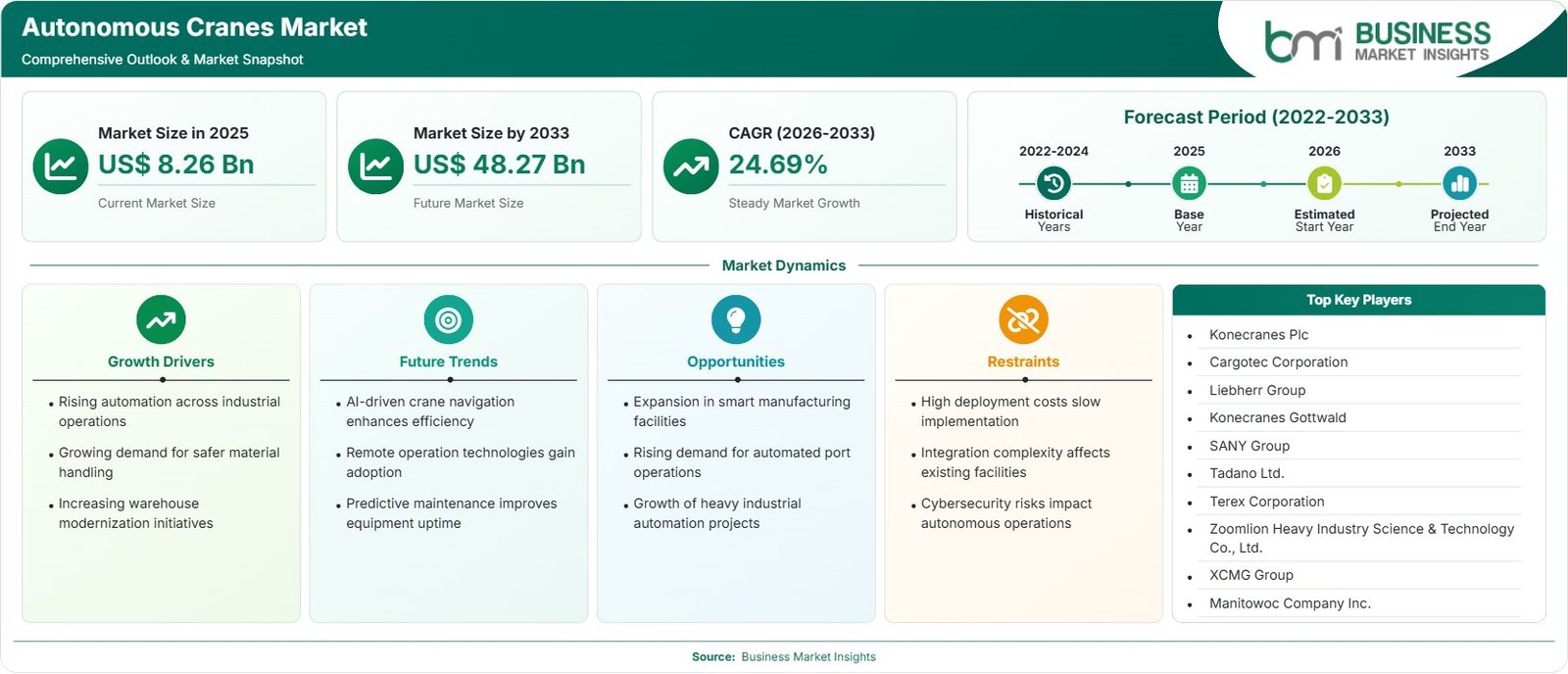
According to Business Market Insights, the Autonomous Cranes Market size was valued at US$ 8.26 billion in 2025 and is projected to reach US$ 48.27 billion by 2033, growing at a CAGR of 24.69% during 2026–2033.
Technological advancement is continuously transforming the Autonomous Cranes Market through AI-based navigation, LiDAR positioning, machine vision, real-time monitoring, predictive maintenance, digital twins, and cloud-based fleet management. These capabilities are enabling cranes to perform lifting and material-handling functions with greater automation while reducing manual intervention and improving operational visibility.
Download Sample Report : https://www.businessmarketinsights.com/sample/BMIPUB00036588
What Are Autonomous Cranes?
Autonomous cranes are intelligent lifting systems that combine crane machinery with sensors, control systems, connectivity, navigation technologies, and software to automate selected lifting and material-handling activities. Depending on the implementation, autonomous systems can support automated movement, positioning, obstacle detection, monitoring, and operational coordination with limited direct operator intervention.
The market covers Static Cranes and Mobile Cranes used across Building & Construction, Marine & Offshore, Mining & Excavation, and other industrial applications. Integration with warehouse automation, robotics, smart manufacturing platforms, and port-management systems is expanding the role of autonomous cranes beyond conventional lifting operations.
Market Drivers
Rising automation across industrial operations: Industrial facilities are increasingly deploying automation technologies to improve productivity, process reliability, and operational efficiency. Autonomous cranes can operate alongside robotics, AI, Industrial IoT, and digital twin systems, helping organizations automate repetitive material-handling activities and improve coordination across connected production environments.
Growing demand for safer material handling: Heavy lifting can expose workers to hazardous operating conditions and repetitive handling activities. Autonomous crane technologies incorporate machine vision, obstacle detection, real-time monitoring, and automated control capabilities that can reduce direct human exposure in selected environments while improving operational oversight and consistency.
Increasing warehouse modernization: E-commerce growth and increasingly automated distribution centers are encouraging warehouse operators to adopt intelligent material-handling systems. Autonomous cranes can work with automated storage and retrieval systems, fleet-management platforms, and real-time inventory technologies to improve warehouse space utilization and support continuous material movement.
Market Opportunities
Expansion of smart manufacturing facilities: Industry 4.0 investments are creating opportunities for autonomous cranes that can communicate with production equipment, industrial software, sensors, and analytics platforms. Real-time monitoring, automated navigation, and cloud-based operational analytics can support more integrated and data-driven manufacturing environments.
Rising demand for automated port operations: Port operators are increasingly modernizing cargo-handling infrastructure to improve logistics productivity and operational efficiency. Autonomous cranes integrated with positioning systems, machine vision, remote monitoring, and fleet-management technologies are creating opportunities across automated container terminals and smart port projects.
Growth of heavy industrial automation projects: Mining, steel, energy, logistics, and heavy engineering companies are investing in intelligent automation to improve material movement and operational safety. Autonomous cranes equipped with sensors, predictive analytics, and remote monitoring can support these modernization programs while increasing equipment visibility and utilization.
Get More Details: https://www.businessmarketinsights.com/buy/BMIPUB00036588
Market Segmentation
By Crane Typel
- Static Crane
- Mobile Crane
The Crane Type segment accounted for 58%–61% of total market share in 2025 and is projected to grow at a CAGR of 24.8%–25.4% during 2026–2033. Mobile Cranes represented the leading share at 58%–61% in 2025 and are forecast to grow at a CAGR of 24.8%–25.3%, supported by operational flexibility, mobility, intelligent navigation, and broad use across construction, mining, logistics, and infrastructure projects.
By End-Use
- Building & Construction
- Marine & Offshore
- Mining & Excavation
- Others
The End-Use segment accounted for 46%–49% market share in 2025 and is projected to grow at a CAGR of 25.1%–25.7% during 2026–2033. Marine & Offshore represented 18%–21% share in 2025 and is anticipated to grow at a CAGR of 26.5%–27.1%, supported by port automation, intelligent cargo handling, offshore infrastructure, and maritime digitalization.
Regional Insights
North America: North America accounted for 34%–37% market share in 2025 and is projected to grow at a CAGR of 23.8%–24.4% through 2033. Industrial automation, warehouse modernization, smart manufacturing, infrastructure investment, and intelligent logistics systems are supporting regional adoption. The United States represented 29%–32% of global revenue in 2025 and is forecast to grow at a CAGR of 24.0%–24.6%.
Europe: Europe held 25%–28% market share in 2025 and is expected to expand at a CAGR of 23.2%–23.8%. Strong industrial engineering capabilities, smart factory adoption, automated port operations, workplace safety requirements, and sustainable industrial technologies are supporting growth. Germany leads regional demand, while the Netherlands records the fastest growth at 24.5%–25.1%.
Asia Pacific: Asia Pacific accounted for 28%–31% market share in 2025 and is projected to register the highest CAGR of 26.2%–26.8% during 2026–2033. Rapid industrialization, expanding manufacturing capacity, smart port investments, infrastructure development, and government-supported digital transformation are accelerating demand. China leads the regional market, while India is projected to expand at a CAGR of 27.1%–27.7%.
Rest of World: Rest of World held 8%–10% market share in 2025 and is projected to grow at a CAGR of 24.1%–24.7% through 2033. Industrial automation, logistics modernization, mining expansion, smart city projects, energy infrastructure, and automated port investments are creating opportunities. Brazil and Saudi Arabia are important growth markets within the region.
Top Players in the Autonomous Cranes Market
- Konecranes Plc
- Cargotec Corporation
- Liebherr Group
- Konecranes Gottwald
- SANY Group
- Tadano Ltd.
- Terex Corporation
- Zoomlion Heavy Industry Science & Technology Co., Ltd.
- XCMG Group
- The Manitowoc Company, Inc.
The competitive landscape is characterized by continuous investment in intelligent automation, AI-enabled control systems, digital monitoring, and autonomous lifting technologies. Leading companies are strengthening software capabilities, developing smart crane portfolios, expanding remote-control and monitoring functions, and forming partnerships with automation and industrial technology providers.
Technological Innovations
AI-based navigation, LiDAR positioning, machine vision, and advanced sensing systems are enabling cranes to recognize operating environments, monitor obstacles, and support more automated movement and positioning. These technologies are particularly relevant to construction sites, warehouses, ports, and industrial facilities where operating conditions can change continuously.
Predictive maintenance, digital twins, cloud-based fleet management, and IIoT connectivity are further improving autonomous crane capabilities. Connected systems can provide information about equipment condition, utilization, and maintenance requirements, helping operators optimize maintenance schedules and reduce unplanned interruptions.
Future Market Outlook
The Autonomous Cranes Market is expected to maintain rapid growth through 2033 as industrial automation, warehouse modernization, smart manufacturing, automated ports, and intelligent material handling continue expanding. The market is projected to increase from US$ 8.26 billion in 2025 to US$ 48.27 billion by 2033 at a CAGR of 24.69%.
Mobile cranes will remain an important market category because of their flexibility across variable operating environments, while marine and offshore applications are expected to create significant opportunities through port automation and intelligent cargo-handling projects. Asia Pacific is expected to remain a major expansion region as manufacturing, infrastructure, and smart port investments continue increasing.
High deployment costs and integration complexity remain important challenges. Autonomous crane implementation can require investment in intelligent hardware, sensors, AI software, connectivity infrastructure, workforce training, and system commissioning. Legacy facilities may also require substantial modifications before autonomous systems can be integrated efficiently.
Industry Snippet: https://www.businessmarketinsights.com/industry-overview/autonomous-cranes-market
Frequently Asked Questions
1. What is the Autonomous Cranes Market size in 2025?
The Autonomous Cranes Market was valued at US$ 8.26 billion in 2025.
2. What is the Autonomous Cranes Market forecast for 2033?
The market is projected to reach US$ 48.27 billion by 2033, growing at a CAGR of 24.69% during 2026–2033.
3. Which region is expected to grow fastest in the Autonomous Cranes Market?
Asia Pacific is projected to be the fastest-growing region, with an estimated CAGR of 26.2%–26.8% during 2026–2033.
4. Which crane type leads the Autonomous Cranes Market?
Mobile Cranes are the leading crane type, accounting for 58%–61% market share in 2025.
5. What factors are driving the Autonomous Cranes Market?
Key factors include rising industrial automation, growing demand for safer material handling, warehouse modernization, smart manufacturing investments, automated port operations, and increasing adoption of AI, machine vision, predictive maintenance, and IIoT technologies.
Browse More Reports:
Less Lethal Ammunition Market Outlook
Military Lighting Market Outlook
Nanosatellite and Microsatellite Market Outlook
About Us
Business Market Insights is a market research platform that provides subscription service for industry and company reports. Our research team has extensive professional expertise in domains such as Electronics & Semiconductor; Aerospace & Defense; Automotive & Transportation; Energy & Power; Healthcare; Manufacturing & Construction; Food & Beverages; Chemicals & Materials; and Technology, Media.
Contact Us
If you have any questions about this report or would like further information, please contact us:
Contact person: Ankit Mathur
Email: sales@businessmarketinsights.com
Phone: +16467917070