Roll-to-Roll Technologies for Flexible Devices Market to Reach US$ 63.92 Billion by 2034
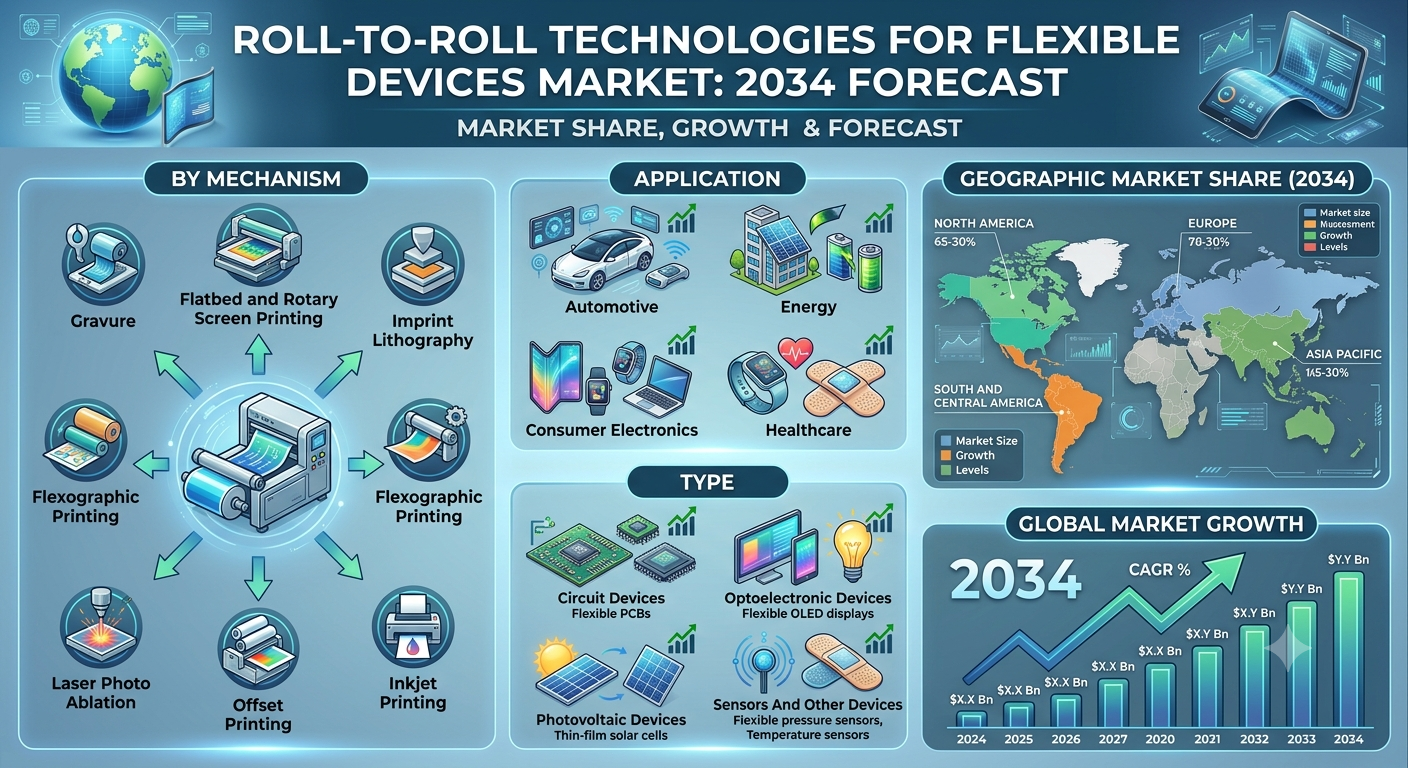
The growing adoption of lightweight, bendable, and multifunctional electronic components is transforming how advanced devices are designed and manufactured. Roll-to-roll (R2R) processing enables continuous production on flexible substrates, supporting applications ranging from circuits and sensors to photovoltaic and optoelectronic devices. The technology can improve production efficiency, reduce processing time, and support scalable manufacturing for next-generation flexible electronics.
The Roll-to-Roll Technologies for Flexible Devices Market Size was valued at US$ 46.18 billion in 2025 and is projected to reach US$ 63.92 billion by 2034, registering a CAGR of 4.15% from 2026 to 2034. The total addressable opportunity is estimated at approximately US$ 512.13 billion during 2026–2034. The industry is being supported by advances in innovative materials, improved production techniques, and increasing demand for wearable technology.
Get a Sample PDF: https://www.theinsightpartners.com/sample/TIPRE00004028
Innovative Materials Boost Flexible Device Performance
One of the key drivers for the Roll-to-Roll Technologies for Flexible Devices Market is the development of innovative materials that improve the performance, flexibility, durability, and functionality of electronic devices. Flexible substrates, conductive materials, advanced inks, thin films, and other functional materials allow manufacturers to develop devices that are lighter and more adaptable than conventional rigid electronics.
R2R manufacturing is particularly valuable because these materials can be processed continuously over long substrate rolls. This capability supports high-volume manufacturing while maintaining consistent processing conditions. As flexible circuits, sensors, optoelectronic components, and photovoltaic devices become more sophisticated, manufacturers are increasingly focusing on materials and processing technologies that can support scalable production.
Enhanced Production Techniques Reduce Cost and Time
Manufacturing efficiency represents another important growth driver. Traditional electronics production can involve multiple discrete processing steps, which may increase manufacturing time, material handling requirements, and production costs. R2R technology enables continuous processing through techniques such as gravure printing, screen printing, flexographic printing, imprint lithography, laser photo ablation, offset printing, and inkjet printing.
Continuous production can help manufacturers optimize throughput and reduce unnecessary handling of flexible substrates. Improvements in automation, process control, printing accuracy, and material utilization are further strengthening the commercial potential of R2R manufacturing. These benefits are particularly relevant as manufacturers seek scalable approaches for producing flexible electronics at higher volumes.
Rising Demand for Wearable Technology
The increasing adoption of wearable devices is creating new opportunities for flexible electronics manufacturing. Wearable technologies require components that can conform to curved surfaces, tolerate movement, and remain lightweight. R2R processes can support the production of flexible circuits, sensors, conductive patterns, and other components needed for wearable applications.
The technology also has potential in smart textiles, where electronic functionality can be integrated into fabrics and flexible materials. The Insight Partners identifies smart textiles as an emerging opportunity for R2R technologies, alongside sustainable electronics production and cost-effective flexible display manufacturing.
Expanding Applications Across Key Industries
The technology is being applied across automotive, energy, consumer electronics, and healthcare sectors. In automotive applications, flexible electronic components can support advanced displays, sensors, lighting, and other electronic systems. In energy applications, R2R processing can contribute to flexible photovoltaic devices and other thin-film technologies.
Consumer electronics remains an important application area because manufacturers continue to explore lightweight displays, flexible circuits, sensors, and other compact components. Healthcare applications also offer opportunities for flexible sensors and electronic devices designed for monitoring and diagnostic purposes. The Insight Partners segments the industry by circuit devices, optoelectronic devices, photovoltaic devices, and sensors and other devices.
Key Players
Prominent companies profiled in the Roll-to-Roll Technologies for Flexible Devices Market include Ascent Solar Technologies, Inc.; E Ink Holdings Inc.; Emfit Ltd.; Flexium Interconnect Inc.; Fujikura Ltd.; GSI Technology, Inc.; Johnson Electric Holdings Limited; Materion Corporation; NIPPON MEKTRON, LTD; and Sumitomo Electric Industries, Ltd.
Competition is influenced by technological development, manufacturing capabilities, product innovation, and the ability to provide scalable solutions for emerging flexible-device applications. Industry participants are also focusing on improving processing efficiency and developing solutions compatible with increasingly advanced flexible materials.
Segmentation and Regional Analysis
The report analyzes the industry according to mechanism, application, type, and geography. Mechanism segments include gravure, flatbed and rotary screen printing, imprint lithography, flexographic printing, laser photo ablation, offset printing, and inkjet printing. Applications include automotive, energy, consumer electronics, and healthcare.
Geographically, the analysis covers North America, Europe, Asia Pacific, South and Central America, and the Middle East and Africa. The US is identified as a key country-level market, supported by innovative materials, improved production techniques, and growing demand for wearable technology.
Get the Premium Research Report @ https://www.theinsightpartners.com/buy/TIPRE00004028
Future Outlook
The future of R2R manufacturing is closely connected with the broader development of flexible and printed electronics. Continued advances in materials, automation, printing processes, and sustainable manufacturing are expected to create new applications. Smart textiles, flexible displays, wearable electronics, healthcare sensors, photovoltaic devices, and automotive electronics could provide additional opportunities through 2034.
Related Reading / Reports
Home Energy Management System Market Regional Share, Trend, and Growth Opportunity
Vision Transformers Market Regional Share, Trend, and Growth Opportunity
Differential-Pressure Mass Flow Controller Market Regional Share, Trend, and Growth Opportunity
About The Insight Partners
The Insight Partners is a leading market research and consulting firm delivering actionable insights through in-depth industry analysis and strategic intelligence. The firm supports clients across various industries in making informed business decisions by providing comprehensive market forecasts, competitive assessments, and growth opportunities.
Contact Us:
If you have any queries about this report or if you would like further information, please contact us:
Contact Person: Ankit Mathur
E-mail: sales@theinsightpartners.com
Phone: +1-646-491-9876
Also Available in :
Korean | German | Japanese | French | Chinese | Italian | Spanish