OLED Display Market (2025 – 2033)
OLED Display Market Summary
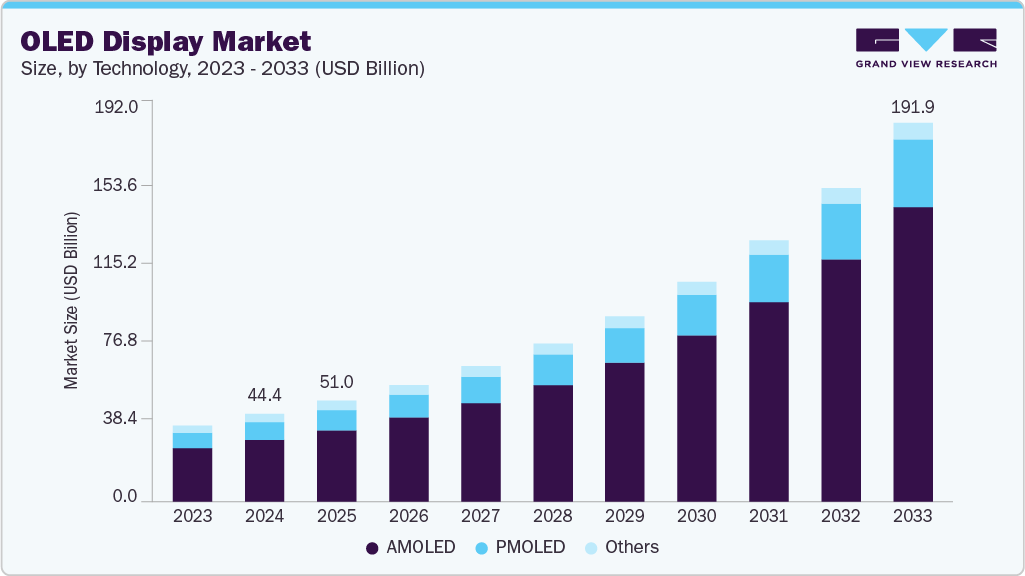
The global OLED display market size was estimated at USD 44.39 billion in 2024 and is projected to reach USD 191.86 billion by 2033, growing at a CAGR of 18.0% from 2025 to 2033. Increasing investment and demand for consumer electronics such as mobile phones and cameras that use this technology are expected to favorably impact the industry.
Key Market Trends & Insights
- Asia Pacific dominated the global OLED Display market with the largest revenue share of 34.59% in 2024.
- The U.S. OLED display industry is expected to grow significantly in 2024, driven by the significant expansion of major players in this region.
- By technology, the AMOLED segment led the market with the largest revenue share of 70.74% in 2024.
- By application, the smartphones and tablets segment held the dominant market position with the leading revenue share of 24.3% in 2024.
- By display size, the 6 to 20 Inches segment is expected to grow at the fastest CAGR of 19.2% from 2025 to 2033.
Market Size & Forecast
- 2024 Market Size: USD 44.39 Billion
- 2033 Projected Market Size: USD 191.86 Billion
- CAGR (2025-2033): 18.0%
- Asia Pacific: Largest market in 2024
Although OLEDs offer superior performance, declining LCD prices are expected to restrain market growth. The life span of LCDs is also longer; as a result, they are preferred in consumer durables. Due to the lower cost of raw materials and labor in the Asia Pacific, manufacturing activities were mainly concentrated in the region. Developing cost-effective manufacturing techniques is imperative for overcoming business challenges and reducing overall prices.
OLED technologies include Active Matrix OLED and Passive Matrix OLED. While PMOLEDs were used initially for MP3 players, AMOLED is the preferred technology being used presently for mobile phones and other displays. They are also used in portable gaming machines and have no size or resolution constraints. The average selling prices of OLEDs are inversely proportional to volume; therefore, cost decreases with increasing manufacturing. OLEDs consume less power and are used in a variety of electronics as well as in signage. Mobile phones were the biggest end use segment of OLEDs. Usage in television sets is also gaining traction since technological advances have aided in the development of large-sized displays. OLEDs are used for numerous purposes in high-end automobiles in components including rear-view mirrors, back-window alerts, and dashboard displays.
Furthermore, significant initiatives by key players are augmenting the growth of the OLED display industry. For instance, in June 2025, LG Display announced an investment plan of USD 925 million to develop advanced OLED technologies over the next two years, until June 30, 2027. This significant funding aims to enhance OLED production capabilities, focusing on small and medium-sized displays such as those for smartphones and IT devices, along with improving WOLED technology for TV panels. The investment will support R&D efforts to increase the production of higher-end OLED panels and integrate new foundational technologies. This move underlines LG Display’s commitment to leading innovation and expanding the application of OLED technology across various devices.
To learn more about this report, https://www.grandviewresearch.com/industry-analysis/oled-display-industry/request/rs2