Mobile Games Market Accelerates into a New Era of Digital Entertainment
The global mobile games market is undergoing a powerful transformation, emerging as the dominant force within the broader gaming industry. Driven by rapid smartphone adoption, evolving monetization models, and the rise of competitive gaming ecosystems, mobile gaming has shifted from casual entertainment to a central pillar of digital media consumption. As technology continues to advance and user expectations grow, the market is poised for sustained expansion in the years ahead.
Market Size and Growth Trajectory
The scale of the mobile gaming market highlights its growing importance. Industry estimates indicate that the market reached approximately USD 139 billion in 2024 and is projected to surpass USD 256 billion by 2030, growing at a compound annual growth rate (CAGR) of over 10%.
This growth is further reinforced by long-term forecasts suggesting the market could approach nearly USD 289 billion by 2034, underlining strong investor confidence and expanding global demand.
Mobile gaming now accounts for a substantial share of total gaming revenue worldwide, fueled by its accessibility and ability to reach a diverse, global audience. Unlike traditional gaming platforms, mobile devices serve as an entry point for millions of new users, particularly in emerging economies.
Looking for more specific insights? Customize this report to suite your business needs
Smartphone Penetration as a Core Driver
One of the most significant factors behind the expansion of the mobile games market is the widespread availability of affordable smartphones. As devices become more powerful and internet connectivity improves, users are able to access increasingly sophisticated gaming experiences on handheld devices.
In many regions, particularly across Asia-Pacific, Latin America, and Africa, mobile phones represent the primary gaming platform. This accessibility has dramatically expanded the player base, enabling individuals who may not own consoles or gaming PCs to participate in the gaming ecosystem.
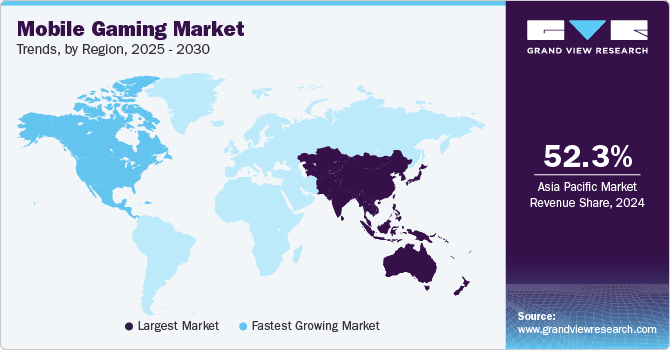
Asia-Pacific continues to dominate the market, accounting for nearly half of global revenue, driven by large populations, strong digital infrastructure, and a culture that embraces mobile-first experiences.
Monetization Models Reshaping Revenue Streams
The mobile gaming economy is built on innovative monetization strategies that differ significantly from traditional game sales. In-app purchases remain the leading revenue generator, accounting for more than half of market share in recent years.
Free-to-play models, supported by microtransactions and advertising, have proven highly effective in attracting and retaining users. Players can download games at no cost and choose to spend on virtual items, upgrades, or premium features. This model has enabled developers to reach a wider audience while generating recurring revenue streams.
Subscription-based services and season passes are also gaining traction, offering players exclusive content and ongoing engagement. These hybrid monetization approaches are helping companies diversify income sources and reduce reliance on one-time purchases.
Rise of Mobile Esports and Social Gaming
Mobile gaming is no longer limited to casual play. The rise of esports has elevated mobile titles into competitive arenas, with professional tournaments, live streaming, and large-scale audiences becoming increasingly common.
Popular multiplayer games have created communities that extend beyond gameplay, fostering social interaction and long-term engagement. Features such as real-time chat, team-based competitions, and global leaderboards have transformed mobile gaming into a shared experience.
In addition, social gaming elements—such as cooperative missions, in-game events, and player-driven content—are contributing to higher retention rates and deeper user involvement.
Technological Advancements Driving Innovation
Technology continues to play a central role in shaping the mobile games market. The integration of artificial intelligence, cloud gaming, and augmented reality is opening new possibilities for developers and players alike.
Cloud gaming, in particular, is expanding access by allowing users to stream high-quality games without requiring advanced hardware. Meanwhile, the rollout of 5G networks is enhancing gameplay experiences through faster speeds and reduced latency.
Emerging technologies such as augmented reality (AR) and virtual reality (VR) are also gaining traction, offering immersive gameplay that blends digital and physical environments. These innovations are expected to drive the next wave of growth in the mobile gaming sector.
Competitive Landscape and Key Players
The mobile gaming market is highly competitive, with both established companies and new entrants vying for market share. Major industry players continue to invest heavily in game development, acquisitions, and global expansion strategies.
Leading publishers are focusing on creating high-quality, engaging content while leveraging data analytics to understand player behavior and preferences. At the same time, independent developers are finding opportunities in niche genres and innovative gameplay concepts.
Strategic partnerships, cross-platform integration, and intellectual property (IP) collaborations are becoming increasingly common, enabling companies to broaden their reach and enhance user engagement.
Challenges Facing the Industry
Despite its rapid growth, the mobile gaming market faces several challenges. Development costs are rising as players demand more sophisticated graphics, storytelling, and gameplay mechanics.
Market saturation is another concern, with thousands of new games launched each year. Standing out in crowded app stores requires significant investment in marketing and user acquisition.
Regulatory issues, particularly around data privacy and monetization practices, are also gaining attention. Governments and industry bodies are increasingly scrutinizing in-app purchases and advertising models to ensure transparency and consumer protection.
Additionally, player retention remains a critical challenge. While downloads may be high, maintaining long-term engagement requires continuous updates, fresh content, and meaningful player experiences.
Regional Opportunities and Emerging Markets
Emerging markets present significant growth opportunities for the mobile gaming industry. Regions such as Latin America, Africa, and Southeast Asia are experiencing rapid increases in internet penetration and smartphone adoption.
Localized content, culturally relevant themes, and region-specific strategies are becoming essential for success in these markets. Developers who can tailor their offerings to local preferences are likely to gain a competitive advantage.
At the same time, mature markets in North America and Europe continue to generate high revenue through premium content and strong consumer spending.
The Future of Mobile Gaming
Looking ahead, the mobile games market is expected to remain a driving force within the global entertainment industry. Continued advancements in technology, combined with evolving consumer preferences, will shape the next phase of growth.
The convergence of gaming, social media, and digital entertainment is creating new opportunities for innovation. As mobile devices become more powerful and interconnected, the line between gaming and other forms of media will continue to blur.
Ultimately, the success of the mobile gaming market will depend on its ability to balance innovation with sustainability. Companies that can deliver engaging, high-quality experiences while addressing challenges such as monetization ethics and user retention will be best positioned to thrive.
With billions of users worldwide and a rapidly expanding ecosystem, mobile gaming is no longer just a segment of the gaming industry—it is its center of gravity, redefining how people play, connect, and experience digital entertainment.
Looking for a report customized to your requirements? Explore our Custom Research Offering
Grand View Research offers
√ Focused market intelligence reports on specific geographies or high-growth segments.
√ Extended forecast timelines for long-term planning.
√ Competitor Benchmarking and Supply Chain Analysis
√ Inclusion of regulatory and policy assessments.
√ Inclusion of custom data models, KPIs, or applications unique to your business
√ Specific high-impact Data Decks and Tables to support effective decision making
And much more…