Solid State Transformers Market growing at a CAGR of 32.0% from 2025 to 2030
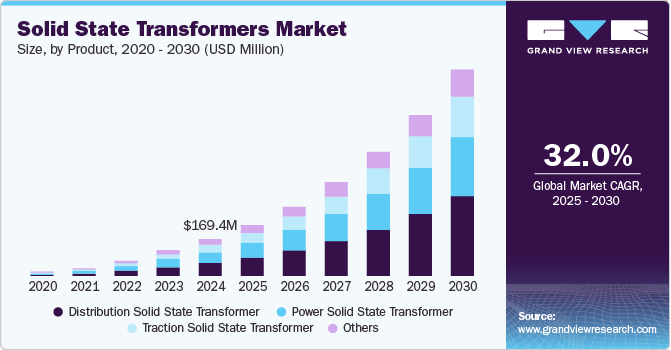
The global solid state transformers market size was valued at USD 169.4 million in 2024 and is projected to reach USD 935.8 million by 2030, growing at a CAGR of 32.0% from 2025 to 2030. Continued efforts to modernize the aging power distribution infrastructure and increasing adoption of electric vehicles (EVs) are key growth drivers.
Key Market Trends & Insights
- Asia Pacific accounted for a leading revenue share of 36.6% in the global market in 2024.
- By product, the distribution solid state transformers (D-SSTs) accounted for the largest revenue share of 37.0%.
- By application, the renewable power generation segment accounted for a leading revenue share in the global market in 2024.
Market Size & Forecast
- 2024 Market Size: USD 169.4 Million
- 2030 Projected Market Size: USD 935.8 Million
- CAGR (2025-2030): 32.0%
- Asia Pacific: Largest market in 2024
Request Free Sample Report: https://www.grandviewresearch.com/industry-analysis/solid-state-smart-transformer-market/request/rs1
Moreover, with constant developments in smart grid infrastructure, there is an urgent need to coordinate different stress levels brought about by deploying multiple energy sources in this system, which can be challenging for conventional transformers.
SSTs help address these concerns, controlling and improving electricity quality through compensation of reactive power and reduction in voltage drops. Developed nations such as the U.S., Australia, Canada, Japan, and economies in Western Europe have announced ambitious plans concerning smart grids, increasing companies’ focus on developing innovative and efficient components such as solid state transformers.
The growing demand for electric vehicles globally and the need to establish an optimized charging infrastructure is a primary factor driving industry expansion. Governments globally are undertaking several important steps to ensure a constant increase in the density of charging stations. For instance, the National Electric Vehicle Infrastructure (NEVI) Formula Program and the National EV Charging Initiative are major programs launched in the U.S. to enable expansion and innovations in this ecosystem. In January 2024, the U.S. Government announced USD 623 million in grants to enhance the EV charging network across the country. The move is part of the government’s objective of developing a comprehensive national network of EV charging solutions, including a minimum of 500,000 public chargers by 2030. As a result, competitors are launching application-specific solutions and partnering with various automakers and automotive associations to drive growth. For instance, in October 2022, Delta Americas, a subsidiary of Delta Electronics, demonstrated a cutting-edge SiC MOSFET SST-based 400kW extremely fast EV charging solution to General Motors, NextEnergy, the American Center for Mobility, DTE Energy, and Virginia Tech’s Center for Power Electronics Systems (CPES), all of which are the company’s U.S. Department of Energy grant program partners.
Product Insights
Distribution solid state transformers (D-SSTs) accounted for the largest revenue share of 37.0% in the global market in 2024. The demand for these products is growing steadily due to several factors enabling the evolution of electrical distribution systems. For instance, the shift toward renewable energy sources such as solar and wind requires efficient and flexible power conversion solutions, with distribution SSTs facilitating the integration of such intermittent resources into the grid. Furthermore, the transition to smart grids is driving the need for advanced technologies that enhance monitoring, control, and automation in power distribution, aiding segment growth. The existing power infrastructure requires constant upgrades due to the growing urbanization and population. The compact design of these transformers makes them ideal for urban environments where space is limited. Additionally, the rising popularity and adoption of electric vehicles (EVs) have highlighted the need for a robust charging infrastructure wherein D-SSTs can efficiently manage the required power distribution at charging stations.
The traction solid state transformers segment is expected to advance at a substantial CAGR from 2025 to 2030. The increasing pace of modernization and electrification of railway infrastructure presents a major avenue for growth for these types of transformers. The development of high-speed rail systems and urban transit systems such as electric buses and trams has driven the need for efficient conversion and distribution of power and energy usage. Traction SSTs are advanced power conversion devices specifically designed for railway and transportation applications. They combine the functionalities of conventional transformers with modern power electronics to enhance efficiency, reliability, and flexibility in electrified rail systems.
Application Insights
The renewable power generation segment accounted for a leading revenue share in the global market in 2024. Increasing clean energy requirements globally and government initiatives to establish large-scale wind and solar projects have necessitated the utilization of solid state transformers to ensure efficiency and reliability in power generation. SSTs minimize energy losses during conversion, making them more efficient than traditional transformers in maximizing the output from renewable sources. It can conveniently adjust output voltage levels, accommodating the varying voltages produced by renewable energy sources like solar panels and wind turbines.
The automotive segment is anticipated to grow at a significant CAGR from 2025 to 2030. The industry is witnessing significant advancements and innovations due to the increasing adoption of EVs and the emergence of technologies such as Vehicle-to-Grid (V2G). Solid state transformers offer significant efficiency, integration, and functionality advantages, making them a key component in modern and upcoming automotive power systems. They provide efficient power conversion solutions to manage high voltage and current levels essential for EV propulsion systems. They can also improve the efficiency of the battery charging and discharging processes, making them ideal for integrating with advanced battery management systems in these vehicles.
Solid State Transformers Market Report Scope
|
Report Attribute |
Details |
|
Market size value in 2025 |
USD 233.8 million |
|
Revenue forecast in 2030 |
USD 935.8 million |
|
Growth Rate |
CAGR of 32.0% from 2025 to 2030 |
|
Base year for estimation |
2024 |
|
Historical data |
2018 – 2023 |
|
Forecast period |
2025 – 2030 |
|
Quantitative units |
Revenue in USD million and CAGR from 2025 to 2030 |
|
Report coverage |
Revenue forecast, company ranking, competitive landscape, growth factors, and trends |
|
Segments covered |
Product, application, region |
|
Regional scope |
North America, Europe, Asia Pacific, Latin America, MEA |
|
Country scope |
U.S., Canada, Mexico, Germany, U.K., France, China, Japan, India, South Korea, Australia, Brazil, UAE, Saudi Arabia, South Africa |
|
Key companies profiled |
Semiconductor Components Industries, LLC; ABB; Infineon Technologies AG; Siemens; ROHM Co., Ltd.; STMicroelectronics; Renesas Electronics Corporation; Alstom SA; Toshiba Corporation; Mitsubishi Electric Corporation |
|
Customization scope |
Free report customization (equivalent up to 8 analysts working days) with purchase. Addition or alteration to country, regional & segment scope. |
|
Pricing and purchase options |
Avail customized purchase options to meet your exact research needs. Explore purchase options |