Software Defined Networking Market growing at a CAGR of 17.9% from 2024 to 2030
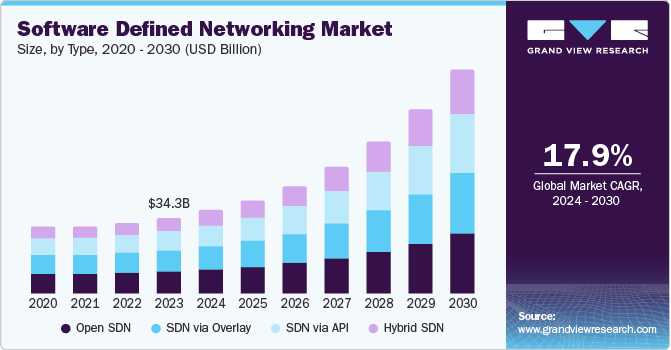
The global Software Defined Networking market size was estimated at USD 34.29 billion in 2023 and is projected to reach USD 101.33 billion by 2030, growing at a CAGR of 17.9% from 2024 to 2030. Increasing demand for simplified network management solutions, SMEs’ focus on cost reductions and process automation, and changing business demands in the information and technology industry are some of the key growth-driving factors for this market.
Key Market Trends & Insights
- North America software defined networking market dominated the global industry and accounted for the revenue share of 36.0% in 2023.
- The U.S. dominated the regional SDN market in 2023.
- By component, the solutions segment dominated the SDN market and accounted for a revenue share of 70.3% in 2023.
- By type, The open SDN segment held the largest revenue share of the global industry in 2023.
- By end-use, telecommunication services providers dominated the global industry for software-defined networking in 2023.
Market Size & Forecast
- 2023 Market Size: USD 34.29 Billion
- 2030 Projected Market Size: USD 101.33 Billion
- CAGR (2024-2030): 17.9%
- North America: Largest market in 2023
- Asia Pacific: Fastest growing market
Request Free Sample Report: https://www.grandviewresearch.com/industry-analysis/software-defined-networking-sdn-market-analysis/request/rs1
Over the last decade, multiple businesses linked to the information and technology sector and advanced computing technology have experienced enormous transitions. The emergence of complex network infrastructures has become common in numerous industries that rely highly on automation and computing technology for routine business operations. Enhanced centralized network control and simplified network management have attained significance in sectors. To improve network efficiency, control traffic, and achieve improved agility, flexibility, cost-efficiency, and visibility, various businesses in different industries are seeking suitable software-defined networking solutions and services.
A large number of companies from a variety of industries emphasize establishing a notable digital footprint to support their business strategies related to growth and customer engagement. The need for effective control and communication between networks, software, and underlying hardware infrastructure has increased. The rapid digital transformation of businesses and simultaneous growth in cyber-attacks and potential cyber threats have also contributed to the development of this market in recent years.
The emerging and growing adoption of advanced technologies such as artificial intelligence, the Internet of Things, machine learning, and system automation, coupled with the increasing penetration and availability of 5G network services, is expected to generate an upsurge in demand for the software-defined networking market during the forecast period. Telecommunication industry participants are investing large amounts in enhancing the further deployments of effective networking solutions to develop and secure a strong network infrastructure.
For instance, in July 2024, Chunghwa Telecom Co., Ltd., one of the prominent companies operating in the telecom industry, and EXATEL Telecom, a key organization in the telecom and technology market, jointly announced the accomplishment of 5G network and software defined networking (SDN) solution validation. The newly formed solution integrates EXATEL’s SDN system expertise with Chunghwa’s network solutions and combines this with Askey’s 5G deployment and Taiwan’s network equipment. This marked the first-ever deployment of SDN solutions by EXATEL in Asia.
Component Insights
The solutions segment dominated the SDN market and accounted for a revenue share of 70.3% in 2023. Unlike generalized services, SDN solutions provide customized and targeted approaches for particular business requirements. Companies are focusing on improving network performances and reliability to align business functions with modern consumer demands and industry dynamics. SDN solutions provided by prominent market participants enable businesses to ensure enhanced network security, ease of network control, smooth cloud integrations, accommodation of growing demand in traffic volumes, and distributed application control. Organizations with the necessary funds have preferred adopting customized SDN solutions for complete control and efficient network management.
The services segment is expected to experience the fastest CAGR during the forecast period. Growth of this segment is primarily driven by factors such as the growing adoption of SDN technology, the increasing significance of centralized control over resources and networks, the rising need for management and direction of traffic volume, and growing network threats encouraging businesses and organizations to adopt enhanced security measures. The SDN services include consulting, training & maintenance, integration & deployment, and managed services.
Type Insights
The open SDN segment held the largest revenue share of the global industry in 2023. User enterprises prefer the openness of protocols, development processes, and standards as it allows software use, redistribution, and modification while eliminating limitations related to other proprietary solutions. The flexibility offered by open SDN solutions, a collaborative approach enabling contributions by co-developers, versatility, innovation, and cost effectivity are expected to drive demand for open SDN solutions during the forecast period. Open SDNs ensure quick identification of potential and existing security threats while allowing rapid response and address by many contributors.
The hybrid SDN segment will experience the fastest CAGR from 2024 to 2030. Growing demand for hybrid SDN is attributed to the capacity to ensure seamless integration of existing legacy systems without an entire overhaul of the technology, assistance in maintaining operational continuity, flexibility, compatibility with scaled network resources, cost efficiency, and ability to support advanced technologies such as IoT, cloud computing, and others. The hybrid SDN is increasingly preferred by businesses that choose to continue using legacy systems owing to dependency on critical business functions, extraordinary risks related to data migration activities, and extremely higher costs of replacement of systems and integrations that follow.
Software Defined Networking Market Report Scope
|
Report Attribute |
Details |
|
Market size value in 2024 |
USD 37.66 billion |
|
Revenue forecast in 2030 |
USD 101.33 billion |
|
Growth rate |
CAGR of 17.9% from 2024 to 2030 |
|
Base year for estimation |
2023 |
|
Historical data |
2018 – 2022 |
|
Forecast period |
2024 – 2030 |
|
Quantitative units |
Revenue in USD billion and CAGR from 2024 to 2030 |
|
Report coverage |
Revenue forecast, company ranking, competitive landscape, growth factors, and trends |
|
Segments covered |
Component, type, end-use, region |
|
Regional scope |
North America; Europe; Asia Pacific; Latin America; MEA |
|
Country scope |
U.S.; Canada; Mexico; Germany; UK; France; China; Japan; India; South Korea; Australia; Brazil; Saudi Arabia; UAE; South Africa |
|
Key companies profiled |
Arista Networks, Inc.; Cisco Systems, Inc.; Ciena Corporation; Dell Inc.; LM Ericsson; Extreme Networks; Fortinet, Inc.; Hewlett Packard Enterprise Development LP; Huawei Technologies Co., Ltd.; IBM; Juniper Networks, Inc.; Nokia; Palo Alto Networks; Broadcom |
|
Customization scope |
Free report customization (equivalent up to 8 analysts working days) with purchase. Addition or alteration to country, regional & segment scope. |
|
Pricing and purchase options |
Avail customized purchase options to meet your exact research needs. Explore purchase options |