Agriculture Equipment Market growing at a CAGR of 6.7% from 2025 to 2033
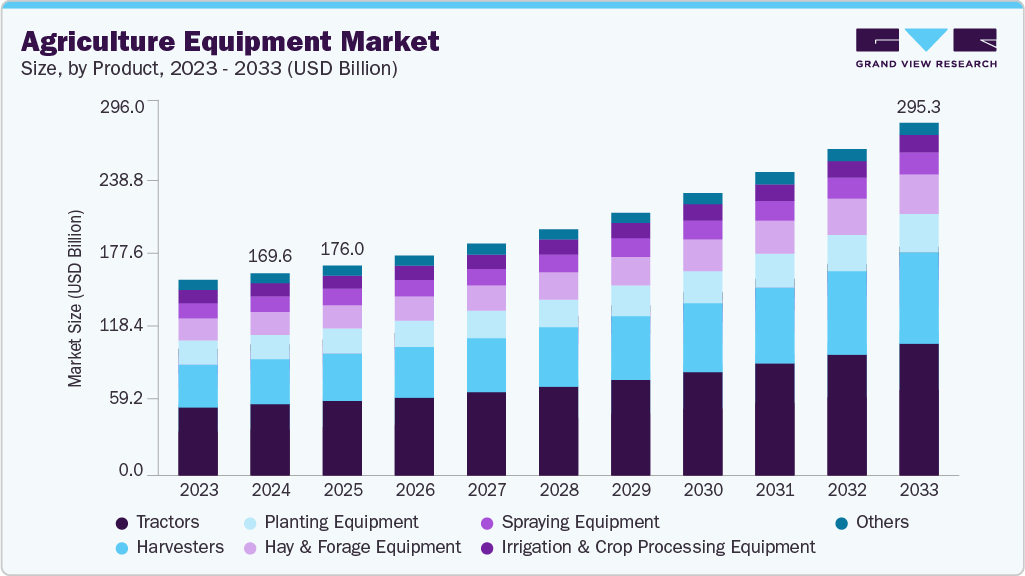
The global agriculture equipment market size was estimated at USD 169.55 billion in 2024 and is projected to reach USD 295.28 billion by 2033, growing at a CAGR of 6.7% from 2025 to 2033. Increasing mechanization in the agriculture sector, coupled with a surge in farmers’ income, is expected to be a primary factor driving the market growth.
Key Market Trends & Insights
- Asia Pacific held a 37.7% revenue share of the global agriculture equipment market.
- In China, the trend toward farm consolidation and the emergence of large agribusinesses is accelerating the demand for the agriculture equipment market.
- By product, the tractors segment held the largest revenue share of 34.9% in 2024.
- By application, the land development & seed bed preparation segment held the largest revenue share in 2024.
Market Size & Forecast
- 2024 Market Size: USD 169.55 Billion
- 2033 Projected Market Size: USD 295.28 Billion
- CAGR (2025-2033): 6.7%
- Asia Pacific: Largest market in 2024
Request Free Sample Report: https://www.grandviewresearch.com/industry-analysis/agriculture-equipment-market/request/rs1
The rise of sustainable agriculture, which is pushing manufacturers to develop eco-friendly and energy-efficient equipment, is accelerating market growth. In response to tightening emissions regulations and climate goals set by international bodies and national governments, there is an increasing push for electric tractors, biofuel-compatible engines, and hybrid farm equipment. These machines not only reduce greenhouse gas emissions but also offer lower operating costs in the long run. European countries are actively promoting low-carbon farming technologies, which has created demand for new products of agricultural machinery designed for minimal environmental impact. The integration of sustainability with profitability is creating a fresh wave of innovation within the industry.
The growth of custom hiring centers and machinery rental services is also expanding access to agriculture equipment, especially in developing markets, where purchasing large machines outright may be financially burdensome. These services allow small-scale farmers to rent modern machinery on a need-based basis, significantly lowering the barriers to mechanization. Governments, cooperatives, and private firms are increasingly investing in shared equipment hubs or pay-per-use platforms, fostering a more inclusive agricultural ecosystem. This trend is not only enabling higher productivity among resource-constrained farmers but also fueling demand for durable, multi-purpose machinery suitable for frequent rental usage.
The rise of contract farming and corporate agriculture is also contributing to the demand for specialized agricultural equipment markets. As multinational agribusiness firms enter into agreements with local farmers to produce specific crops at agreed-upon standards, there is a growing expectation for mechanized consistency and quality. These contracts often include recommendations or even requirements for the use of particular equipments to ensure uniform crop quality, timely delivery, and reduced spoilage. In response, farmers involved in these arrangements are turning to precision seeders, specialized sprayers, and post-harvest machinery that align with the quality and quantity targets set by the contracting companies. This structured form of agriculture is thus promoting a more consistent and predictable demand for equipment tailored to contract-based farming.
In regions with fragmented landholding patterns, especially in South Asia and sub-Saharan Africa, the development of multipurpose and modular agricultural equipment is gaining momentum. These machines are designed to perform multiple functions, such as tilling, sowing, and spraying, within a compact, adaptable format, which makes them ideal for small and irregularly shaped plots. Farmers benefit from cost savings, as one machine can fulfill several roles across the cultivation cycle. Moreover, these modular designs make it easier to perform maintenance or upgrade certain components as technology evolves. This trend addresses a crucial structural challenge in global agriculture: making modern equipment viable and practical for farmers who do not operate on a large scale.
Product Insights
The tractors segment dominated the market with a revenue share of 34.9% in 2024. The emergence of equipment leasing services and tractor-on-demand platforms is reducing entry barriers for farmers who cannot afford outright purchases. These platforms, often supported by agri-tech startups and cooperatives, allow farmers to rent tractors for specific tasks or seasons. This growing model of shared equipment access is further driving the demand for durable and easy-to-maintain tractors, creating a recurring revenue stream for manufacturers and service providers. As this ecosystem of support services grows around the tractor segment, it enhances the long-term sustainability and accessibility of tractor use, ensuring continued growth in both mature and developing markets.
The harvesters segment is projected to be the fastest-growing segment from 2025 to 2033. The increasing prominence of contract farming and agri-business models is creating institutional demand for harvesters. Large food processing companies, commodity traders, and agri-cooperatives often work directly with farmers to ensure supply chain efficiency and quality control. These entities frequently supply or lease harvesters to partner farmers as part of an integrated value chain approach. This practice ensures crops are harvested at peak maturity with minimal damage, enabling a seamless transition to processing or storage. The integration of harvesters into contract farming models is particularly impactful in emerging economies where smallholder farmers may lack the capital to invest in their machinery. However, it can still benefit from mechanization through collaborative agreements.
Application Insights
The land development & seed bed preparation segment dominated the market. The expansion of commercial and mechanized farming, particularly in countries such as Brazil, the U.S., and India, has significantly contributed to the demand for land preparation equipment. With the consolidation of farmland into larger plots, manual preparation methods are no longer viable for large-scale operations. Farmers increasingly rely on mechanized implements that can quickly prepare extensive tracts of land with minimal effort and labor costs. Moreover, timely land development is becoming even more crucial in areas with shrinking planting windows due to unpredictable weather patterns caused by climate change. In this context, efficient mechanized tools ensure farmers can prepare the soil and sow seeds quickly, minimizing the risk of delays that can affect the entire crop cycle.
The harvesting & threshing segment is projected to be the fastest-growing segment from 2025 to 2033. The emergence of equipment-as-a-service (EaaS) models is yet another factor accelerating the uptake of harvesting and threshing machinery. Digital platforms and local entrepreneurs are now offering machinery rental services that provide access to high-end equipment without requiring farmers to invest heavily in ownership. These platforms allow flexible, on-demand use of harvesters and threshers, often bundled with operator support and maintenance. This model has proven especially effective in regions like South Asia and East Africa, where smallholder farmers dominate, and capital investment in such machines would otherwise be unfeasible. With EaaS, the benefits of mechanized harvesting and threshing are extending to even the most resource-constrained agricultural communities.
Agriculture Equipment Market Report Scope
|
Report Attribute |
Details |
|
Market size value in 2025 |
USD 176.02 billion |
|
Revenue forecast in 2033 |
USD 295.28 billion |
|
Growth Rate |
CAGR of 6.7% from 2025 to 2033 |
|
Actual data |
2021 – 2024 |
|
Forecast period |
2025 – 2033 |
|
Quantitative units |
Revenue in USD million and CAGR from 2025 to 2033 |
|
Report coverage |
Revenue forecast, company share, competitive landscape, growth factors, and trends |
|
Segments covered |
Product, application, region |
|
Regional scope |
North America; Europe; Asia Pacific; Latin America; MEA |
|
Country scope |
U.S.; Canada; UK; Germany; France; Italy; Netherlands; Spain; Denmark; Russia; China; India; Japan; Australia; South Korea; Singapore; Taiwan; Brazil; Mexico; Argentina; UAE; Saudi Arabia; South Africa |
|
Key companies profiled |
AGCO Corporation; Fliegl Agro-Center GmbH; Agromaster; APV GmbH; Bellota Agrisolutions; CLAAS KGaA mbH; CNH Industrial N.V.; Deere & Company; Escorts Limited; HORSCH Maschinen GmbH; ISEKI & Co., Ltd.; J C Bamford Excavators Ltd; Quivogne CEE GmbH (Kiwon RUS LLC); Rostselmash; KRUKOWIAK; KUBOTA Corporation; KUHN SAS; LEMKEN GmbH & Co. KG; Mahindra & Mahindra Ltd; Mascar SpA; Maschio Gaspardo S.p.A, MaterMacc S.p.A; Morris Equipment Ltd; SDF S.p.A.; Tractors and Farm Equipment Limited (TAFE); Väderstad AB; Valmont Industries, Inc. |
|
Customization scope |
Free report customization (equivalent to 8 analysts working days) with purchase. Addition or alteration to country, regional & segment scope. |
|
Pricing and purchase options |
Avail customized purchase options to meet your exact research needs. Explore purchase options |