Membrane Filtration Market growing at a CAGR of 7.8% over the forecast period from 2026 to 2033
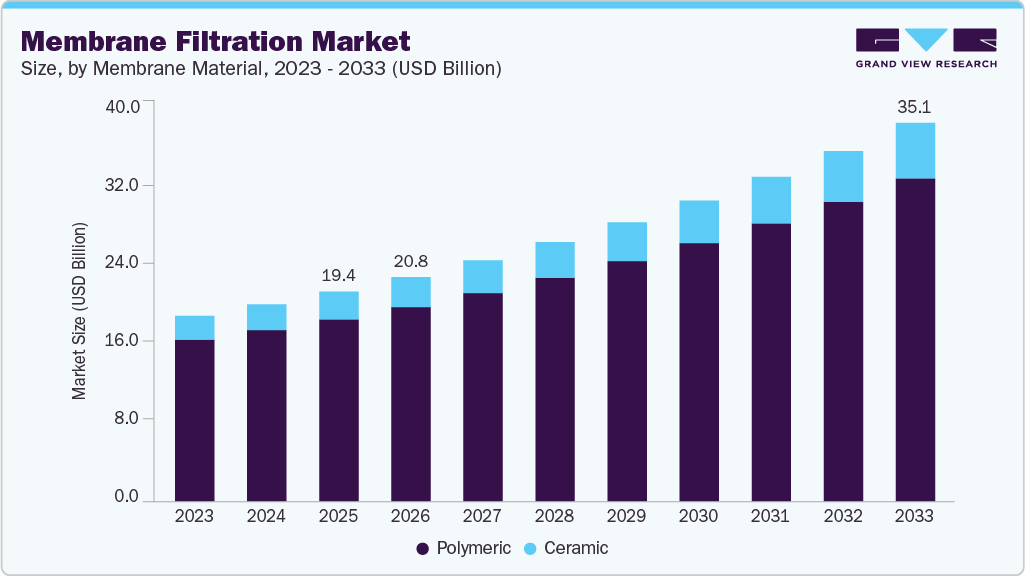
The global membrane filtration market size was estimated at USD 19,405.0 million in 2025 and is expected to reach USD 35,059.7 million by 2033, growing at a CAGR of 7.8% over the forecast period from 2026 to 2033. Driven by increasing demand for clean water, wastewater treatment, and industrial process applications. Rapid urbanization, population growth, and industrialization are creating pressure on existing water resources, prompting adoption of efficient filtration technologies.
Key Market Trends & Insights
- Asia Pacific dominated the membrane filtration market with the largest revenue share of 36.5% in 2025.
- By membrane material, ceramic segment is expected to grow at a considerable CAGR of 9.2% from 2026 to 2033 in terms of revenue.
- By module design, hollow fiber segment is expected to grow at a considerable CAGR of 7.7% from 2026 to 2033 in terms of revenue.
- By application, pharmaceutical segment is expected to grow at a considerable CAGR of 9.0% from 2026 to 2033 in terms of revenue.
Market Size & Forecast
- 2025 Market Size: USD 19,405.0 Million
- 2033 Projected Market Size: USD 35,059.7 Million
- CAGR (2025-2033): 7.8%
- Asia Pacific: Largest market in 2025
- Asia Pacific: Fastest growing region
Request Free Sample Report: https://www.grandviewresearch.com/industry-analysis/membrane-filtration-market-report/request/rs1
Membrane filtration offers high separation efficiency, low energy consumption, and scalability, making it suitable for municipal, industrial, and healthcare applications. Additionally, stringent regulations on water quality, environmental protection, and effluent discharge are compelling industries and municipalities to invest in advanced filtration systems.
Technological advancements such as ultrafiltration, nanofiltration, and reverse osmosis membranes, along with growing awareness of water sustainability, are further accelerating market expansion globally across regions like North America, Europe, and Asia-Pacific.
Industry Concentration & Characteristics
The membrane filtration market is moderately fragmented, with a mix of global manufacturers and numerous regional players competing for market share. Large companies focus on technological innovation, high-performance membranes, and comprehensive service offerings, while smaller regional firms provide cost-effective, niche, or specialized solutions. This structure maintains competition without complete consolidation, as customers choose between established brands for reliability and smaller providers for customized or localized solutions. Moderate fragmentation also encourages continuous product development and market diversification.
The membrane filtration market shows high degree of innovation, driven by the development of high-performance membranes such as ultrafiltration, nanofiltration, and reverse osmosis. Innovations focus on improving filtration efficiency, energy consumption, fouling resistance, and lifespan. Companies are also integrating smart monitoring systems and modular designs to optimize operations. Continuous research and adoption of advanced materials support diverse applications in water treatment, food & beverage, pharmaceuticals, and industrial processes.
Merger and acquisition activity in the market is significant and largely strategic. Large players often acquire regional or specialized membrane manufacturers to gain market share, enhance R&D, and integrate complementary solutions. These strategic activities allow firms to offer comprehensive filtration systems, improve competitiveness, and respond to growing global demand efficiently.
Regulations significantly influence the membrane filtration market, particularly in water quality, wastewater treatment, and industrial effluent management. Governments worldwide impose strict standards for potable water, environmental protection, and industrial discharges. Compliance with these regulations drives adoption of advanced filtration technologies. Regulatory pressure encourages innovation, investment in high-efficiency membranes, and the expansion of monitoring and maintenance services to ensure safe, clean, and sustainable water management practices globally.
Drivers, Opportunities & Restraints
Rising global demand for clean water is a primary driver for the membrane filtration market. Population growth, urbanization, and industrial expansion are putting pressure on freshwater resources, prompting municipalities and industries to adopt efficient filtration technologies. Membrane systems, such as ultrafiltration and reverse osmosis, provide high purification efficiency, lower energy consumption, and scalability, making them increasingly preferred for water treatment, wastewater recycling, and industrial process applications.
Emerging economies present significant growth opportunities for the market. Expanding industrialization, urban water infrastructure projects, and increasing awareness of water scarcity encourage adoption of advanced filtration solutions. Technological advancements in durable, fouling-resistant, and energy-efficient membranes allow companies to target municipal, industrial, and healthcare sectors. Investment in smart filtration systems and modular solutions further expands market potential in regions with growing water treatment demands.
High capital and operational costs are a major challenge for the market. Advanced membrane systems require significant upfront investment, periodic maintenance, and replacement of membranes to maintain efficiency. Fouling, scaling, and energy consumption further increase operational expenses, especially for smaller municipalities or cost-sensitive industries. These factors can slow adoption, limit market penetration in developing regions, and push customers to consider alternative or lower-cost water treatment methods.
Membrane Filtration Market Report Scope
|
Report Attribute |
Details |
|
Market size value in 2026 |
USD 20,770.7 million |
|
Revenue forecast in 2033 |
USD 35,059.7 million |
|
Growth Rate |
CAGR of 7.8% from 2026 to 2033 |
|
Base year for estimation |
2025 |
|
Historical data |
2021 – 2024 |
|
Forecast period |
2026 – 2033 |
|
Quantitative units |
Revenue in USD million and CAGR from 2026 to 2033 |
|
Report coverage |
Revenue forecast, company market position analysis, competitive landscape, growth factors, and trends |
|
Segments covered |
Membrane material, module design, technology, application, and Region |
|
Regional scope |
North America, Europe, Asia Pacific, Latin America, and Middle East & Africa |
|
Country Scope |
U.S., Canada, Mexico, Germany, France, UK, Italy, Spain, China, India, Japan, Australia, Brazil, Argentina, Saudi Arabia, South Africa, UAE |
|
Key companies profiled |
Alfa Laval, GEA Group, DuPont, Pall Corporation, Veolia, 3M, Pentair, Porvair Filtration Group, Donaldson Company, Inc., MMS Membrane Systems, Koch Separation Solutions, ProMinent, SPX Flow, TORAY INDUSTRIES, INC., MANN+HUMMEL. |
|
Customization scope |
Free report customization (equivalent up to 8 analysts working days) with purchase. Addition or alteration to country, regional & segment scope. |
|
Pricing and purchase options |
Avail customized purchase options to meet your exact research needs. Explore purchase options |