Polyglycerol Market growing at a CAGR of 10.8% from 2025 to 2033
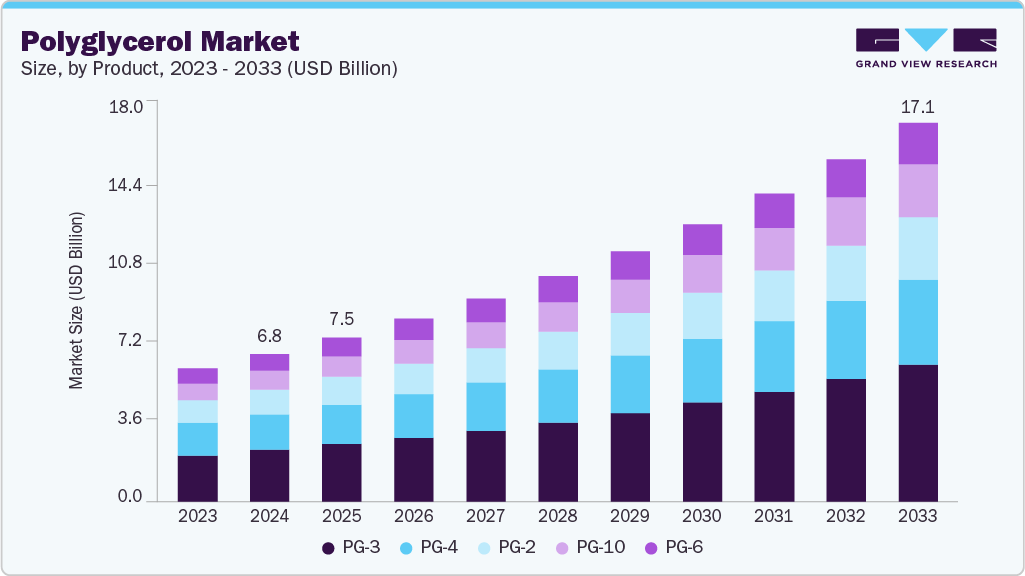
The global polyglycerol market size was estimated at USD 6.77 billion in 2024 and is projected to reach USD 17.06 billion by 2033, growing at a CAGR of 10.8% from 2025 to 2033. The market is primarily driven by the rising demand for biodegradable and non-toxic emulsifiers across the food, pharmaceutical, and personal care industries.
Key Market Trends & Insights
- Asia Pacific dominated the polyglycerol market with the largest revenue share of 38.6% in 2024.
- The market in China is expected to grow at a significant CAGR of 12.0% from 2025 to 2033.
- By product, the PG-10 segment is expected to grow at a CAGR of 12.8% from 2025 to 2033 in terms of revenue.
- By application, the personal care segment held the largest revenue share of 46.3% in 2024 in terms of value.
- By product, PG-3 segment held the largest revenue share of 34.3% in 2024 in terms of value.
Market Size & Forecast
- 2024 Market Size: USD 6.77 Billion
- 2033 Projected Market Size: USD 17.06 Billion
- CAGR (2025-2033): 10.8%
- Asia Pacific: Largest market in 2024
Request Free Sample Report: https://www.grandviewresearch.com/industry-analysis/polyglycerol-market/request/rs1
In addition, growing consumer preference for clean-label and plant-based ingredients is accelerating the adoption of polyglycerol-based formulations. The market presents significant growth opportunities driven by increasing demand for sustainable and multifunctional ingredients across various industries. Expanding applications in bio-based lubricants, biodegradable plastics, and cosmeceuticals are opening new avenues for innovation. Moreover, the rising focus on natural and plant-derived excipients in pharmaceuticals and the growing popularity of vegan and organic personal care products further enhance the market potential, especially in emerging markets across Asia Pacific and Latin America.
Despite its growth prospects, the market faces challenges related to high production costs and limited scalability compared to conventional synthetic alternatives. Raw material dependency, particularly on plant-based glycerol sources such as palm or soybean oil, raises concerns regarding price volatility and supply chain sustainability. Furthermore, compliance with varying international regulatory standards for food and pharmaceutical applications may pose entry barriers for new players and delay product commercialization.
Market Concentration & Characteristics
The market is moderately fragmented, with a few global players, such as Cargill, Incorporated, Sakamoto Yakuhin kogyo Co., Ltd., Solvay, and Spiga Nord S.p.A. dominating the competitive landscape. These companies benefit from their scale of operations, competitive pricing, and diversified product offerings. They are actively investing in research and development, expanding production capacities, and focusing on sustainable practices to strengthen their positions in the competitive market.
Leading players in the global market are adopting strategies such as strategic partnerships, product innovation, and capacity expansion to strengthen their market position. Companies invest in R&D to develop high-purity, multifunctional polyglycerol grades tailored for specialized food, pharmaceuticals, and personal care applications. Moreover, several players are focusing on sustainable sourcing of raw materials and introducing bio-based formulations to align with evolving consumer preferences and regulatory standards.
Product Insights
The PG-3 segment accounted for the largest revenue share of 34.3% in 2024, primarily driven by its widespread use in food and personal care applications. PG-3 offers an optimal balance between hydrophilicity and emulsifying performance. It is a key ingredient in food-grade emulsifiers such as polyglycerol esters of fatty acids (PGEFs), commonly used in bakery, confectionery, and dairy products. Its non-toxic and biodegradable nature aligns well with the growing demand for clean-label and sustainable additives. In addition, PG-3’s compatibility with a wide range of formulations has made it a preferred choice in personal care products such as lotions, creams, and cleansers.
Meanwhile, PG-6 and PG-10 segments are expected to witness the fastest growth over the forecast period, driven by increasing demand from pharmaceutical and high-performance personal care applications. These higher polymerized forms offer superior emulsification, moisture retention, and film-forming capabilities, making them ideal for advanced formulations such as drug delivery systems, anti-aging skincare, and cosmeceuticals. PG-4 also holds a steady share, bridging low and high polymerized grades, especially in multiphase formulations. Product innovation and customization across these grades enhance their relevance across diverse end-use industries, contributing to sustained segmental growth.
Application Insights
The personal care segment held the largest revenue share of 46.3% in 2024, driven by the increasing demand for safe, multifunctional, and biodegradable ingredients. In personal care, polyglycerol is used as a humectant, emulsifier, and solubilizer in products such as moisturizers, sunscreens, and facial cleansers, with PG-6 and PG-10 gaining popularity in premium skincare lines. In pharmaceuticals, polyglycerol is valued for its non-toxic, non-irritating characteristics and is used in topical formulations, ointments, and drug delivery systems. The PG-10 segment, which includes industrial applications such as lubricants, surfactants, and biodegradable packaging materials, represents a niche but expanding area, offering potential for future innovation as industries increasingly shift toward greener alternatives.
The food and beverage segment held a significant revenue share of 30.6% in 2024, owing to its extensive use as an emulsifier, stabilizer, and texture enhancer in a variety of processed food products. Polyglycerol, particularly in polyglycerol esters of fatty acids (PGEFs), is widely approved for use in bakery, dairy, confectionery, and margarine applications due to its excellent emulsification properties and safety profile. Growing consumer demand for clean-label and plant-based ingredients has further propelled their adoption in natural and organic food formulations. Regulatory approvals across major economies and the expanding global processed food industry are expected to support sustained growth in this segment.
Regional Insights
Asia Pacific held the largest revenue share of 38.6% in 2024, driven by the region’s strong industrial base, expanding food processing sector, and growing demand for personal care and pharmaceutical products. Rapid urbanization, increasing consumer awareness toward clean-label and sustainable ingredients, and supportive regulatory frameworks in countries such as Japan, South Korea, and India have further fueled market growth.
Global Polyglycerol Market Report Scope
|
Report Attribute |
Details |
|
Market size value in 2025 |
USD 7.50 billion |
|
Revenue forecast in 2033 |
USD 17.06 billion |
|
Growth rate |
CAGR of 10.8% from 2025 to 2033 |
|
Base year for estimation |
2024 |
|
Historical data |
2021 – 2023 |
|
Forecast period |
2025 – 2033 |
|
Quantitative units |
Volume in kilotons, revenue in USD million/billion, and CAGR from 2025 to 2033 |
|
Report coverage |
Volume & revenue forecast, company ranking, competitive landscape, growth factors, and trends |
|
Segments covered |
Product, application, region |
|
Regional scope |
North America; Europe; Asia Pacific; Middle East & Africa; Latin America |
|
Country scope |
U.S.; Canada; Mexico; Germany; UK; France; Italy; Spain; China; India; Japan; South Korea; Brazil; Argentina; South Africa; Saudi Arabia |
|
Key companies profiled |
Cargill, Incorporated; Sakamoto Yakuhin kogyo Co., Ltd.; Solvay, Spiga Nord S.p.A.; The Good Scents Company; Lonza; Stepan Company; Savannah Surfactants; Palsgaard; NIKKO CHEMICALS CO., LTD.; Procter & Gamble; Croda International Plc |
|
Customization scope |
Free report customization (equivalent up to 8 analysts’ working days) with purchase. Addition or alteration to country, regional & segment scope. |
|
Pricing and purchase options |
Avail customized purchase options to meet your exact research needs. Explore purchase options |