In-line Process Viscometer Market growing at a compound annual growth rate (CAGR) of 6.4% from 2023 to 2030
The global in-line process viscometer market size was valued at USD 199.0 million in 2022 and is expected to reach USD 327.2 million by 2030, growing at a compound annual growth rate (CAGR) of 6.4% from 2023 to 2030. The rise in global energy demand has led to an increase in refining capacities which is eventually expected to drive the market for in-line process viscometers (ILPV).
Key Market Trends & Insights
- Asia Pacific dominated the global market and accounted for the largest revenue share of 37.50% in 2022.
- By technology, vibration segment dominated the overall market and accounted for the largest revenue share of 22.22% in 2022.
- By industry, the petroleum segment accounted for the largest revenue share of 38.70% in 2022.
Market Size & Forecast
- 2022 Market Size: USD 199.0 Million
- 2030 Projected Market Size: USD 327.2 Million
- CAGR (2023-2030): 6.4%
- Asia Pacific: Largest market in 2022
Request Free Sample Report: https://www.grandviewresearch.com/industry-analysis/in-line-process-viscometer-ilpv-market/request/rs1
In-line process viscometers have several advantageous properties that help them to stabilize the refining process as well as to provide reliability and accuracy while operating. Moreover, the use of ILPV reduces the viscosity-related issues of identifying and resolving time, which helps to increase the process efficiency. These properties of ILPV are further expected to drive the market.
It has become essential for countries to take substantial steps to meet the increasing energy demand. Thus, global economies are focusing on increasing their refining capacities which is beneficial for the ILPV market growth. According to the International Energy Agency’s June 2022 report, the global oil demand was anticipated to reach 101.6 million (b/d) in 2023, which is higher than the pre-pandemic demand. Viscosity is a very crucial attribute that needs to be maintained in the refineries. Thus with the rise in consumption and demand of energy, viscometers become a very crucial component for refineries. Moreover, the regulatory norms set by regulatory bodies such as the American Society for Testing and Materials (ASTM) are forcing the producers to consider viscometers as a solution for quality control.
It takes approximately 4-12 hours to identify and rectify a problem arising due to the viscosity of a particular fuel. This can lead to damage costing around USD 1.5 million, which can be reduced or minimized using ILPV. Besides, the cost of setting up an in-line process viscometer is only one-fourth that of the cost incurred during breakdown maintenance. Accurate control of fuel viscosity is considered to be a crucial component in the automotive industry, and an in-line process viscometer controls fuel atomization, beneficial for efficient combustion, and hence is gaining acceptance in the automotive industry across the globe. It has real-time monitoring which helps the producers to keep a watch on product quality and meet the regulatory standards simultaneously.
Technology Insights
Based on technology, the market is segmented into rotational, torsional oscillation, vibration, moving piston, coriolis, dynamic fluid pressure, acoustic wave and others. The vibration segment dominated the overall market and accounted for the largest revenue share of 22.22% in 2022. Vibration-based viscometers have had the highest demand due to their ease of incorporation into various industrial fluid processes. They provide real-time viscosity measurement without coming in direct contact with the fluid and interrupting the flow. This aids in ensuring the highest quality, accuracy, and reliability over larger periods.
The acoustic wave segment is expected to grow at the fastest CAGR of 7.2% from 2023 to 2030. This growth can be attributed to their ability to provide accurate measurements using waves. The increasing demand for high-precision wireless sensing devices that provide accuracy and reliability is driving segmental growth.
Industry Insights
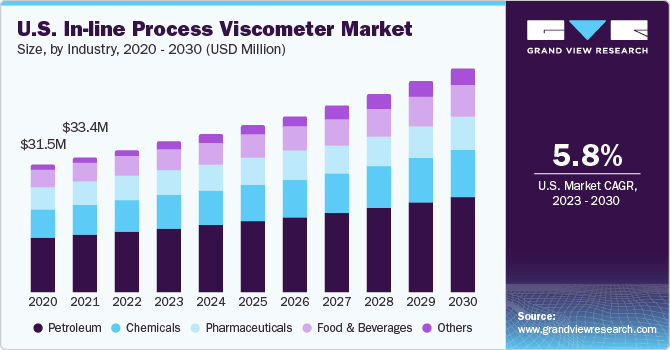
The petroleum segment accounted for the largest revenue share of 38.70% in 2022 and it is expected to grow at the fastest CAGR of 7.1% over the forecast period. This can be attributed to the utilization of viscometers in the petroleum industry for applications such as crude oil production and refining process. Quality control is a key parameter in the petroleum industry that can be monitored using the in-line process viscometer.
The increase in demand and production of crude oil is further expected to drive the segment growth. According to the U.S. Energy Information Administration in January 2023, the country’s average crude oil production in 2022 was 11.9 million barrels per day (b/d), which is estimated to reach an average of 12.4 million (b/d) by 2023 and further 12.8 million (b/d) by 2024.
The chemical market is estimated to grow at a significant CAGR in the forecast period. High revenue chemical industries such as lubricants and oils, adhesives, paints and coatings, inks, etc. are striving for automation of their manufacturing processes. This will result in a growing demand for ILPV in the chemical segment.
In-line Process Viscometer Market Report Scope
|
Report Attribute |
Details |
|
Market size value in 2023 |
USD 210.2 million |
|
Revenue forecast in 2030 |
USD 327.2 million |
|
Growth rate |
CAGR of 6.4% from 2023 to 2030 |
|
Base year for estimation |
2022 |
|
Historical data |
2018 – 2021 |
|
Forecast period |
2023 – 2030 |
|
Report updated |
October 2023 |
|
Quantitative units |
Revenue in USD million and CAGR from 2023 to 2030 |
|
Report coverage |
Revenue forecast, company ranking, competitive landscape, growth factors, and trends |
|
Segments covered |
Technology, industry, region |
|
Regional scope |
North America, Europe, Asia Pacific, Central & South America, Middle East & Africa |
|
Country scope |
U.S.; Canada; Mexico; Germany; U.K.; France; Italy; Russia; Spain; China; India; Japan; South Korea; Thailand; Indonesia; Malaysia; Australia; Brazil; Argentina; Saudi Arabia; UAE; South Africa |
|
Key companies profiled |
Lamy Rheology; Brabender Gmbh & Co. Kg; Hydramotion Ltd.; Werbeagentur Johnson; VAF Instruments; FUJI ULTRASONIC ENGINEERING Co., Ltd.; Sofraser; Emerson Electric Co. Endress+Hauser Group Services AG; Lemis Baltic; BARTEC Top Holding GmbH; Analytical Technology and Control Ltd (ATAC) |
|
Customization scope |
Free report customization (equivalent up to 8 analyst’s working days) with purchase. Addition or alteration to country, regional & segment scope |
|
Pricing and purchase options |
Avail customized purchase options to meet your exact research needs. Explore purchase options |