Hair Supplements Market growing at a CAGR of 11.1% from 2026 to 2033
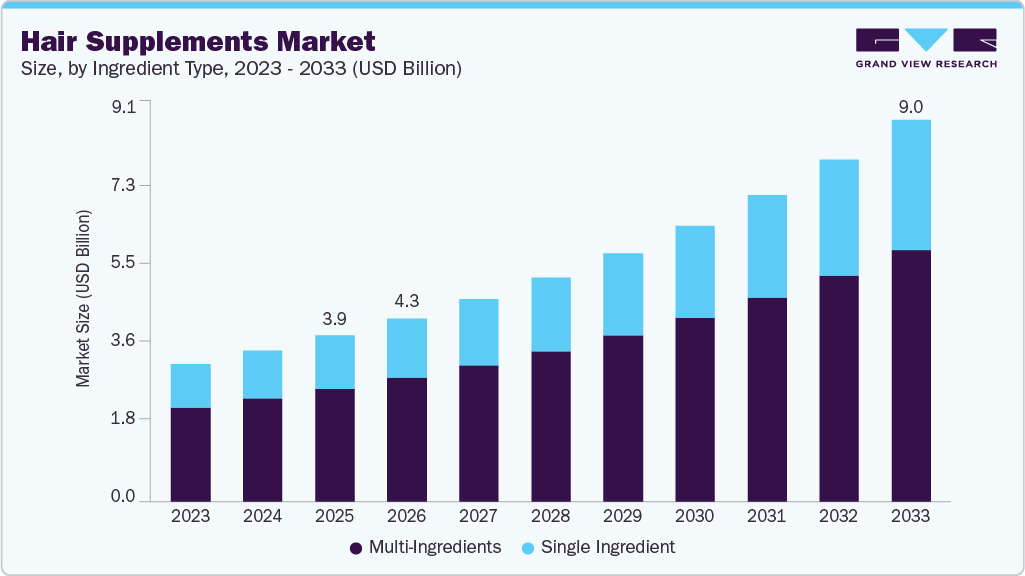
The global hair supplements market size was estimated at USD 3.93 billion in 2025 and is projected to reach USD 9.04 billion by 2033, growing at a CAGR of 11.1% from 2026 to 2033. The market is growing because more people are experiencing hair fall and thinning due to stress, lifestyle changes, aging, and nutritional gaps, leading them to seek simple, non-invasive solutions.
Key Market Trends & Insights
- The Asia Pacific hair supplements market held largest a revenue share of 48.59%.
- By ingredient type, Multi-ingredients led the market with a share of 67.92% in 2025.
- By ingredient, vitamin led the market with a share of 23.80% in 2025.
- By application, hair growth/thinning/loss led the market with a share of 52.69% in 2025.
- By form, gummies accounted for a market share of 35.77% in 2025.
Market Size & Forecast
- 2025 Market Size: USD 3.93 Billion
- 2033 Projected Market Size: USD 9.04 Billion
- CAGR (2026-2033): 11.1%
- Asia Pacific: Largest market in 2025
Request Free Sample Report: https://www.grandviewresearch.com/industry-analysis/hair-supplements-market-report/request/rs1
A key market trend is the shift toward natural and clean label formulations, with consumers increasingly preferring supplements made from vitamins, minerals, collagen, and botanicals rather than synthetic compounds. This trend is driven by growing awareness of ingredient safety, interest in plant-based wellness, and the influence of dermatologists and social media promoting holistic approaches to hair health.
Demand for hair supplements is rising as more people face hair fall and thinning due to stress, nutrition gaps, and lifestyle shifts. Consumers are adopting convenient daily solutions to improve strength and density, which has helped brands such as Nutrafol and Viviscal increase their reach by offering clinically backed formulations aimed at thinning and breakage.
Another driver is the strong move toward natural and science-based ingredients. Brands are using vitamins, minerals, and botanicals in more advanced combinations. For example, Nutrafol uses saw palmetto and ashwagandha for stress-related thinning, while JSHealth combines kelp and zinc for root support. Innovation in clean-label and plant-based formulations continues to attract consumers looking for safer and holistic options.
Digital awareness and improved accessibility also strengthen the market. Online platforms amplify product discovery through visible results and user testimonials. Many brands use subscription models and personalized quizzes to recommend tailored plans. Companies such as Ritual and Ouai have launched targeted hair supplements with transparent ingredient sourcing and modern packaging, making them appealing to younger, digitally engaged consumers.
Consumer Insights
Female consumers account for an estimated 65% of users, while males represent about 35%, as women are generally more proactive in addressing hair thinning linked to hormonal changes, stress, and beauty routines. Male usage is steadily increasing due to rising awareness of early hair loss and acceptance of supplement-based solutions.
Application Insights
Hair growth supplements held a market share of 52.69% in 2025. This segment grows due to rising stress levels, post-illness hair fall (e.g., post-viral shedding), hormonal shifts, and aging. Consumers look for supplements claiming to improve density, reduce shedding, and thicken strands. Products with DHT blockers, collagen, or biotin dominate this space, and social media testimonials accelerate adoption.
Scalp Care/Health supplements are anticipated to witness a CAGR of 11.2% from 2026 to 2033. Issues like dandruff, inflammation, itchiness, and sebum imbalance are common, driving demand for probiotics, anti-inflammatory botanicals, and nutrients that support the follicle environment and thereby scalp care. The “skinification of haircare” trend (treating the scalp like facial skin) keeps this category growing.
Hair Supplements Market Report Scope
|
Report Attribute |
Details |
|
Market size value in 2026 |
USD 4.34 billion |
|
Revenue forecast in 2033 |
USD 9.04 billion |
|
Growth rate (revenue) |
CAGR of 11.1% from 2026 to 2033 |
|
Actuals |
2021 – 2025 |
|
Forecast period |
2025 – 2033 |
|
Quantitative units |
Revenue in USD million/billion, and CAGR from 2026 to 2033 |
|
Report coverage |
Revenue forecast, company ranking, competitive landscape, growth factors, and trends |
|
Segments covered |
Ingredient type, ingredients, application, form, type, end user, distribution channel, region |
|
Regional scope |
North America; Europe; Asia Pacific; Central & South America; Middle East & Africa |
|
Country scope |
U.S.; Canada; Mexico; UK; Germany; France; Italy; Spain; China; Japan; Australia & New Zealand; South Korea; Brazil; South Africa |
|
Key companies profiled |
Nutrafol; Viviscal; Nature’s Bounty; Amway (Nutrilite); GNC; HUM Nutrition; SugarBearHair; Swisse Wellness; InVite Health; Codeage |
|
Customization scope |
Free report customization (equivalent up to 8 analysts working days) with purchase. Addition or alteration to country, regional & segment scope. |
|
Pricing and purchase options |
Avail customized purchase options to meet your exact research needs. Explore purchase options |