Alumina Trihydrate Market growing at a 5.6% from 2023 to 2030
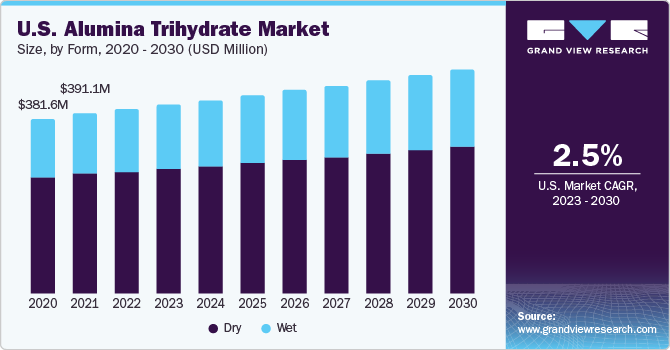
The global alumina trihydrate market size was estimated at USD 3.59 billion in 2022 and is projected to reach USD 5.64 billion by 2030, growing at a 5.6% from 2023 to 2030. The growth is majorly attributed to the rising product adoption from various end-use industries, such as plastics, automotive, construction, and chemical manufacturing.
Key Market Trends & Insights
- Asia Pacific dominated the global market with the largest revenue share of 37.25% in 2022.
- By form, The dry form segment dominated the market with the largest revenue share of 66.70% in 2022.
- By End-use, The plastics segment dominated the market with a revenue share of 28.8% in 2022.
Market Size & Forecast
- 2022 Market Size: USD 3.59 Billion
- 2030 Projected Market Size: USD 5.64 Billion
- CAGR (2023-2030): 5.6%
- Asia Pacific: Largest market in 2022
Request Free Sample Report: https://www.grandviewresearch.com/industry-analysis/alumina-trihydrate-market-report/request/rs1
Alumina trihydrate is used as a flame retardant in plastics as well as construction industry for wires, cables, and building materials due to its excellent flame-retardant properties. Stringent environmental safety standards and environmental regulations have increased the demand for non-toxic, safer flame retardants.
Europe introduced the regulation on the registration, evaluation, authorization, and restriction of chemicals (REACH) regulation in 2007 to protect the environment and human health from the risks posed by chemicals. It places responsibility on companies to provide safety and manage risks from potentially harmful substances. This has led companies to look for eco-friendly alternatives, such as alumina trihydrate. Aluminum trihydrate is used in battery enclosures and for flame-resistant cable insulation in electric vehicles (EVs) to avoid fire hazards.
Regulations, such as AIS-156 Amendment 3, demand high levels of safety for battery packs. Its durability, low weight, and good thermal conductivity make it ideal to be used in battery casings. More than 10 million electric cars were sold in 2022 and the number is expected to grow by another 35% in 2023 to reach 14 million. The U.S., China, and Europe form the three biggest markets for electric cars with China alone accounting for 60% of global electric car sales in 2022. By 2030, these three markets are expected to have an average share of electric cars at around 60%. As the demand for EVs is on the rise globally, it is expected to have a positive impact on the product market as well.
Form Insights
The dry form segment dominated the market with the largest revenue share of 66.70% in 2022. The growing use of tablets where alumina trihydrate is used as an excipient is driving the consumption of dry products. Alumina trihydrate in its dry form is produced as a white, crystalline powder with a chemical formula of Al (OH)3. Bauxite ore is made to go through an elaborate set of processes to manufacture it in a usable form. The dry product is used in pharmaceuticals, water treatment, and ceramics production. Wet alumina trihydrates are used in a variety of applications, such as water treatment, aluminum manufacturing, and ceramics production. Ceramic materials are non-metallic, organic materials bonded with ionic or covalent bonds.
They are hard, brittle, strong in compression, and are used in different sectors from construction to heat-resistant micro parts used in space exploration vehicles. The increasing use of ceramics in power grids, batteries, and automobiles has led to an increase in the consumption of wet alumina trihydrates. Another major driver of segment growth is the rise in aluminum manufacturing around the globe. Aluminum being 3 times lighter than steel, aids in enhancing fuel efficiency and hence is an ideal choice for usage in aviation, automotive, and defense sectors. The overall consumption of aluminum has increased by approximately 20 times in the last sixty years, with a gradual shifting of production centers from west to east in countries such as India, China, and the Middle East.
Alumina Trihydrate Market Report Scope
|
Report Attribute |
Details |
|
Market size value in 2023 |
USD 3.85 billion |
|
Revenue forecast in 2030 |
USD 5.64 billion |
|
Growth rate |
CAGR of 5.6% from 2023 to 2030 |
|
Base year for estimation |
2022 |
|
Historical data |
2018 – 2021 |
|
Forecast period |
2023 – 2030 |
|
Quantitative units |
Volume in kilotons, revenue in USD million/billion, and CAGR from 2023 to 2030 |
|
Report coverage |
Volume forecast, revenue forecast, company ranking, competitive landscape, growth factors, and trends |
|
Segments covered |
Form, end-use, region |
|
Regional scope |
North America; Europe; Asia Pacific; Central & South America; Middle East & Africa |
|
Country scope |
U.S.; Canada; Mexico; Germany; U.K.; France; Italy; Spain; The Netherlands; China; India; Japan; South Korea; Australia; Brazil; Argentina; Saudi Arabia; South Africa |
|
Key companies profiled |
Nabaltec AG; NALCO India; ALMATIS; Akrochem Corp.; ALTEO; TOR Minerals; LKAB Minerals; Hindalco Industries Ltd.; The R.J. Marshall Company; Huber Advanced Materials; Sumitomo Chemical Co., Ltd.; Southern Ionics Inc. |
|
Customization scope |
Free report customization (equivalent up to 8 analysts’ working days) with purchase. Addition or alteration to country, regional & segment scope |
|
Pricing and purchase options |
Avail customized purchase options to meet your exact research needs. Explore purchase options |