Glycerol Market growing at a CAGR of 1.9% from 2023 to 2030
The global glycerol market size was estimated at USD 4.87 billion in 2022 and is projected to reach USD 5.67 billion by 2030, growing at a CAGR of 1.9% from 2023 to 2030. This is attributed to its increasing demand from food, pharmaceutical, and nutraceutical industries.
Key Market Trends & Insights
- Asia Pacific dominated the glycerol market and accounted for the largest revenue share of 36.40% in 2022.
- Europe was the second-largest regional market in 2022 and accounted for 29.23% of the revenue share.
- Based on product, the refined segment dominated the market for glycerol and accounted for the largest revenue share of 75.27% in 2022.
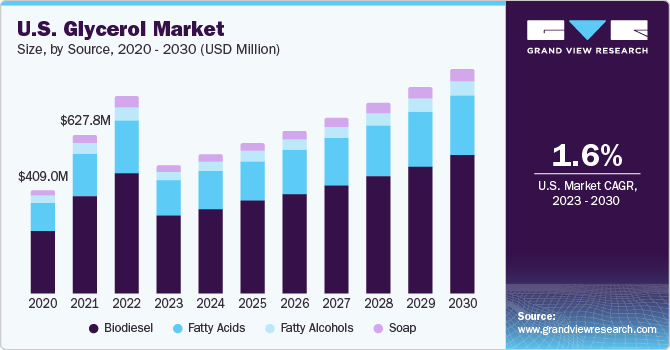
- Based on source, the biodiesel dominated the market and accounted for the largest revenue share of 59.5% in 2022.
- Based on application, the personal care and cosmetics segment dominated the market for glycerol and accounted for the largest revenue share of 40.93% in 2022.
Market Size & Forecast
- 2022 Market Size: USD 4.87 Billion
- 2030 Projected Market Size: USD 5.67 Billion
- CAGR (2023-2030): 1.9%
- Asia Pacific: Largest market in 2022
Request Free Sample Report: https://www.grandviewresearch.com/industry-analysis/glycerol-market/request/rs1
The product is widely used in several food products including processed meat, condensed milk, and bakery products. There is a rise in consumer preference for glycerol as it is non-toxic and has excellent nutritive values attached to it. It can be derived naturally as well as from petrochemical feedstock. The demand for the product is likely to increase globally in the coming years as it is easy to store and does not harm the environment. Moreover, it is widely used for improving hydration levels and performance levels in athletes, skin conditions, and helps relieve constipation as well. These factors are likely to positively affect the growth of the market for glycerol over the forecast period.
Glycerol is available in two forms in the market – crude form and refined form. The crude form is obtained from the production of biodiesel, which is in its raw form and then sold to large refineries for further processing. It acts as an outstanding source of calories for non-ruminants such as swine, hens, and broilers. The refined form of the product is hygroscope in nature and is used in different applications such as pharmaceuticals, polyether polyols, food and beverages, and alkyd resins.
Glycerol is formed via hydrolysis reaction, saponification, and transesterification during biodiesel production. The substance that is produced has various impurities in it such as remaining wastewater, soaps, salts, esters, and catalysts. It is converted/purified into valuable products during the manufacturing process of biodiesel. Glycerol is manufactured by the hydrolysis of fats and natural oils from animals and plants. The synthesis of the product in yeasts and other organisms takes place through the dephosphorylation of glycerol 3 phosphates.
The prices of raw materials play a crucial role in the market for glycerol. Other costs that come into play apart from those of raw materials include pre-operational costs, capital investments, and working capital. Also, pre-operating costs include installation, setup, capitalized interests, project engineering and management, and commissioning costs. Increasing prices of fossil fuels have led to a rise in the prices of biodiesel, thus triggering the prices at a global level.