NanoSilica Market growing at a CAGR of 15.4% from 2025 to 2033
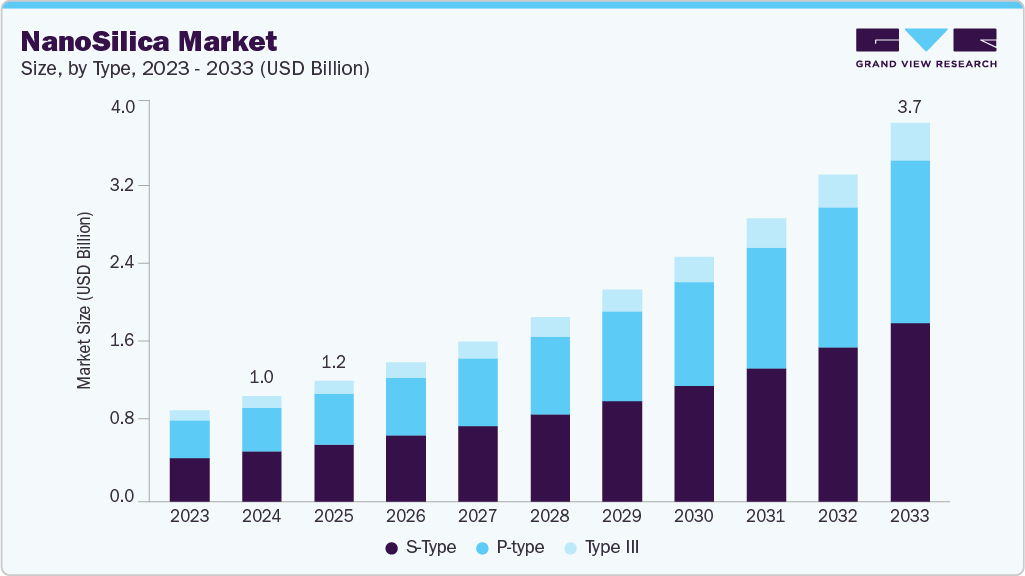
The global nanosilica market size was estimated at USD 1.01 billion in 2024 and is expected to reach USD 3.65 billion by 2033, growing at a CAGR of 15.4% from 2025 to 2033. The growth is attributable to the rise in the demand for nanocoating across aviation, automobile, and medical industries.
Key Market Trends & Insights
- The Asia Pacific nanosilica market registered a market share of 33.8% in 2024.
- The nanosilica market in U.S. was propelled by the growing demand for nanocoating across aviation, automobile, and medical industries.
- By product, the P-type variant products have registered the dominant market share with 41.8% in 2024.
- By end use, the rubber industry has secured the dominant market share in 2024.
Market Size & Forecast
- 2024 Market Size: USD 1.01 Billion
- 2033 Projected Market Size: USD 3.65 Billion
- CAGR (2025-2033): 15.4%
- Asia Pacific: Largest market in 2024
Request Free Sample Report: https://www.grandviewresearch.com/industry-analysis/nanosilica-market/request/rs1
Manufacturers have increasingly used nanosilica to enhance moisture and bacteria resistance, UV damage, and abrasion in nanocoatings. Aerospace equipment benefits from metal nanocoatings that shield it from temperature fluctuations, minor scratches, and water damage with their ability to protect against corrosion and oxidation. The robust expansion of electronics and healthcare industries which increasingly applied nanosilica is a key market driver. The material’s tiny particle size and large surface area are valued for enhancing the performance of electronics in terms of conductivity, durability, and thermal stability. In healthcare settings, nanosilica is applied in drug delivery systems, wound healing, and diagnostic tools.
Furthermore, the market was fueled by material science advancements. Companies including PPG Industries and NanoPore Incorporated have increasingly recognized the potential of nanosilica in influencing the future of materials science. This has led market players to invest in R&D efforts related to nanotechnology and material science and introduce innovative manufacturing processes.
In addition, concerns about environmental impact have resulted in a shift toward eco-friendly formulations. Nanosilica offers an alternative to green technology owing to its unique properties such as tiny particle size and large surface area. The market has witnessed businesses increasingly segmenting the advanced material’s properties to assess its potential across various industries and enhance products and applications.
Market Concentration & Characteristics
The nanosilica market is moderately consolidated, with a players such as Evonik Industries, Cabot Corporation, and Wacker Chemie AG. These companies maintain strong control over technology, product quality, and supply chains, while smaller regional manufacturers cater to cost-sensitive applications. Strategic partnerships and capacity expansions are common as producers aim to strengthen their foothold in emerging markets.
Environmental and occupational safety regulations significantly influence nanosilica production and application. Strict policies by agencies such as the EPA and ECHA require compliance with nanomaterial handling, labeling, and exposure standards. These regulations encourage manufacturers to invest in safer synthesis routes and eco-friendly product formulations. While compliance increases production costs, it also drives product standardization and credibility across key end-use sectors.
Furthermore, nanosilica faces partial substitution from materials such as carbon black, titanium dioxide, and aluminum oxide in applications such as rubber reinforcement, coatings, and additives. However, its superior surface area, chemical stability, and mechanical strength often provide performance advantages. Substitutes are generally selected in cost-sensitive or less performance-critical uses, keeping nanosilica well-positioned in high-value industrial and construction segments.
NanoSilica Market Report Scope
|
Report Attribute |
Details |
|
Market size value in 2025 |
USD 1.16 billion |
|
Revenue forecast in 2033 |
USD 3.65 billion |
|
Growth rate |
CAGR of 15.4% from 2025 to 2033 |
|
Base year for estimation |
2024 |
|
Historical data |
2021 – 2023 |
|
Forecast period |
2025 – 2030 |
|
Quantitative units |
Volume in kilotons, revenue in USD million/billion, and CAGR from 2025 to 2033 |
|
Report coverage |
Revenue forecast, company ranking, competitive landscape, growth factors, and trends |
|
Segments covered |
Product, end use, region |
|
Regional scope |
North America; Europe; Asia Pacific; Latin America; MEA |
|
Country scope |
U.S.; Canada; Mexico; Germany; UK; France; Italy; Spain. China; India; Vietnam; Thailand; South Korea; Brazil; Argentina; South Africa; Saudi Arabia |
|
Key companies profiled |
Evonik Industries; AkzoNobel N.V.; E. I. du Pont de Nemours and Company; Cabot Corporation; NanoPore Incorporated; Nanostructured & Amorphous Materials, Inc. (NanoAmor); Fuso Chemical Co. Ltd.; Wacker Chemie AG; Dow Corning Corporation; Bee Chems |
|
Customization scope |
Free report customization (equivalent up to 8 analysts working days) with purchase. Addition or alteration to country, regional & segment scope. |
|
Pricing and purchase options |
Avail customized purchase options to meet your exact research needs. Explore purchase options |