Battery Sensor Market (2026 – 2033)
Battery Sensor Market Summary
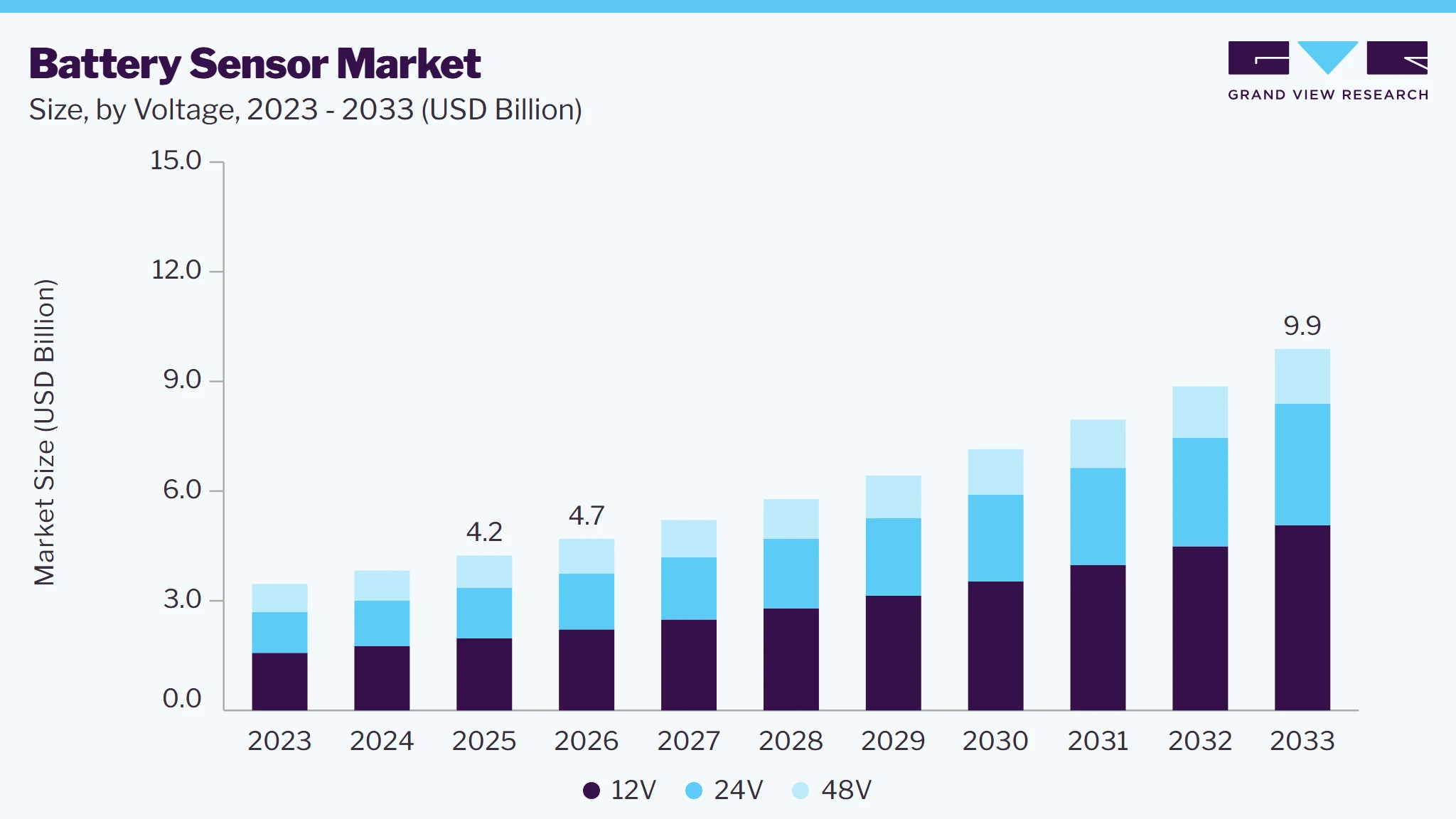
The global battery sensor market size was valued at USD 4.2 billion in 2025 and is projected to grow from USD 4.7 billion in 2026 to USD 9.9 billion by 2033, at a CAGR of 11.2% from 2026 to 2033. Asia Pacific dominated the market, accounting for the largest revenue share of 45.7% in 2025. The market consists of battery sensors that are used for monitoring the electric vehicle battery in the automotive industry.
Key Market Trends & Insights
- By voltage: 12V segment dominated the market, with a revenue share of 46.6% in 2025.
- By communication: Controller area network segment held the largest market share of 48.0% in 2025.
- By vehicle category: Passenger car segment held the largest revenue share in 2025.
- By vehicle type: BEV segment held the largest revenue share in 2025.
Regional Highlights
- Largest regional market: Asia Pacific (45.7% revenue share, 2025)
- By country: The India is the fastest growing country in 2025.
Market Size & Forecast
- Market size in 2025: USD 4.2 Billion
- Estimated market size in 2026: USD 4.7 Billion
- Projected market size by 2033: USD 9.9 Billion
- CAGR (2026-2033): 45.7%
Request a free sample copy or view report summary: https://www.grandviewresearch.com/industry-analysis/battery-sensor-market-report/request/rs1
Market Dynamics
Advancements in battery technologies, electric mobility, energy storage systems, and smart battery management systems (BMS) are significantly driving the demand for high-performance battery sensors capable of monitoring voltage, current, temperature, pressure, and state-of-charge parameters with greater accuracy and reliability. The integration of artificial intelligence, IoT connectivity, wireless monitoring, and predictive diagnostics enhances battery safety, operational efficiency, lifespan, and real-time performance optimization across electric vehicles, consumer electronics, industrial equipment, and grid-scale energy storage applications. However, high development and integration costs, stringent safety and performance standards, sensor calibration complexities, and challenges associated with operating under harsh environmental conditions increase deployment expenses and limit adoption among cost-sensitive end users. Meanwhile, the rapid expansion of electric vehicle production, growing investments in renewable energy storage infrastructure, increasing emphasis on battery safety regulations, and the emergence of next-generation solid-state and high-energy-density batteries are creating opportunities for manufacturers to develop intelligent, miniaturized, highly accurate, and energy-efficient battery sensor solutions tailored to evolving electrification and energy transition requirements.
Voltage Insights
Based on voltage, the 12V segment led the market with the largest revenue share of 46.6% in 2025 and is expected to retain its dominance over the forecast period. The 12V battery sensor segment is experiencing growth due to its low cost and essential role in technologies like regenerative braking and start/stop systems. The continuous rise in vehicle production and stringent emission norms aimed at reducing CO2 emissions are further driving demand. As automotive manufacturers focus on enhancing fuel efficiency and meeting regulatory standards, the adoption of 12V battery sensors is increasing, thus significantly contributing to the 12V segment’s growth.
Communication Insights
Based on communication, the controller area network (CAN) segment led the market with the largest revenue share of 58.0% in 2025. The segment’s growth is driven by its ability to support high-speed communication and robust data transmission capabilities. CAN technology facilitates real-time monitoring of critical battery parameters such as voltage, current, and temperature in electric vehicles (EVs), ensuring efficient operation and safety. As automakers increasingly integrate advanced electronic control systems in vehicles, the demand for CAN-based battery sensors is expanding.
Vehicle Type Insights
Based on vehicle type, the BEV segment led the market with the largest revenue share of 72.1% in 2025. The segment is experiencing rapid growth within the battery sensor market, driven by increasing global adoption of fully electric vehicles. BEVs rely heavily on advanced battery sensors to optimize performance, monitor health metrics, and ensure safety. As consumers and governments prioritize zero-emission transportation solutions, the demand for precise and reliable battery monitoring systems is escalating, thereby contributing to the BEV segment’s growth.
Battery Sensor Market Report Scope
|
Report Attribute |
Details |
|
Market size in 2025 |
USD 4.2 billion |
|
Estimated Market size in 2026 |
USD 4.7 billion |
|
Projected Market size by 2033 |
USD 9.9 billion |
|
Growth rate |
CAGR of 11.2% from 2026 to 2033 |
|
Base year for estimation |
2025 |
|
Historical data |
2021 – 2024 |
|
Forecast period |
2026 – 2033 |
|
Quantitative units |
Revenue in USD million/billion and CAGR from 2026 to 2033 |
|
Report coverage |
Revenue forecast, company ranking, competitive landscape, growth factors, and trends |
|
Segments covered |
Voltage, communication, vehicle category, vehicle type, region |
|
Regional scope |
North America; Europe; Asia Pacific; Latin America; MEA |
|
Country scope |
U.S.; Canada; Mexico; U.K.; Germany; France; China; Japan; India; Australia; South Korea; Australia; Brazil; Kingdom of Kingdom of Saudi Arabia (KSA); UAE; South Africa |
|
Key companies profiled |
Continental AG; Robert Bosch GmbH; Furukawa Electric Co., Ltd.; NXP Semiconductors; Vishay Intertechnology Inc.; Inomatic GmbH; Texas Instruments Incorporated; HELLA; TE Connectivity; Battery Watering Technologies. |
|
Customization scope |
Free report customization (equivalent up to 8 analysts’ working days) with purchase. Addition or alteration to country, regional & segment scope. |
|
Pricing and purchase options |
Avail customized purchase options to meet your exact research needs. Explore purchase options |