3D Secure Authentication Market Overview To Reach US$ 1885.64 million by 2031
The 3D Secure Authentication Market is expanding rapidly as e-commerce, mobile commerce, digital banking, and online payment transactions continue to grow worldwide. 3D Secure (3DS) authentication provides an additional security layer for card-not-present transactions by helping verify whether the individual making an online payment is the legitimate cardholder.
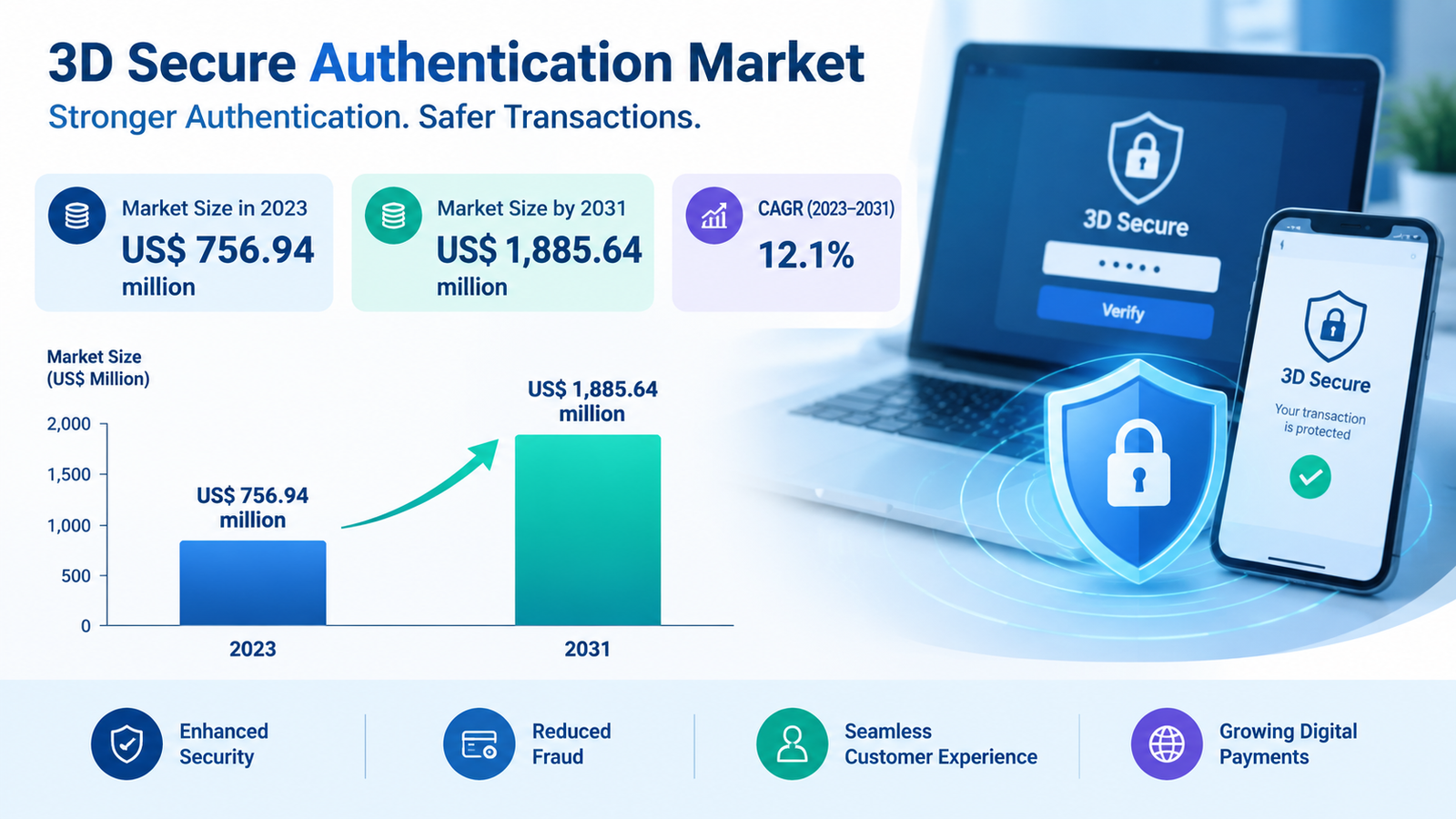
According to The Insight Partners, The 3D secure authentication market size is projected to reach US$ 1885.64 million by 2031 from US$ 756.94 million in 2023. The market is expected to register a CAGR of 12.1% during 2023–2031
Key Drivers of the 3D Secure Authentication Market
· Growing E-Commerce and Digital Payments:-The rapid expansion of e-commerce is one of the primary growth drivers for the 3D Secure Authentication Market. Consumers increasingly purchase products and services through websites and mobile applications, creating a larger volume of card-not-present transactions. As online transaction volumes increase, merchants face greater exposure to payment fraud, account takeover, stolen credentials, and unauthorized card usage.
· Increasing Cyberattacks and Payment Fraud:-The growing sophistication of cyberattacks is encouraging businesses and financial institutions to strengthen payment security. Fraudsters increasingly use stolen payment credentials, phishing, automated attacks, and other techniques to target digital transactions.
· Regulatory Requirements:-Regulatory initiatives supporting stronger customer authentication are another important market driver. Requirements such as Europe’s PSD2 Strong Customer Authentication framework have encouraged payment providers to adopt stronger authentication mechanisms. Similar payment-security initiatives in other countries are creating additional demand for authentication technologies. The Insight Partners specifically identifies PSD2 and comparable regulatory requirements in the UK, India, and Australia as factors supporting adoption.
Get Sample PDF @ https://www.theinsightpartners.com/sample/TIPRE00021739
Technological Advancements Transforming the Market
The 3D Secure Authentication Market is increasingly incorporating artificial intelligence, machine learning, behavioral analytics, biometrics, and risk-based authentication. These technologies enable payment platforms to analyze transaction characteristics and identify potentially fraudulent behavior more efficiently.
AI and machine learning can evaluate factors such as transaction history, device information, location, behavioral patterns, and merchant information. This allows authentication systems to make more intelligent risk assessments and potentially reduce unnecessary authentication challenges.
Biometric authentication is also gaining importance. Fingerprint and facial recognition can provide customers with a convenient method of verifying their identity while reducing dependence on traditional passwords or one-time passwords.
The broader authentication ecosystem is also moving toward passkeys and other passwordless approaches. Recent developments across the payments industry show increasing integration of biometrics and FIDO-based authentication into online payment experiences.
3D Secure Authentication Market Segmentation
The Insight Partners segments the 3D Secure Authentication Market primarily based on component and end user.
By Component
Based on component, the 3D Secure Authentication Market is divided into:
- Solution
- Services
The solution segment held the largest market share in 2023. Payment authentication solutions provide the core technology required to authenticate cardholders, evaluate transaction risk, and support secure digital payments. Services complement these solutions through implementation, integration, consulting, maintenance, and technical support.
By End User
Based on end user, the 3D Secure Authentication Market is segmented into:
- Banks
- Merchant and Payment Processor
Banks represent an important customer group because financial institutions must authenticate cardholders and protect payment networks from unauthorized transactions. Meanwhile, merchants and payment processors are increasingly deploying 3DS capabilities to reduce fraud, improve transaction approval rates, and meet payment-security requirements.
Regional Outlook
The 3D Secure Authentication Market covers North America, Europe, Asia Pacific, South and Central America, and the Middle East and Africa.
Asia Pacific held the largest market share according to The Insight Partners and is expected to register the highest CAGR during the forecast period. India, China, and Japan are among the important markets contributing to regional growth. Increasing smartphone adoption, digital payments, e-commerce penetration, and digital transformation are creating strong demand for secure authentication technologies.
North America is supported by the strong presence of payment technology providers, financial institutions, e-commerce companies, and advanced digital infrastructure. The region’s mature online payment ecosystem creates continued demand for fraud prevention and authentication solutions.
Europe benefits from stringent payment-security requirements, including Strong Customer Authentication under PSD2. These regulatory developments encourage merchants and financial institutions to strengthen authentication capabilities.
South and Central America, along with the Middle East and Africa, are also expected to provide opportunities as digital commerce, mobile payments, and financial technology adoption increase.
Key Players in the 3D Secure Authentication Market
Major companies identified by The Insight Partners include:
- Netcetera
- GPayments Pvt Ltd.
- ASEE GROUP
- AsiaPay Limited
- Modirum
- Msignia, Inc.
- Ravelin Technology Ltd
- RS Software
- UL LLC
- Izealiant Technologies Pvt. Ltd.
These companies are focusing on product development, partnerships, authentication capabilities, fraud prevention, and integration with payment ecosystems.
Get the Premium Research Report @ https://www.theinsightpartners.com/buy/TIPRE00021739
Recent Developments and Market Trends
The industry is moving toward authentication solutions that combine stronger security with minimal customer friction. Risk-based authentication, artificial intelligence, biometrics, tokenization, and passwordless authentication are becoming increasingly important.
For example, Visa’s current 3DS approach uses data-driven verification to support secure transactions while minimizing unnecessary customer challenges. Visa also reports that authenticated transactions can experience lower fraud and improved authorization performance.
The payments industry is also transitioning toward newer authentication approaches. Visa has announced changes involving its Digital Authentication Framework 3DS program as it moves toward newer methods such as Visa Payment Passkey.
These developments indicate that the future of authentication will not simply depend on adding more security steps. Instead, providers are expected to focus on intelligent, adaptive, and low-friction authentication that can identify legitimate customers quickly while applying stronger verification when transaction risk is higher.
Future Outlook
The future outlook for the 3D Secure Authentication Market remains positive as digital commerce and online payment adoption continue to expand. According to The Insight Partners, the market is expected to increase from US$756.94 million in 2023 to US$1,885.64 million by 2031, reflecting a 12.1% CAGR.
Related Report
Authentication Services Market Size and Forecasts (2021-2034)
Passwordless Authentication Software Market Size and Forecasts (2021 – 2034)
About The Insight Partners
The Insight Partners is a global leader in market research, delivering comprehensive analysis and actionable insights across diverse industries. The company empowers decision-makers with data-driven intelligence to navigate evolving markets and accelerate growth.
Contact Us:
- Contact Person: Ankit Mathur
- E-mail: ankit.mathur@theinsightpartners.com
- Phone: +1-646-491-9876
Also Available in :